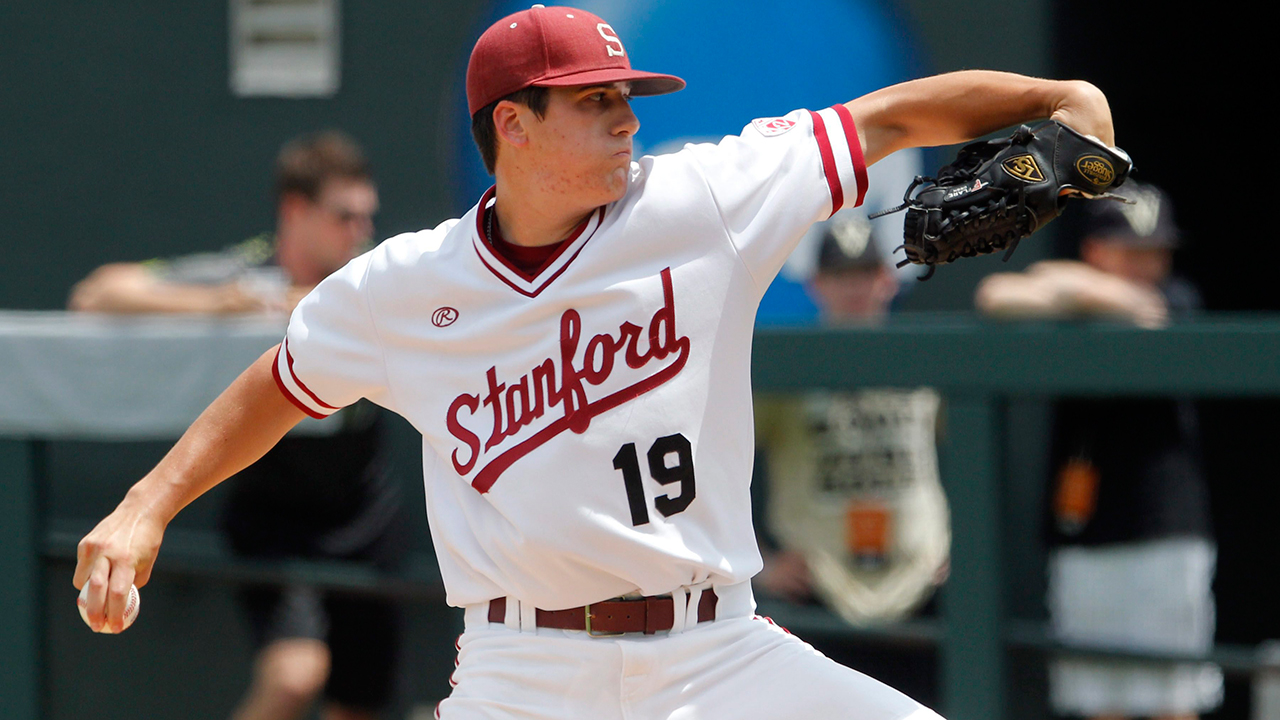
Cal Quantrill tried not to reel last spring as two words, “UCL tear,” jumped out at him amid the medical mumbo jumbo in his MRI report. The Canadian right-hander knew something was wrong three starts into his sophomore season at Stanford, but he tried to talk himself into believing it might simply be a flexor strain, or maybe tendinitis, nothing too bad. It wasn’t. His season was over, the momentum from a strong freshman campaign halted. Outside the doctor’s office, as he sat in the parked Honda CRV he borrowed from teammate and roommate Chris Viall, Quantrill looked for ways to cope with the setback.
“It really took me 30 minutes sitting in the car wrapping my head around the MRI results, just going, ‘Why me? What did I do?’” Quantrill recalled in an interview this week. “But I called Pops (former Blue Jays reliever Paul Quantrill), realized pretty quick there were two ways I could handle this: I could whine, complain, why me, la di da all day long, or I could use this time to get better.”
Quantrill, 21, believes he’s done the latter, and was selected eighth overall by the San Diego Padres on the first day of the baseball draft Thursday night. Only one Canadian has gone higher in the draft – Adam Loewen at No. 4 to the Baltimore Orioles in 2002, with Jeff Francis going to the Colorado Rockies at nine.
Prior to the injury, talk was building that Quantrill could be among the top picks this year, but now he’s more of an upside play like fellow Tommy John surgery recipients Jeff Hoffman, taken ninth overall by the Blue Jays in 2014, or Brady Aiken, selected at 17 by the Cleveland Indians last year.
Being selected by the Padres caps a difficult but rewarding year in which he left himself 4-5 units short of his management science and engineering degree by completing the program’s most difficult courses, while at the same time recalibrating himself on the mound.
“I took full advantage of the time,” said Quantrill, who had the surgery March 20, 2015. “What I realized pretty quick is there’s a reason I decided to go to the school I went to, and there’s a reason I was raised the way I am. Baseball is vitally important to me, there’s nothing I want to do more in the world, but I’m surrounded by an incredible group of people here, I reinvested in some of the other things I do well and what I found out is I’m actually a better baseball player because of it.”

Quantrill stretches during a team workout in Stanford, Calif., on Jan. 21, 2016. (Marcio Jose Sanchez/AP)
Quantrill was highly touted coming out of high school after the Port Hope, Ont., native starred for the Canadian junior national team, but he was fully committed to attending Stanford. The New York Yankees drafted him in the 26th round of the 2013 draft just in case, “but there was pretty much no number that was going to get me not to go.”
He went 7-5 with a 2.68 ERA while logging a team-high 110.2 innings, striking out 98 batters, as a freshman in 2014, and that summer made four more starts (22.2 innings) for the Morehead City Marlins of the Coastal Plain League.
That workload, in combination with some physical changes, caught up to him the next year.
“I put on 20, 30 pounds and five or six mph on the fastball in a matter of months, it was like you snap your fingers and all of a sudden I was capable of doing these things,” said Quantrill. “It was awesome, it made me a better pitcher, but it was a big adjustment for the arm, I was making too many changes too quick, and it blew up and it stinks. … It seems half the guys get it anyways, at least I got mine done.”
The downtime provided him an opportunity to “go back to the drawing board in terms of how I want to pitch,” something he didn’t really do when he first started getting bigger and stronger as he reached Stanford. He has a four-pitch mix, throwing a curveball, a slider and a changeup to go with his fastball, and his secondary stuff projects to be at least major-league average.
Putting the entire package together, however, needed work.
“I’m still the pitcher I always was, but I was 6-foot-1 throwing 88-90 and then all of a sudden I was 6-3 throwing 94-95, and there’s a difference and there’s a better way you can approach hitters with the new stuff you have,” Quantrill explained. “It’s about coming up with a cleaner delivery, figuring out what do I need to be ready for each game. I changed my training, I changed my eating, I changed my throwing habits – everything. The reward has been awesome, my arm feels healthier than it ever felt before, I’m stronger, I’m bigger, I feel leaner, it’s been really good. I wouldn’t have had that opportunity had I not got hurt. I’m definitely not pro-Tommy John, but in my case it ended up not being a bad thing.”

Quantrill shows a scars on his elbow from Tommy John surgery during a team workout in Stanford, Calif. (Marcio Jose Sanchez/AP)
The time recovering also gave Quantrill a chance to better examine everything else happening on campus with the game taken from him.
“What is baseball when you’re surrounded by a bunch of people who are going to be CEOs, presidents and kings? The people here are special,” he said. “You walk back to your room, and there’s an equal likelihood that the guy who’ll play in MLB will run a billion-dollar business. It puts things in perspective. That doesn’t mean I care about baseball any less than anyone else, it just means I’ve been really, really lucky to have been exposed to even more stuff.”
Quantrill spent the leadup to the draft helping his five roommates, all members of the baseball team, clean up their apartment, a place he described as “deadly” because of the mess. He wrote exams Friday, Monday and Tuesday and Stanford is allowing him to walk in graduation ceremonies June 12 for both the university and the school of engineering even though he’s a few credits short.
“If things go well (in the draft), I won’t have a chance to do it next year so it was really nice of the administration to let me do that,” said Quantrill. “I’ll either do (missing units) online or as soon as I can. On the 13th, assuming all goes well, I’ll be driving to wherever I have to go.”
About 15 months removed from his surgery, he’ll do so with, “no hard feelings toward the elbow.”
NOTES: Other Canadians to keep an eye on in the draft: University of British Columbia right-hander Curtis Taylor of Port Coquitlam, B.C.; junior national team righty Jordan Balazovic of Mississauga, Ont.; high-school righty Austin Shields of Dundas, Ont.; junior national team catcher Andrew Yerzy of Toronto; University of Virginia shortstop Daniel Pinero; UBC righty Alex Webb of Surrey, B.C.; University of Pittsburgh shortstop Charles LeBlanc of Laval, Que.; and junior national team outfielder Clayton Keyes of Calgary. … Last year, 30 Canadians were selected in the draft including two in the first round: first baseman Josh Naylor of Mississauga by Miami at No. 12 and right-hander Mike Soroka of Calgary at 28 by Atlanta.