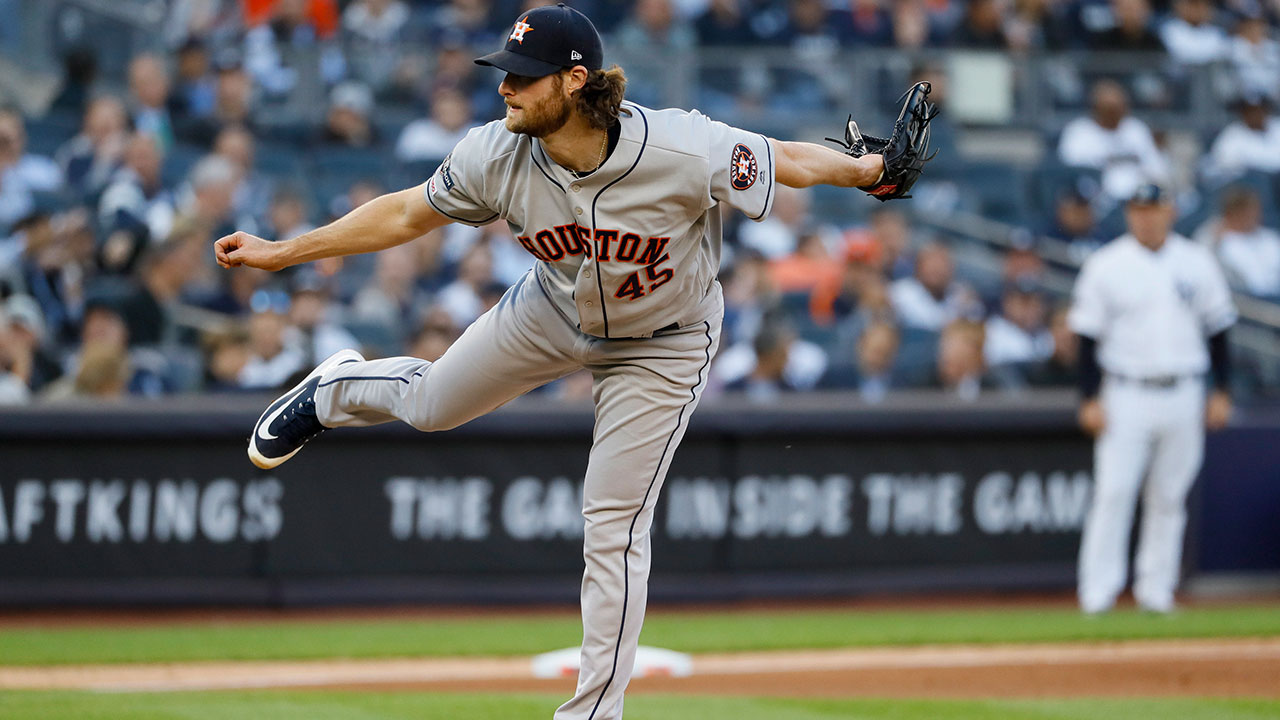

TORONTO – If Gerrit Cole’s not the best pitcher in baseball, he certainly belongs in the conversation with teammate Justin Verlander, World Series foe Max Scherzer and defending NL Cy Young winner Jacob deGrom.
A week or so from now, Cole will hit free agency with a seemingly legitimate chance of becoming the best-compensated pitcher of all-time. Within a couple months, someone’s starting rotation is going to improve considerably.
To state the obvious, Cole would make the Toronto Blue Jays much better. At 29 years old, he should still have many good years ahead. Eventually he’ll decline, as all players do, but at this point he still seems to be getting better.
Yet once we shift from fantasy to reality, it’s apparent the Blue Jays won’t be signing Cole. So why, at a time that the team needs pitching and has payroll flexibility, would the front office not make a serious play for Cole? And if they don’t pursue top-tier free agents, what’s the next step in their search for arms?
[snippet id=3305549]
To answer the first of those questions, we have to take stock of the Blue Jays’ rebuild. No team, regardless of market size, would set free agent spending records in the early stages of a rebuild. It’s only as rebuilding efforts near (or appear to near) their end that we’ve seen clubs like the Cubs, White Sox and Phillies bid for players more aggressively.
That leads to the question of where the Blue Jays are on that arc. Objectively speaking, they don’t appear all that close to contending in 2020. Perhaps more importantly, Blue Jays decision makers don’t seem to see this club as a near-finished product.
There’s upside on this roster, so nobody’s ruling out contention in 2020, of course. That would be insulting to fans and players alike. At the same time, the front office isn’t making promises about the coming season. Presumably the Blue Jays are past the worst of the rebuild now, but that doesn’t mean they believe they’re at the end just yet.
To be fair, that hasn’t stopped some teams from making bold strikes in free agency. The Padres and Phillies attempted to jump-start their rebuilds with massive deals, for example. But those clubs have faltered even with Eric Hosmer, Manny Machado, Jake Arrieta and Bryce Harper.
This time last year, Phillies owner John Middleton foreshadowed the club’s record deal with Harper by discussing his willingness to spend ‘stupid’ money. Contrast that with the way Blue Jays team president Mark Shapiro speaks, and you don’t get the impression he expects to set free agent spending records.
“Looking at other teams, even in recent history, San Diego, Philadelphia, that added big-name free agents, it’s kind of thinking about ‘Are we looking to win the off-season, or are we looking to take the next leap for this team?’” Shapiro said earlier this month. “We want to take that next step, moving from competing to winning.”
[relatedlinks]
Of course there are counter-examples to teams like the Phillies and Padres. The Cubs signed Jon Lester for $155 million after an 89-loss season in 2014. The following year, they won 97 games and reached the NLCS. Cleary, a well-timed deal with an elite free agent can put a team over the top. There should come a time when the Blue Jays fully assert themselves as a large-market team and spend at the top of the market again.
Yet the Blue Jays’ front office is nothing if not deliberate, and there’s ample evidence showing that free agents generate a disproportionate amount of their value early in their contracts. Knowing that, the Blue Jays will likely be hesitant to make their biggest free agent additions until they believe they’re on the brink of contending.
“The reality of any free agent contract is you’re kind of frontloading the value of the contract,” Shapiro said last week on the At the Letters podcast. “The nature of free agency, 80 per cent of the time is you’re getting a player who’s either at his prime or past his prime, so you’re paying for some decline in performance. You never know how rapidly it’s going to occur, so you’re frontloading the value, because you’re getting the max performance in the first few years of the deal. And you accept that and know that. You’re not getting tricked.”
At this stage, it’s easiest to imagine this group proceeding with a measured approach. That’s been the pattern here since Shapiro arrived, as evidenced by the fact that J.A. Happ’s three-year, $36 million deal remains the biggest free agent commitment made by this regime.
Ben Cherington, a key voice in the Toronto front office, was similarly patient as Red Sox general manager, typically prioritizing player development over free agent deals designed to push ahead competitive timelines (he did eventually sign Hanley Ramirez and Pablo Sandoval to deals that didn’t work out, but the decision to hold onto core players like Mookie Betts and Xander Bogaerts helped Boston win it all in 2018).
In theory, patience could help in Toronto, too. Instead of targeting players now and hoping they’ll sustain elite performance a year or more into the future, the Blue Jays can wait and strike with more precision later.
[snippet id=4722869]
Yet even if that makes sense on a logical level, a skeptic might still wonder whether that point will arrive at all. Based on the Blue Jays’ modest spending under Shapiro those doubts are fair. After all, it’s not just small-market teams that are spending cautiously these days. The Dodgers have avoided big free agent contracts under Andrew Friedman and even the Yankees are operating more cautiously of late.
Shapiro and Atkins have consistently said the Blue Jays will have the means to spend big when needed, even if it means out-spending revenues. A recent history of spending $160 million-plus on payroll lends some credence to that idea, but of course that possibility seems distant at a time that the club has less than $30 million committed to 2020 payroll.
In the meantime, the Blue Jays will still spend on free agents in moderation. At the team’s season-ending media availability, Atkins said he expects to “be much more open to different structure and term” this winter. As a point of reference, he invoked the off-seasons after 2015 and 2016, when the Blue Jays committed $60-70 million per winter on major-league free agents.
That’s not enough to start a conversation with Cole or any elite free agents, but it’ll still represent a step forward compared to last winter, when the Blue Jays’ discipline may have nudged some free agent arms to go elsewhere. According to sources, the club had some interest in Charlie Morton but didn’t offer more than one year and talks never gained traction. Discussions with Mike Fiers did get more serious only to fall through.
With more dollars and term now available, the Blue Jays are less likely to get outbid on those mid-tier options. In a best-case scenario, they replicate the success of that 2015 Happ deal and stabilize a rotation that posted a 5.25 ERA in 2019.
There’s likely a limit to their aggressiveness, though. You can make a case that they should spend more – that Cole’s peak will last for years and he’d be worth the investment for any team – but reading between the lines, that’s simply not the way the Blue Jays see it at this stage in their rebuild.