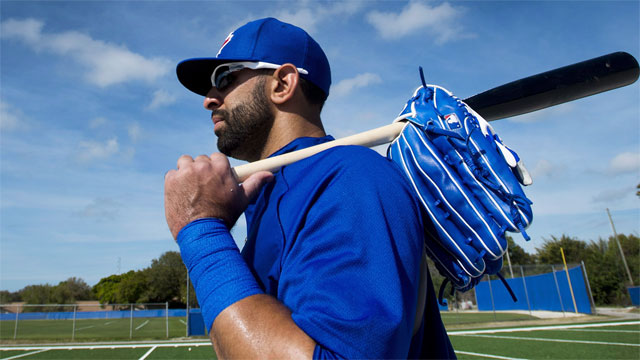

There is a bigger picture to all this for Jose Bautista than simply the creation of a foundation to do good deeds.
The Bautista Family Education Fund is about returning a gift given to the Toronto Blue Jays slugger years ago by a little-known American businessman whose generosity changed many lives, and ensuring that others in a similar position are able to get an opportunity like the one he once did.
It’s also about teaching young baseball players in the Dominican Republic that taking a few thousand dollars to play pro ball at 16 isn’t the only option, that by staying in school and working toward a college degree at the same time, they can insure the pursuit of their dream with the potential for another career.
Put simply, it doesn’t have to be baseball or bust.
“That was my inspiration, and just knowing there’s so much of a need for the opportunity in the Dominican is my real motivation,” says Bautista, whose parents Americo and Sandra always made sure he and his brother Luis put homework before home runs. “There are so many kids that have no choice, they have to sign or quit baseball. I’m trying to find a different opportunity for them.
“Maybe some kids aren’t good enough to sign, maybe some kids shouldn’t sign, maybe some kids would love that opportunity. I’m just trying to make that opportunity available to more kids.”
Bautista’s helping hand came when he was 18-years-old from the Latin Athletes Education Fund, run by a California stockbroker named Don Odermann.
His program helped connect qualified students with partial or full scholarships in American colleges, and provided money to cover shortfalls for things like books, food, computers and other such necessities schools didn’t cover.
Initially Bautista’s thought was to help extend the program with his own resources and reach, but “because (Odermann) has run into some health issues, I don’t really know if his efforts are going to be continued by anybody,” he explained. “So what I decided to do was create my own foundation and replicate what he’s done.”
The Bautista Family Education Fund, or BFEF, has been a couple of years in the making and functional since last fall. Its first fundraiser in Canada is set for Aug. 29, a golf event at Eagles Nest Golf Course in Maple, Ont., and already 14 students are receiving aid.
Most of the funding thus far has been contributed by Bautista himself, diverting portions of various endorsement deals into the kitty. His corporate partners have also made donations.
Students selected by the BFEF (based on a combination of grades, community work and athletic ability) receive money for things their scholarships don’t cover, such as an iPad to do assignments and meal money.
“Depending on the case, the travel could be covered once a year to and from home if a kid is extremely poor and would have no other means to get to say North Carolina,” says Bautista.
“The No. 1 goal of the foundation is to provide kids with another opportunity in life, not necessarily having to quit playing sports or only having the choice of being a professional athlete in order to continue playing sports,” he adds. “A lot of kids from smaller countries come to the point where you would have to provide for your family at a younger age, some kids get pushed into becoming a professional or have to drop out to go to work, because even if they didn’t want to drop out, how can they cover the expenses attached to going to school? I want to provide those kids an opportunity to pursue becoming a student athlete.”
That’s precisely what Odermann’s program did for Bautista years ago.
Creeping towards 19 years old, having rejected offers from the New York Yankees ($5,000) and Arizona Diamondbacks ($60,000) and watching a $300,000 deal with the Cincinnati Reds fall through when the club went through an ownership change, Bautista was running out of options in baseball.
At the same time he was working out for big-league teams, he was taking business classes at Pontificia Universidad Catolica Madre Y Maestra in Santo Domingo, and the self-made VHS demo tapes he was sending out to American colleges in the hopes of landing a scholarship weren’t opening any doors.
The University of Jacksonville showed some interest and offered to bring him aboard as a walk-on, but he could afford neither the tuition, nor the room and board.
Then fate intervened.
Rafael Perez, whose father Oscar ran one of the city league’s Bautista played in growing up, was tipped off by his dad, became impressed watching the young outfielder work out for the Diamondbacks, and mentioned him to Juan Peralta.
The two had gone through Odermann’s program — Perez attending Chipola Junior College in Florida and later the University of Alabama, graduating with a degree in accounting; Peralta leaving Troy State University with degrees in business administration and social work – and remained active with the fund afterward.
Peralta happened to be on a trip in the States trying to find a school for a young infielder when Chipola baseball coach Jeff Johnson said he was looking for an outfielder.
“I told him I’ve got an outfielder, his name is Jose Bautista, he’s already passed the TOEFL test and has very good high-school grades,” remembers Peralta, who is now the Domincian Republic Academy director for the Cincinnati Reds. “I gave him a scouting report on the baseball side. The coach said, ‘I’ll go by your word, I trust you, so I’m going to give him a full ride.’ Then we started the paperwork.”
Within a week Bautista was en route to Chipola, in the Florida panhandle locale of Marianna, with Odermann’s aid helping him cover the financial gaps, primarily for food and a phone to call home, since his parents couldn’t afford to send him any steady money.
“When you leave home for the first time at that age, you are constantly on the phone,” says Bautista. “The dormitories only had a bed, so you have to get a fridge, a little portable stove, baseball equipment, the team paid for some stuff, but not everything. All the money Don provided us helped cover a lot of the expenses, including meals.”
Helping ease the transition to Chipola was the presence of three other Dominican players, including Fernando Isa, another recipient of Odermann’s assistance who is now executive director of Bautista’s program.
Perez, who met his wife while at Chipola, was a frequent visitor to the area and would do his part to bring a taste of home to the boys.
“In gratitude for what Don did for me, I helped him with recruiting, scouting and also to serve as a mentor to some of the guys playing in the panhandle area,” says Perez, now Major League Baseball’s director of Dominican operations. “Every time I went to visit my in-laws, I’d invite Jose over, I’d cook Dominican food, I was there to answer any questions, I was a phone call away as well.
“Jose was one of those guys that really appreciated it.”
After one season at Chipola, Bautista was selected in the 20th round of the 2000 draft by the Pittsburgh Pirates. Rules at the time gave teams a year to follow players in junior colleges, and the Pirates waited until the next spring to lock him up, eventually offering up a $500,000 bonus to buy him out of a commitment to the University of South Carolina, where he planned to study finance.
Eventually, he blossomed into a superstar with the Blue Jays, taking a path to the big-leagues vastly different than that of many of his countrymen.
“Putting up the numbers he does, he’s going to be a role model,” says Peralta. “This kid who wanted to play college and went on to be successful at the big-league level is going to be something the young generation, the young kids are going to try to (follow). It’s so difficult to make it to the major-league level, and the right choice is to have both, play baseball and also go to school, you know?”
Bautista placed both Peralta and Perez on the BFEF’s board of directors with Isa, while his brother Luis handles most of the work in the Dominican Republic. Also on the board are Moises Feliz, another former teammate at Chipola, and Blue Jays farmhand Ricardo Nanita.
Each passed through Odermann’s program, and feels indebted.
“One of the biggest things we’re trying to do (at Major League Baseball) is enhance the level of education of the players,” says Perez. “Most Dominican players have a very poor level of education. The foundation, what it does, it provides an alternative to players for whom school is important.
“Don Odermann’s foundation is basically shut down because of health issues, so the legacy of Don carries on through Jose’s foundation and the people involved in it. It continues to tell Dominican players that there is another venue to reach your goals of becoming a major-league player through college.”
And while Odermann’s program was well known within some of the game’s most influential circles — Felipe Alou, Manny Mota, Davey Concepcion had ties while Sandy Alderson donated money through the Oakland Athletics, according to Perez — the average Dominican family had no clue he or his program existed.
That won’t be a problem for Bautista.
“Jose has the ability to spread the word of the foundation, of this possibility, a lot more than Don ever did because of his status, and his fame,” says Perez. “I think that’s what he’s all about. He even told me one time, ‘I want to take advantage of what I am right now to really make an impact.’ That really earned my respect even more.
“He’s very much aware that the time he has as this figure is limited, it’s not going to last forever, even though he’s building a name that will hopefully carry on after his career is over. He knows this is the time when he has to take advantage of trying to do this, because a lot of people will do things just because of who he is, and that right there says a lot about him.”
Secure financially and professionally, Bautista remains grateful for the hand up that allowed him to accomplish all that he has, and is repaying that debt by extending his own hand to others.