
TORONTO – A mere three years ago, rival executives considered the Boston Red Sox one of the best positioned clubs in the majors, boasting an enviable mix of veteran and young players at the major-league level.
Mookie Betts, Xander Bogaerts, Andrew Benintendi, Rafael Devers, Jackie Bradley Jr. and Eduardo Rodriguez formed a nucleus of emerging stars primed to lead a new competitive window. Dustin Pedroia, Hanley Ramirez, Chris Sale, David Price and Craig Kimbrel were there to steer the course. They won the American League East in 2017 for the second straight year and made it three consecutive division titles in 2018, when they also won the World Series.
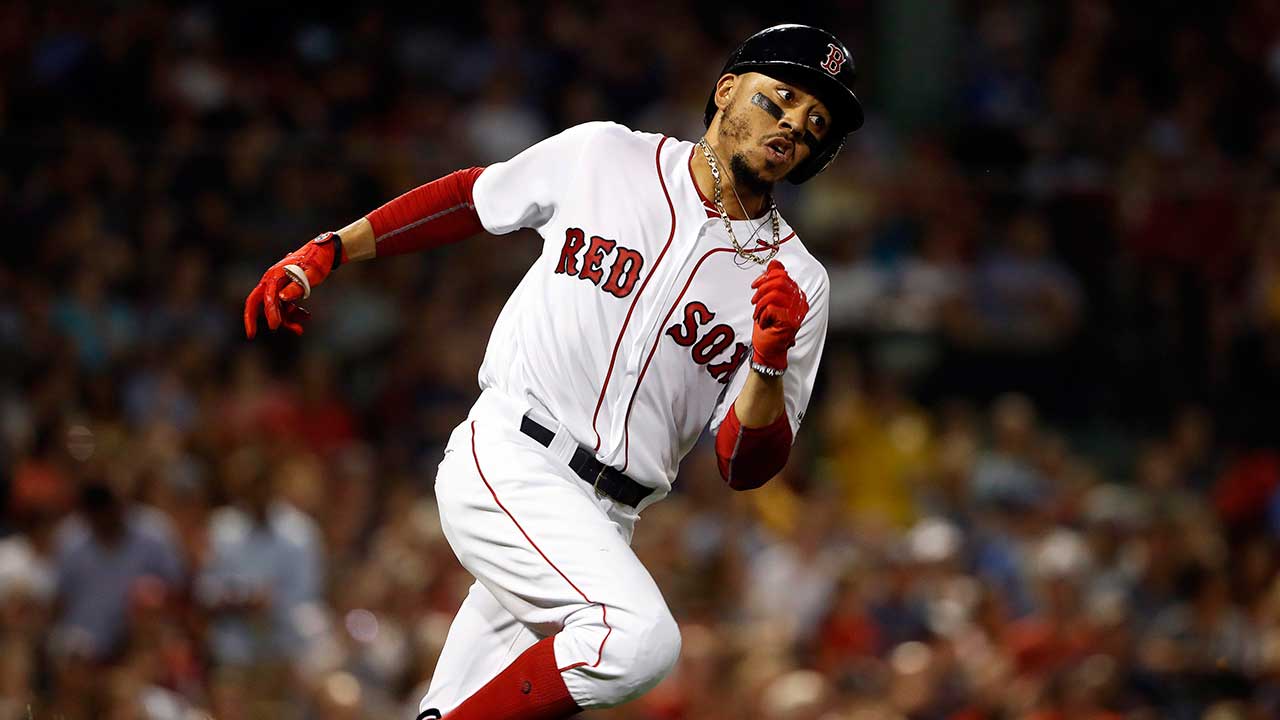
Even in a down season last year, they still won 84 games in the AL East meat-grinder. Yet rather than doubling down on the core in place, Chaim Bloom, the Red Sox’s new chief baseball officer, began a strategic retreat with the pending deal of Betts and Price to the Los Angeles Dodgers, triggering the expected howls from Boston’s spoiled, angst-ridden faithful.
Cheap owners don’t want to pay the competitive balance tax! Small-market executive still thinking he’s running the Tampa Bay Rays! Should have signed Betts for all the money!
You know, all the standard stuff.
At first glance for the Toronto Blue Jays, the departure of Betts – who torched them for a .953 OPS in 92 career games – and Price from the division is welcome, even if the reported adds of outfielder Alex Verdugo and right-hander Brusdar Graterol in the complicated three-way trade that also includes the Minnesota Twins could turn into a clever roster repositioning.
Still, for the Blue Jays and their fans, there should be some déjà vu here, as after the 2017 season, they were in a similar spot to the one the Red Sox were in this winter.
Back then, the Blue Jays were also coming off a down year with a talented, if aging, core, a farm system not yet ready to deliver impact, and a payroll hamstrung by declining players for years to come.
Rather than Betts, they had Josh Donaldson, along with Marcus Stroman and Aaron Sanchez, the latter coming off an injury-marred season. Their farm system carried far more promise than Boston’s thanks to the presence of Vladimir Guerrero Jr., Bo Bichette and Cavan Biggio, among others, so they had an opportunity to bridge between cores rather than reset.
But both teams had to make a decision on whether to push in on a group that was fading.
The Blue Jays opted for a middle-ground approach, adding on the periphery without subtracting from the developing prospect capital in their farm system. Randal Grichuk, Teoscar Hernandez, Aledmys Diaz, Yangervis Solarte and Curtis Granderson, however, weren’t enough for another run at the post-season. And when Donaldson got hurt, he returned only Julian Merryweather at the waiver deadline, so they got the worst of both worlds.
Still, the Blue Jays turned down the opportunity to max out in order to take another shot, although one managed carefully to mitigate long-term risk. The Red Sox, understanding the current landscape of an AL East led by the dominant and well-positioned New York Yankees and Tampa Bay Rays, with the ascendant Blue Jays gaining ground, opted to back off instead.
[snippet id=4722869]
Now, the parallels between the organizations aren’t perfect.
The 2020 Red Sox still boast more talent and a younger big-league base than the 2018 Blue Jays, and Betts in a contract year might have pushed them over the top. Factored into their considerations is their failure to lock up the dynamic outfielder long-term, and the combination of off-loading Betts for more than a compensatory draft pick while also gaining some salary relief by moving Price, even if subsidized for the Dodgers, advances the Red Sox’s situation on multiple fronts.
From a dispassionate vantage point, you can understand Bloom’s motivation. Verdugo and Graterol may not reach the ceiling on their potential, but they add youth to an organization that doesn’t have a substantive injection of talent from the farm system looming on the horizon. Moving Betts and Price opens up some financial flexibility for next winter and beyond. And they should still be a decent team in 2020, with upside.
The cost, though, is what might have been with Betts, one sure to be debated over and over if he has another MVP-calibre season for the Dodgers. Still, if the Red Sox kept him, he got hurt and the value of the asset crashed, the second-guessing would happen in reverse.
[relatedlinks]
All that is inherently unfair, which is why sometimes you need to judge process along with results. If you praise a team for going for it and the season goes sideways, you can’t turnaround and complain that it didn’t work out and a sell-off should have happened instead.
Sometimes you make a decision and live with the result.
The entire predicament is also a reminder of how fleeting success can be, and the challenges that will soon be upon the Blue Jays as they prepare to open a new competitive window.
Guerrero, Bichette, Biggio, Danny Jansen, Reese McGuire, Nate Pearson and their other young players will start earning bigger and bigger salaries in the coming seasons and will eventually need extensions, too, which is why every contract placed on the books must be measured.
The likelihood is that Hyun-Jin Ryu’s $80-million, four-year contract won’t look so hot in 2022 or ’23. The jury is still out on Grichuk’s extension, which runs another four years. Each dollar committed now impacts who gets paid and who doesn’t down the road.
And so the tightrope walk for the Blue Jays is on, trying to stay on the line for as long as possible without needing to make the type of leap the Red Sox were forced into with Betts.