TORONTO — About an hour after the Toronto Blue Jays dropped the opener of their weekend series with the Baltimore Orioles Thursday night, Devon Travis and Darwin Barney sat at their lockers having a long chat.
Still wearing most of their uniforms—cleats, eye black and all—they talked about hitting, they talked about life, and they talked about this outrageous game they play. A game where good players fail more than two-thirds of the time. A game that doesn’t get any easier no matter how hard you work at it. A game that persistently tests your mental fortitude, like never-ending flood waters washing up on the levees.
Travis, mired at the time in a 3-for-34 skid to begin the season, was being tested every night.
“We’ve all had stretches where we feel less than perfect,” Barney says. “Sometimes, it just helps to talk it out. Sometimes you just need to joke around with someone, even. It helps to have those conversations about the little things that will happen to you in this game. Because it’s a crazy game, man.”
Travis knows that well. He’s fought through a Spartan Race of obstacles in his young career, from an abrupt centre field experiment when he was in the Detroit Tigers organization to the shoulder and knee injuries that shortened the first two seasons of his big league career.
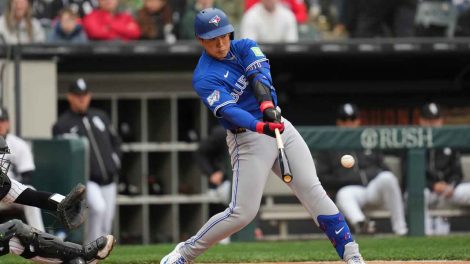
The latest challenge is his April funk, one that persisted through his first three plate appearances Friday night—all of them strike outs. In the ninth, he finally broke through, lining a single into right field as the Blue Jays attempted another failed comeback.
The hit, no doubt, was a relief. Had to be. It was his first since the second game of the season last Wednesday—two-and-a-half series ago. He came to the plate 31 times in between, reaching base only twice with walks. That’s why he sat with Barney late into the night Thursday, trying to make sense of it all.
“We were just talking a lot about the game and life,” Travis says. “If there’s something going wrong, he’s always a guy I can lean on. We’ll talk about what I’m feeling and he’ll give me a couple ideas. He’s got good pointers—he really watches the game closely. And I’ll take whatever help I can get.
“I just don’t know what’s going on. I feel like I’m seeing the ball alright. I’ve just got to pick it up, you know? I feel fine. It has nothing to do with my body. I’m just struggling, man. I have no idea why. But I’m working every day to figure it out.”
[relatedlinks]
Travis has fought back against his slump by spending more time in the video room and taking far more swings in the batting cages than he normally would at this point in the season. When he watches himself closely on video, he doesn’t see any glaring issues he needs to clean up. There are little things, sure. But there are always little things.
“You can probably find those little things in doubles or triples or home runs that I’ve hit in the past,” Travis says. “It’s nothing crazy.”
Blue Jays manager John Gibbons hasn’t seen any red flags either. He hypothesizes that Travis’ role as the team’s leadoff hitter earlier this season may have encouraged him to be too patient at the plate, looking to make a pitcher work while letting hittable, early-count pitches get past him. It’s part of the reason why Gibbons recently dropped Travis to ninth in the Blue Jays’ batting order.
“I’d like to see him be a little more aggressive. I think he’s taking a lot of fastballs,” Gibbons says. “Sometimes you’ve got to ambush pitchers—burn them right out of the gate. I mean, hell, if you’re making an out on the first pitch or the second pitch, is it that much of a difference?”
There could be some legitimacy to that. Going into Friday night’s game, a little more than 58 per cent of the pitches Travis had seen this year were hard (four-seamers, cutters, sinkers), and he’d swung at 42.5 per cent of them, with exactly one hit to show for it. His other two hits came off sliders, a pitch he was seeing far less frequently. Plus, Travis got a first-pitch heater in 21 of his first 36 plate appearances this season, swinging at it only three times.
But it’s also worth noting that Travis was only taking 3.81 pitches per plate appearance, which was among the bottom half of qualified MLB hitters. It’s not like he was waiting around for a pitch that would never come. He simply wasn’t attacking the first pitch he saw.
And that’s an awfully fine line. You generally want your hitters logging selective plate appearances, upping a starter’s pitch count and letting the other eight hitters in the dugout get a good look at what he’s featuring that night. Plus, if Travis was frequently swinging at the first pitch he saw and still making outs, many would be saying he needs to be more patient.
The temptation when things aren’t going well is often to start changing things. But sometimes the best course is to keep your approach consistent and trust your plan.
“You can’t force it,” says Blue Jays shortstop Troy Tulowitzki, who knows a thing or two about hitting. “You don’t want to make a bad stretch any bigger than it is. There’s a lot of guys in here waiting for that big hit. You just have to trust that it will come and that things are going to turn. You stick with it. That’s all you can do.”
And Travis has been through this before. In 2014, when he was 23 and playing for the double-A Erie SeaWolves, he went 7-for-his-first-50 with only one walk. That produced an ugly .140/.154/.140 slash line, something that bothered Travis a lot in those days, when he spent far more time parsing his numbers than he does now.
[snippet id=3332249]
He learned from that experience. Learned to look less at the stats and let the numbers take care of themselves. Learned to focus more on the process than the results. Learning that no matter how poorly things are going, and no matter how deep a hole you dig yourself, things will always turn around if you take care of your business.
That’s what happened that year in Erie, when Travis immediately followed up his awful start with a 12-game hit streak in which he went 23-for-52 with a .442/.463/.827 line. And that’s what Travis keeps working towards making happen now.
“If anything, that showed me that you can get through those tough times. They don’t last forever,” Travis says. “But you don’t get through them if you show up to the yard feeling bad for yourself or moping around. You have to show up every day and fight and bring energy. You’ve got to continue to put in work. And, over time, things will all even out and take care of themselves.
“I just need to find that one ball. That one barrel. That one ball in flight that you see and you like. And I think after that things will really start to go back the right way.”
With the Blue Jays down to their final out Friday, he may have found it. On a 97-mph Zach Britton two-seamer of all things. The Orioles closer even located it well, right on the outside black. But Travis was all over the pitch, driving it to the opposite field. Watching from the dugout, his lockermate Barney clapped and pointed at Travis as he stood on first.
“You learn so much about this game the first two or three years you play it. You learn about the adversities. You learn what your body’s doing in the box. You learn how to find ways to be competitive when you’re going through a bad stretch,” Barney says. “There’s no doubt in my mind that it’s going to turn for him. If there’s anyone that I’ll bet my mortgage on, it’s Devon Travis. I’m not worried about him one bit.”