
Editor’s note: FanGraphs is a leader in baseball analytics — a must read resource for fans and MLB teams alike. We’re thrilled to start publishing FanGraphs articles regularly at Sportsnet.
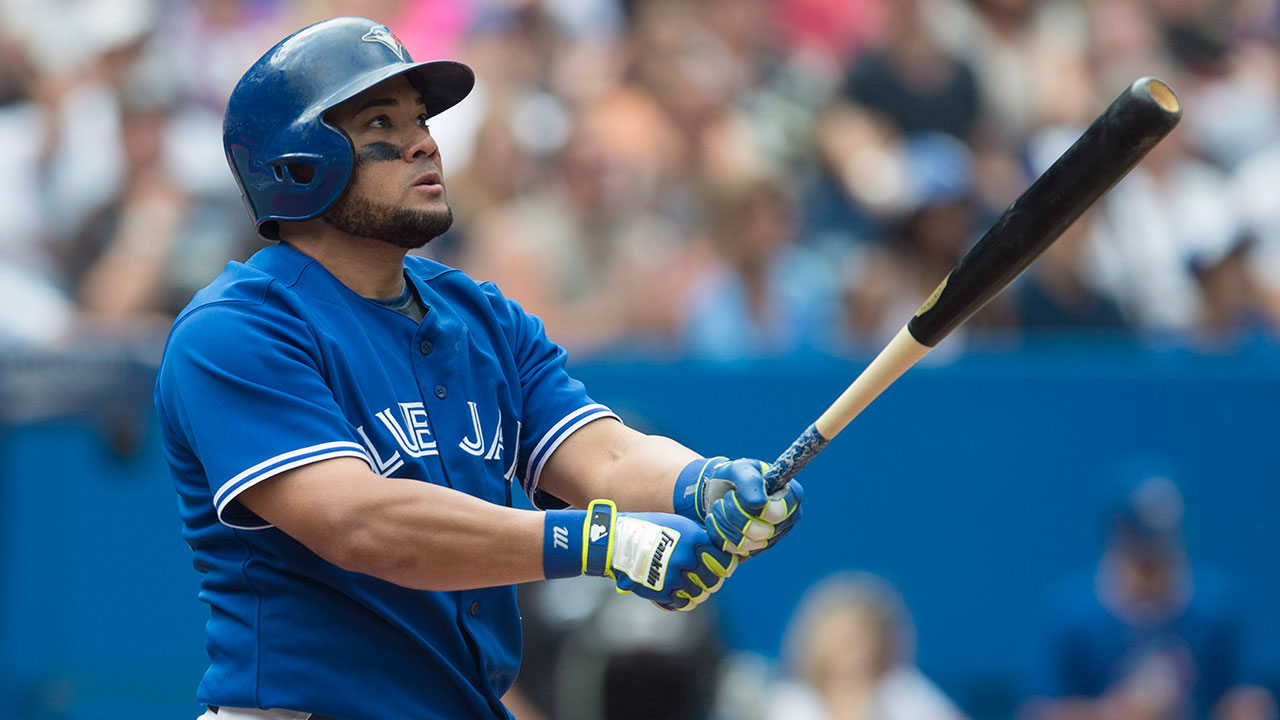
Melky Cabrera‘s season ended on Friday with a broken finger. Normally, “team headed for 21st straight year out of the playoffs, loses second-best outfielder for the final three weeks” isn’t much of a story, but this situation is a little different.
Cabrera is about to be a free agent in what looks to be a terrible market for offence, is only entering his age-30 season in 2015, and has had three pretty good seasons in the last four years. He’s been essentially the same hitter as Anthony Rendon has this year. That’s a pretty good resume to take into free agency, and understandably, talk is already focusing on where he’ll be playing next season.
Also understandably, that discussion has mostly centred around the considerable baggage that Cabrera brings with him, notably his 2012 PED suspension and the associated “let’s build a fake website” weirdness that came with it. ESPN’s Buster Olney devoted a column to it earlier this week, interviewing at least one player who complained that the system is set up in such a way that a rule-breaker can still find himself collecting a huge free agent payday. That player suggested that two-time offenders be restricted to one-year contracts in the future, which seems to me to be a thing that will never, ever happen.
Whether the feelings of that unnamed player are correct or not is kind of beside the point, because the fact is that Cabrera will go into free agency without any official restrictions, just unofficial reservations. While there’s some real reasons to question him going forward, he’s also about to enter a market that is almost totally devoid of outfield offensive talent. Cabrera’s going to get paid, and it’s going to make a lot of people unhappy.
* * *
Let’s start with the market. I made a custom leaderboard of available free agent outfielders this coming winter, and it’s… not pretty. This doesn’t include potential trade targets like B.J. Upton, Andre Ethier or Carl Crawford, but most of those guys are salary dumps of limited value anyway, and any potential Giancarlo Stanton deal takes place on an entirely different planet. I also made some assumptions on options, figuring that Ryan Ludwick would be be bought out, but that Denard Span, Ben Zobrist, Alex Rios and Nick Markakis wouldn’t be. (I went back and forth on Markakis, because $17.5 million seems awfully high for him, so feel free to mentally include him if you like.)

So what do you have there? You have Cruz, who has had a fantastic season but is four years older than Cabrera, is probably a DH going forward, and who comes with many of the same PED questions that Cabrera does. (Not that Cabrera is a great outfielder either, but he’s younger and at least acceptable.) You have Cuddyer, who has hit well, but has missed most of the season due to injury, will be 36, and wasn’t traded by Colorado because they want to keep him. Morse has power and little else. Rasmus is young and talented, but frustratingly inconsistent, and hasn’t even been playing full-time in Toronto lately. Everyone else here is either a bench player at best or an aging star well past his prime.
There’s just not a lot out there for teams looking to upgrade in the outfield, and that’s going to make this an extreme player’s market. Just off the top of my head, the Mets have a big hole in left. So do the Phillies, and the Reds. The up-and-coming White Sox could use a bat to go along with Jose Abreu and Adam Eaton. Maybe the Astros decide it’s time to start buying some players, and don’t think Robbie Grossman and Marc Krauss are enough in left. The Padres are in desperate need of offence. You could do the same exercise for a half-dozen other teams, and don’t count out Toronto, where Cabrera has said he’d be happy to remain, lest the Blue Jays have Kevin Pillar and Anthony Gose making up a 2015 outfield next to Jose Bautista.
The point is, Cabrera is likely to be the only available free agent outfielder who hasn’t yet played his age-30 season who is to be considered an everyday player, aside from whatever Rasmus is. (Sorry, Tyler Colvin.) That alone is going to make him desirable.
So what did last year’s outfield market yield? 12 outfielders signed a free agent deal of at least two years, though as you can see, most aren’t really a great comparison for Cabrera:

There’s two superstars here who got huge deals, two guys in their late 30s, and several role players who got two years for between $2.5 million and $8 million per. There’s only two who fall into the “solid starter” range that Cabrera would be in, and one of them – Byrd — is so much older that it’s hard to compare the two on that basis. Granderson, however, is interesting: He’s three-and-a-half years older, had the qualifying offer on him, was coming off a season ruined by hand injuries, and had put up one hitting season (2011) in the previous five better than what Cabrera has done this year. He’s not a PED guy, of course, but he still came away with four years and $60 million. It seems pretty clear that on the basis of what the market paid for outfielders last year, where older bit players received two years, Cabrera is easily in line for three or four years. But for how much?
Cabrera is currently playing out a two-year, $16 million contract he signed with the Blue Jays fresh off his 2012 drug suspension, the first year of which was a terrible disappointment. Of course, as I outlined here in April, the convenient narrative that goes along with that is that he “got clean” after the bust, and immediately fell apart. What those stories generally fail to mention is that he playing all season with a tumour on his spine that hindered his movement; with the tumour removed, his 2014 offence has been a whole lot more in line with his 2011 (Kansas City) and 2012 (San Francisco) seasons.
So far, so good for Cabrera, but we haven’t yet made it to the two drags on his potential free agency: the qualifying offer, and the stigma of his PED association.
Let’s start with the second part first, and note that as much as players and fans may despise known PED cheats, teams simply haven’t seen it the same way. Yes, Cruz was forced to sign for only one year and $8 million, but as we noted here several times last winter, there were many reasons to be terrified of signing him; it’s impossible to say anyone saw this kind of season coming. Links to PEDs didn’t stop Jhonny Peralta from getting four years and $53 million from St. Louis; they didn’t stop Byrd from getting two years and $16 million from the Phillies despite his advanced age and completely lost 2012. There may be a few teams who refuse to add a PED guy, and there may be others who think twice about it, but there aren’t nearly as many of those clubs as there are teams who badly want to add offence. His reputation probably hurts him a little; it won’t kill his free agency.
The qualifying offer, expected to be about $15 million this winter, and which Toronto would be crazy not to offer, could be a bigger problem. We all know what it did to Kendrys Morales and Stephen Drew, and it’s a big part of what hurt Cruz. It’ll hurt Cabrera too, though not so much if one of the teams interested in him happens to have a protected draft pick. Wouldn’t you know it, if you look at the standings, most of the teams I named above currently have a protected pick, and the Reds and Mets may yet sneak their way in there. The potential that Cabrera can market his services to one of those teams, much like Granderson did with the Mets, would be a huge boost to his prospects.
So what are we left with? Olney suggested the 3/$39 million that Shane Victorino got, coming off a down 2012. The Toronto Star polled agents last month and came away with “a contract somewhere in the neighbourhood of three years and between $36 million and $45 million, or roughly $12 to $15 million per season.” The Score, last month, also said 3/$39 million. That’s all pretty consistent, and maybe it’s right.
Then again, when you look at what Granderson got, and how much money is in baseball right now, and how awful the outfielder market looks to be, and how desperate everyone is to get some offence into their lineup, it’s not hard to see someone pushing to a fourth year. (One scout, not that scouts offer contracts, told Jeff Blair of Sportsnet.ca that “he thought his team would do a four-year deal for Cabrera,” referencing Peralta’s deal.) That sounds like a lot, and with the qualifying offer — which Peralta, a good fielder at a premium position, did not have — it’s possibly not realistic.
Then again, Cabrera has, after all, set a three-win or more pace in each of the last three years in which he didn’t have a tumor on his spine, and that’s a valuable thing. If you believe the valuation that says a win is approximately $6 million in the market, maybe he’ll even be undervalued, though the PED bust and qualifying offer should bump that back to the estimates above. Either way, this is less about what Cabrera “should” get and more about what he actually might. For a lot of people, that’s going to be a very scary thought.
This article was originally published at FanGraphs on September 10th.