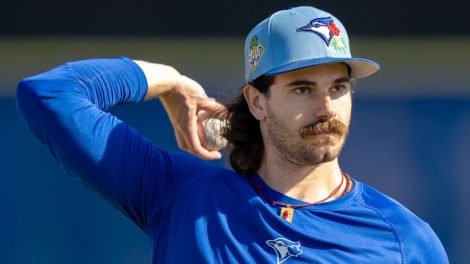

Daniel Norris has thrown all of 30 pitches at the big league level, so it’s fair to assume the arsenal of the Toronto Blue Jays’ 21-year-old pitching prospect hasn’t changed since he was facing triple-A hitters three weeks ago.
But those 30 pitches have proven something to Norris. After striking out David Ortiz in his MLB debut, the left-hander finally knew beyond a doubt that he could retire big league hitters.
“I mean seriously. You never know. There’s always that fear of the unknown,” Norris told Sportsnet. “You have a good minor league season and you think ‘OK, I can get these guys out,’ but you never know until you get there.”
Immediately after striking out Ortiz, Norris was dazed. He can’t recall details from the entire at bat, which he describes as a surreal, near out-of-body experience that left him feeling as though he hadn’t done what he had done.
“When I came into the dugout after I threw, I just stood there in the middle of the dugout and [Mark] Buehrle was like ‘dude, you can sit down,’” Norris recalls. “I was like ‘I don’t know what to do. I really don’t know what to do right now. I don’t want to sit down.’ I was just literally standing there with the biggest smile on my face. I couldn’t help it.”
In the two weeks that followed, Norris would pitch another scoreless inning and absorb as much knowledge as he could from his teammates, veterans and fellow rookies alike. He noticed and appreciated the many differences between Dunedin, where he started the year with the Blue Jays’ Class A affiliate, and Toronto. In the big leagues the stadiums are nicer, the crowds are bigger and the hitters are better (so is the pay, though judging by what Norris says and does, that’s not a motivator for him).
Norris is widely considered one of Toronto’s top young arms after posting a 2.53 ERA with 163 strikeouts in 124.2 innings across three minor league levels this year. Now he has even experienced a little big league success, but the 2011 second-round selection still looks for cues from others around MLB. Clayton Kershaw has become a favourite of Norris’s, not only because of his stuff but because of the way he attacks hitters.

“He just doesn’t back down,” Norris said. “He never nibbles, he just goes right at guys. Here’s my heater, hit it. Here’s my slider, hit it. Here’s my curveball, hit it. It just goes to show that you can get guys out by just attacking them. They’re going to get themselves out.”
Norris pitches with a different repertoire than Kershaw (photo by Mark J. Terrill/AP), though both rely heavily on hard fastballs from the left side. While Kershaw relies heavily on his curve and slider, Norris describes his change-up as “a huge pitch” for him, one he relied on heavily early this season.
The curveball, which Norris used to strike Ortiz out looking, is more of an out pitch, along with the slider.
(Norris throws the change-up to all hitters, though right-handed hitters see it more often. He’ll use it away to right-handed batters with splitter/screwball action, in to right-handed batters with cut change action and low and away to left-handed batters with the same cut change action.)
Having already completed the improbable climb from Class A to MLB in one season, Norris has had a productive year by any standard. How will he follow it up?
He has heard people around him recommend rest, but the idea of taking a few weeks off doesn’t appeal to him. He typically works out once in the morning and once in the evening to condition his fast-twitch muscles to become as explosive as possible. He has no intention of ending his workouts once the season’s over, which means plenty of sprint intervals and time in the gym. And, for good measure, a surfing trip to Nicaragua.
Combined with his rapid ascent through the minors and a newfound sense of his own ability to retire MLB hitters, it will make 2014 a big year.
“I couldn’t have written it up any better,” he said. “Seriously, that was like a storybook.”