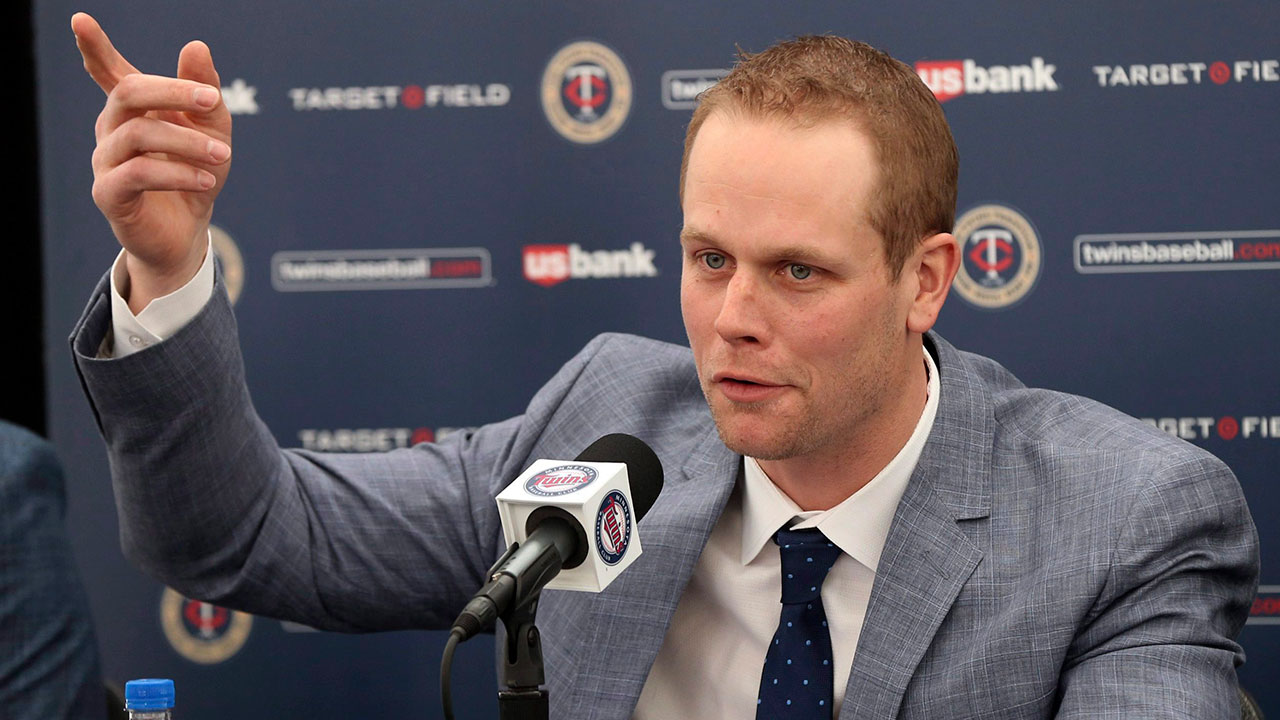

TORONTO – Justin Morneau felt hockey’s pull growing up, becoming a goalie talented enough to enjoy brief stint with the Western Hockey League’s Portland Winter Hawks at age 16. At the same time, the dominance of fellow B.C. native Larry Walker and a Toronto Blue Jays team that won consecutive World Series in 1992 and ’93 consistently drew him back to baseball, serving as the two biggest influences on his career outside of his parents.
That backdrop provided some nice symmetry to the hard-hitting first baseman’s naming to the Canadian Baseball Hall of Fame on Tuesday. His selection comes two weeks after Walker, an idol who became a mentor and a friend, was elected to the National Baseball Hall of Fame in Cooperstown, N.Y. And Morneau will be inducted at St. Marys, Ont., on June 20 alongside John Olerud, whose swing he grew up mimicking and rode to the majors, and fellow Blue Jays star Duane Ward, the type of dominant reliever so revered in today’s game.
Jacques Doucet, the longtime and beloved French-language voice of the Montreal Expos, rounds out the Class of 2020.
“It’s pretty surreal,” said Morneau, the former Minnesota Twins star and 2006 American League MVP. “For (Walker) to finally get in was something special. He actually texted this morning when he saw the release go out, he sent me a text, he said, ‘Congratulations, looks like you’ve got to get your speech ready, too.’ That’s pretty cool. To see that states the significance of the Hall of Fame, and what it means to Canadian baseball players. …
“If John and Duane hadn’t done what they’d done, I’m not sure I would have leaned toward baseball and away from hockey,” he added later. “I had the Blue Jays and I had Larry Walker coming along at the same time. So these guys have had as much impact on Canadian baseball as anyone so I’m glad to be able to go in with them and obviously Jacques as well.”
[relatedlinks]
Olerud, Walker and Ken Griffey Jr. were Morneau’s favourite players growing up and he’d imitate their swings in his backyard. The Blue Jays would be on TV at 4 p.m. on the West Coast, just as he’d be getting home from school, and that allowed him to really study Olerud’s swing, which was widely revered for its smoothness.
Much of that worked into Morneau’s stroke, although it took a side-by-side comparison aired during the 2004 playoffs against the New York Yankees for him to realize how much he’d absorbed.
“They were so similar, other than my one-handed finish and his two-handed finish,” said Morneau. “It was amazing that the swing I imitated growing up was the swing I developed most closely to. I couldn’t do Griffey’s swing. It didn’t feel right. But I had the same hand load as John, the way the bat came through the zone, everything was so similar that it was kind of eerie to watch. I can’t understate how much of an honour it is to be going in with John.”
The connection with Walker adds to that feeling.
In many ways, Morneau assumed the role of leading Canadian in the majors as Walker’s career was coming to an end and his was getting started. A brilliant 2006 season, in which he batted .321/.375/.559 and drove in 130 runs, established him as one of the game’s top hitters, and his role in carrying the Twins to an AL Central title earned him MVP honours.
To that point, Walker was the only other Canadian to win MVP in the majors, although his links to Morneau started long before he had reached the big-leagues.
“Any time you’re in the minor-leagues and someone you’ve never met sends you a box of bats – it’s pretty significant. A guy who was MVP doesn’t really have to concern himself with a kid who’s in double-A,” said Morneau. “He was able to do that and that showed me Canadian baseball as a community is a very tight-knit group … it showed me how important it was to look out for other Canadians. … To have someone like that to lean on made a difference in my career.”
[snippet id=4722869]
Joey Votto, this generation’s other dominant Canuck hitter, became the third MVP from up north in 2010 and Morneau might have made it a Canadian sweep that year if not for a season-ending concussion he suffered while playing against the Blue Jays. He took an inadvertent knee to the head from John McDonald while sliding to break up a double play.
Through 81 games at that point, Morneau was batting .345/.437/.618 with 18 homers and 56 RBIs, on pace to establish a number of career bests. But he didn’t play again in 2010 after that fateful July 7 game in Toronto, and it wasn’t until 2014 with the Rockies, when he hit .319 to win the National League batting title, that he began to resemble his former self.
By then, however, his body had been through a slate of other injuries beyond the concussion woes, curtailing what surely would have been an even more productive peak.
Injuries also shortened Ward’s remarkably dominant career, as he made only four appearances after establishing a Blue Jays single-season record with 45 saves and locking down games as the club won a second consecutive World Series in 1993.
Ward logged five consecutive seasons of 100-plus innings out of the bullpen from 1988-92 as the primary set-up man for Tom Henke before taking over as the closer in 1993, when he logged 71.2 frames.
His durability, dominant fastball and filthy slider would have had today’s executives and managers salivating at the thought of acquiring him. The Ward-Henke combination remains, in some ways, a model for how teams try to design their bullpens today.
“I didn’t really have to worry too because the ball didn’t get put in play very much when Wardo was out there,” said Olerud. “The times you did get guys down to first base, a lot of times I’d hear guys complaining, ‘What is that he’s throwing?’ A lot of people thought he threw a split-finger because of how that pitch would drop off the table, and I’d have to say, ‘No, he doesn’t throw a split-finger, that’s his slider.’ They’d say, ‘No, that can’t be his slider.’ All the time I was arguing with guys that he didn’t throw a split-finger fastball. He was just dominant.”
All the miles caught up with Ward in 1994, when he didn’t pitch due to shoulder and biceps issues and his comeback attempt the next year didn’t work, leading him to retire.
Olerud, whose left-handed stroke was a rare amalgam of art and science, enjoyed far more longevity in a highly under-appreciated 17-year career during which he batted .295/.398/.465, amassed 2,239 hits and walked 1,275 times against only 1,016 strikeouts. A gifted defender, he also won three Gold Gloves.
[snippet id=3305549]
One of only eight players since 1979 to begin his career in the majors without first appearing in the minor-leagues, Olerud’s finest season came in 1993, when he carried a .400 batting average through Aug. 2 and eventually won the batting title at .363.
“That year, I’d not seen anybody hotter and it was a pleasure,” said Ward. “We all sat there and marvelled at his swing, also, just saying, ‘What’s a pitcher thinking after getting through the first two or three guys and then having to face No. 9?’ I mean, this guy is hotter than a firecracker and he’s been that way all year. We knew John was going to put the ball in play, whether it was going to be a double in the gap, a single down the line or a home run. … That year, 1993, to me – I know it was special to John, but to be able to sit back and watch it was nothing but awe-inspiring.”
While his swing at the plate was immediately recognizable thanks to its rare fluidity, Olerud’s look was also distinctive because he wore a helmet while playing defence, a precaution because he had a brain aneurysm while in college.
Doucet, who helped develop French baseball terminology, began calling Expos games in 1972, the start of a 33-year run. He credits Rene Lecavalier – the revered commentator for La Soiree du Hockey, the French version of Hockey Night in Canada – for inspiring him as a broadcaster and former Expos manager Gene Mauch for helping to teach him the game.
But when it came to translating baseball’s English into sensible French, he borrowed terms from the days of the Montreal Royals, and then made things up as he went along.
“When I was stuck on radio trying to come up with a French equivalent for a pick-off at first base, or a shoestring catch or a Texas-leaguer, I wasn’t afraid to say on the air, ‘If anyone out there can come up with an expression in French to really describe what is a pickoff move, what is a shoestring catch, what is a Texas-leaguer, please let me know,’” recalled Doucet.
“A lot of people from the University of Montreal and other baseball fans throughout the province really helped us to come up with expressions that people could understand and then throughout the years, by repeating and repeating and repeating, the people started to adopt those expressions and they shied away from the English expressions. I’m very proud of that.”