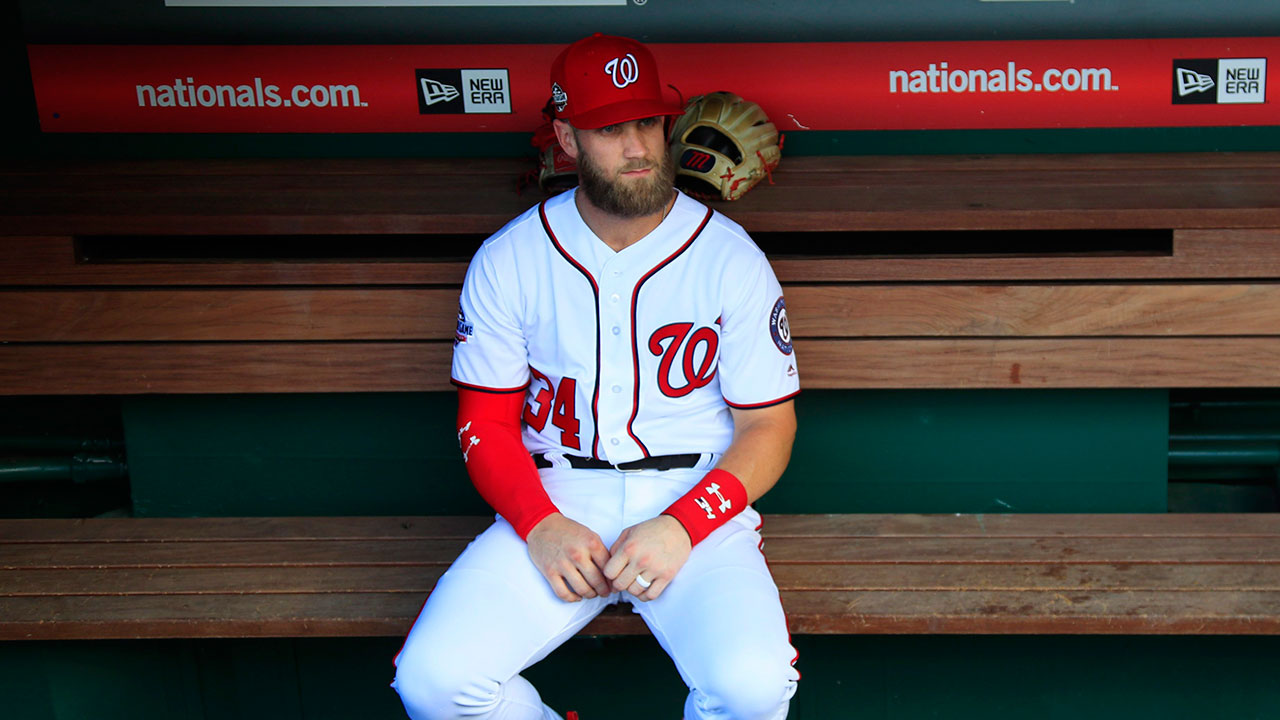

Bryce Harper and Manny Machado are both off the board, financial history has been made like we all thought it would and Scott Boras has his payday. So after all that worrying about player dissatisfaction and growing labour unrest it’s pretty much business as usual, right?
Yeah.
No.
Philadelphia Phillies senior advisor Pat Gillick told us a couple of years ago that any team that wasn’t planning for this winter was essentially guilty of mismanagement. After all, Harper and Machado were the rare transformational free agents hitting the market at the age of 26 — something the game hadn’t seen since Alex Rodriguez. We – all of us – started thinking that Harper might become the first $40-million-per-year player. Even as the winter dragged out and the free-agent freeze-out that has come about as a result of the new collective bargaining agreement wore on, those words from Phillies owner John Middleton about being willing to spend “stupid money” hung out there.
[relatedlinks]
Instead we ended up with a relatively sensible, simple deal: no opt-outs or deferred money or stupid accounting tricks. Boras, Harper’s agent, didn’t even have to take advantage of an aging owner – in this case, the Washington Nationals‘ Ted Lerner – the way he did when Mike Ilitch agreed to Prince Fielder’s contract.
This was a very Boras deal. He gets to say his client has signed the largest guaranteed free-agent contract in North American sports history, with a contract that is bigger by $55 million than the 13-year extension signed by Joel Wolfe client Giancarlo Stanton, which is important for Boras. Harper gets to stay in one place – a hitter-friendly ballpark – for the rest of his career, which seems to matter to him. The Phillies, who had the lowest right-field WAR, have a player that ZIPS projects out to 4.8 WAR at a manageable annual average value of $25.38 million that will allow them to easily make good on their pledge to Harper: that they will have a top-five payroll.
There are in fact nine players who will make more money this season than Harper, including Yoenis Cespedes.
[snippet id=3305549]
There was a rush in some quarters to suggest that Machado’s signing by the San Diego Padres was a sign that a market that had drawn the wrath of many players for its lack of competitiveness was in the process of a reset – a late reset mind you, but one nonetheless – and that it was in fact notable that a team like the Padres was willing to become a player in free agency.
That was, I think, an overly optimistic assessment, just as the recent cooling off of rhetoric on the part of commissioner Rob Manfred and the Major League Baseball Players Association over rule changes and pace of play initiatives offers little hint about future labour conflict other than, maybe, removing some relatively minor issues from the table. (Notable, however, is the idea that baseball is open to the idea of using split screens or inserts for advertising as a way of cutting into advertising-related delays between innings, something players such as Curtis Granderson have championed in recent years.)
Harper and Machado’s contracts are not measuring sticks or signs of a loosening market, nor will they take away from the idea that owners and players need to come to an agreement about adapting to the new economic reality created by a game that is skewing younger and younger and more reliant than ever on multi-million dollar analytics that have removed emotion from negotiating. It cannot be stressed enough: players will soon demand more money at a younger age and as a result are showing a willingness to sign extensions and forego a year or two of free agency. Free agency as we know it – the very definition of it – could be radically changed in the next CBA. That won’t be an easy process, regardless of what transpires during the next big free agent classes — ones that could include Mike Trout, Mookie Betts and Francisco Lindor.
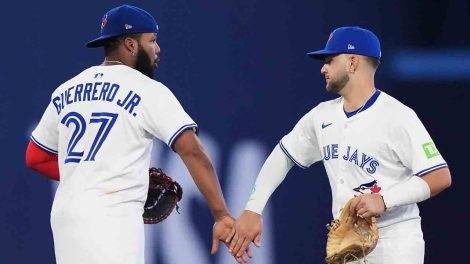
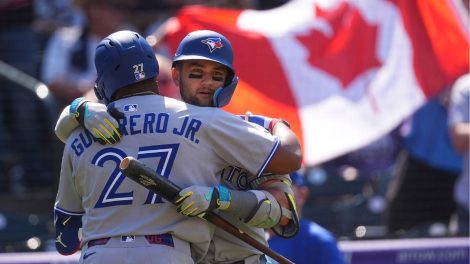
Thursday was the day Bryce Harper got paid. Nothing more. It says far less about where our game is than what Boras will be able to get another of his unemployed clients: pitcher Dallas Keuchel. And if you’re a Blue Jays fan wondering how this affects Vladimir Guerrero, Jr. – once he’s ready to be a major-leaguer, of course – the answer is not as much as the $32.5-million Nolan Arenado will make as part of his extension with the Colorado Rockies.
If you’re one of those people who believes it’s never too early to panic, well, that’s your immediate nightmare. Not Harper. Not yet.