TORONTO — Toronto Blue Jays general manager Ross Atkins was in the middle of listing the traits he likes most in Hyun-Jin Ryu — command, a varied arsenal, athleticism — when he turned to the South Korean left-hander sitting to his right and addressed him directly.
“You truly are fun to watch play,” Atkins said to Ryu on Friday during the press conference introducing Toronto’s newest arm. “It’s remarkable what you’ve already accomplished and we very much look forward to the success you’re going to bring to this organization.”
Undoubtedly, Ryu’s a very fun pitcher to watch. At 6-foot-3 and 255 pounds, he’s an imposing presence on the mound yet one who brings a calm composure to competition. And there’s no arguing that he’s accomplished plenty in his seven-season MLB career. He led baseball with a 2.32 ERA last season, finishing second in National League Cy Young voting. And his 2.71 ERA since the beginning of 2017 ranks fourth among the 115 qualified MLB starters over that span.
But just how much success can Atkins and Blue Jays fans look forward to over the next four years of Ryu’s $80-million deal? That’s the unanswerable question in the wake of the largest free-agent pitching contract the franchise has ever awarded, and one that will go a long way to determining whether or not the club’s current rebuild is ultimately successful.
“He was going for the Cy Young last year — that tells you everything. We got one of the best pitchers in baseball and we’re going to have a chance to win every time he takes the mound,” said Blue Jays manager Charlie Montoyo. “He’s going to be our ace.”
That much is certain — but Ryu won’t be a domineering, fastball-heavy ace like the Astros’ Justin Verlander or the Yankees’ Gerrit Cole. Ryu’s change-up is actually his best pitch, and truly one of the best off-speed weapons in the game. It’s also his only plus offering, which is why he threw it more than any other pitch last season.
Hyun-Jin Ryu, Filthy 83mph Changeup…and pic.twitter.com/LI8GRyojPS
— Rob Friedman (@PitchingNinja) October 7, 2019
Meanwhile, the average velocity (90.7 mph) and spin rate (2,084 RPM) on Ryu’s fastball were among the lowest in MLB. Same goes for his cutter. And while his curveball features above-average movement and can generate some swing-and-miss, it isn’t considered a dominant pitch. Ryu isn’t overpowering or out-stuffing anyone.
Rather, he uses sequencing, control and deception to keep hitters off balance and generate soft contact. Think first-pitch curveballs for strikes, change-ups in fastball counts and fastballs with two strikes. He repeats his delivery and maintains his release point exceptionally well, providing few hints as to what’s about to come out of his hand.
Elite command and control of the baseball allow him to manipulate his pitches to move the way he wants on their way to the plate and end up where he wants when they get there. Each of those pitches move differently and at varied rates of speed. That’s where a lot of the soft contact he generates comes from, as he stays off the heart of the plate and keeps the ball away from the barrels of bats.
It’s also why he barely walks anyone, with a 1.3 BB/9 over the past two seasons, the lowest of any MLB starter (minimum of 150 innings) by a significant margin. Ryu just pounds the edges of the zone while his catchers mix and match his offerings well enough to prevent hitters from picking up his patterns.
“Obviously, speed is an important factor. But ever since I was young, I’ve focused on pitching as more than just the fastball,” Ryu said through interpreter Tad Yo. “Because if you throw it down the middle, they’re going to hit it.”
It all makes him awfully difficult to square up. The average exit velocity Ryu allowed in 2019 (85.3 mph) ranked 15th among the 436 MLB pitchers with at least 100 balls put in play against them. It ranked sixth among the 198 that allowed at least 200. And you can keep pushing him up that leaderboard if you keep increasing the sample, because Ryu was one of only 43 pitchers to allow more than 500 balls in play in 2019.
As strikeouts surged across baseball, Ryu’s K/9 actually decreased from 9.7 in 2018 to 8.0 in 2019. He simply allows a lot of contact and it’s non-negotiable that a team field a skilled, reliable defence behind him, lest ground balls squeak through a leaky infield and line drives not be run down.
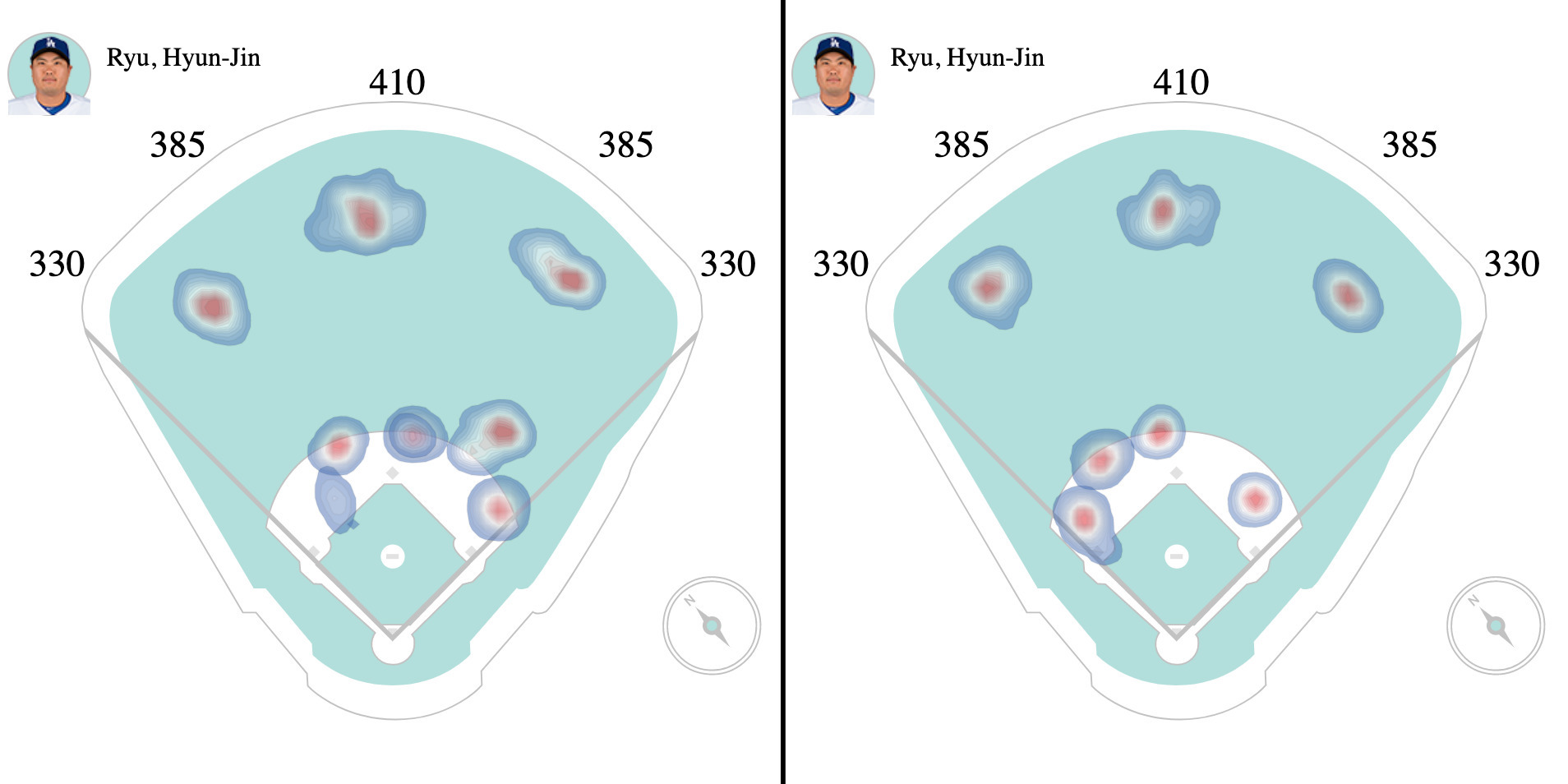
Ryu’s 48.4 per cent career ground ball rate at least demonstrates he’s getting the type of contact you want half the time, as the prevalence of the infield shift has increased the rate at which ground balls are converted into outs. The Los Angeles Dodgers, Ryu’s old team, utilized a shift behind him 40 per cent of the time last season, well above the league average of 25.6 per cent.
On the left is how the Dodgers positioned fielders behind Ryu when he faced left-handed hitters, and on the right is how they approached right-handers:
Has anyone mentioned Toronto was a bottom-10 team across the board in 2019 by whichever advanced defensive statistic you prefer? It seems relevant.
Now, the Blue Jays are expecting to be better defensively on the infield in 2020, with a trimmed-down Vladimir Guerrero Jr. potentially featuring more range at third base, while Bo Bichette and Cavan Biggio continue to improve at shortstop and second. But the outfield is still a big question mark, particularly in centre, which was primarily covered by the erratic routes of Teoscar Hernandez in 2019.
Montoyo may have to tailor his lineups to Ryu’s tendencies on the days he pitches, playing Randal Grichuk in centre and the recently-signed Travis Shaw, who’s accumulated 26 DRS as a third baseman since 2015, at third in order to minimize the possibility of a defensive disaster. It likely won’t be the same calibre of defence Ryu was accustomed to with the Dodgers, but it’ll have to do.
Of course, Ryu will have to be on the mound for any of that to matter, and staying healthy enough to compete has been a perpetual struggle since his MLB debut in 2013. He missed time due to foot and back injuries that year, before hitting the injured list twice in 2014 with shoulder and glute ailments. Then, in 2015, Ryu revealed he’d been pitching with a torn labrum in his left shoulder for years, and underwent surgery to address the issue. A year later, when he was finally attempting a return to play, shoulder soreness and a groin issue kept him out even longer.
In July, 2016, Ryu made his first MLB appearance in 22 months. It was also his last for some time, as elbow tendinitis derailed his comeback and ultimately required surgery two months later. In 2017, it was adductor, hip, foot and forearm issues limiting Ryu to 126.2 innings; In 2018, a groin strain kept him to 82.1. From 2014 through 2018, Ryu threw 365.2 MLB innings — or 73.1 per year. Even last season, his healthiest since he was a rookie, Ryu still made two brief trips to the injured list due to groin and neck issues.
[snippet id=4722869]
Yeah, it’s a lot. And it’s why the Blue Jays are likely expecting something closer to 500 innings from Ryu over the next four season as opposed to 800. Getting 125 innings of elite pitching per season is still worth something, of course. And to the Blue Jays, who ran Ryu through an extensive physical this week, it’s evidently worth $20-million per year.
“There is no free agent signing where you’re not sharing some risk. And we feel like we’ve added an incredible talent to the organization and feel like he’s evolved and learned from his transition as a professional and as a Major League Baseball pitcher,” Atkins said. “We’re confident he’s going to continue to do what he needs to do to stay on the field.”
Still, if he does, it’s hard to expect Ryu to post the same numbers this season as he has over the last two. He’s moving to a more difficult division, in a league with a designated hitter batting once every nine instead of a pitcher, to play in a more hitter-friendly ballpark in front of a worse defence. He’s a year older (Ryu will be 33 on opening day) and threw nearly as many innings last season (182.2) as he did in the four that preceded it (213.2). There is a reason Steamer projects him at 2.9 fWAR after he was worth 4.8 in 2019.
But the only Blue Jays pitcher to post a three-win season since 2017 is Marcus Stroman, who doesn’t play for the team anymore. Even when baking in substantial regression to his recent performance, Ryu is a massive rotation upgrade for a team in desperate need of it. Simply put, when he’s healthy and pitching to his ability, Ryu’s among the most effective starters in baseball. And the price to acquire that rare upside is what the Blue Jays paid.
“We just continue to try to make the organization better. And there will be more opportunities like this one. And there have been opportunities that we’ve missed on,” Atkins said. “But we’ll continue to do that. We’re here for one thing and it’s to win. We’re getting closer to those days.”
[relatedlinks]