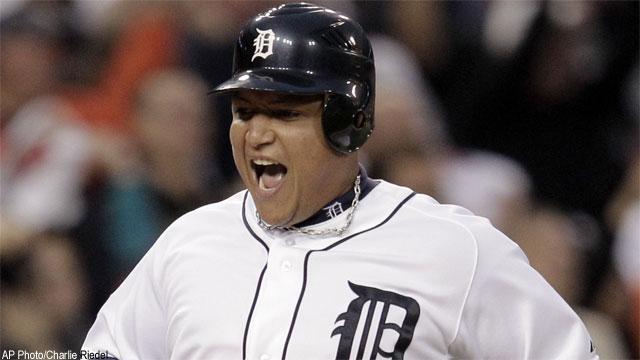

Standing next to Miguel Cabrera in a small room within the depths of Kauffman Stadium in Kansas City, even Jim Leyland can hardly contain his excitement.
Still wearing their hats and uniforms, the pair is expecting a call from Major League Baseball commissioner Bud Selig, who wants to congratulate the guy who just wrapped up a season leading his league in batting average, home runs and RBIs.
As with most things in baseball, they have to wait, standing amongst the gaggle of photographers present to document the moment.
Cabrera, blithe and nonchalant as always, flashes a goofy smile, matching the big-headed cartoon caricatures of past major-leaguers framed on the walls. Leyland is his normal self — the picture of stoicism, the definition of steeliness — until he just can’t handle it anymore.
“I was down there watching (Mike) Trout, watching (Curtis) Granderson, watching you. I was going crazy,” Leyland said to Cabrera, putting his hands on the big third baseman’s chest. “Granderson hit two home runs and I go, ‘Oh my god.'”
Leyland has his hands on his head now, trying to demonstrate to Cabrera the sheer agony he experienced when he thought his star player might see one of baseball’s oldest, purest accomplishments swept out from under him by a Yankee centre fielder having himself a night.
You seldom see this side of Leyland — the giddy, excitable kid within the weathered, 67-year-old manager’s body. It takes something special for it to come out. Something like what Cabrera just did.
The Triple Crown doesn’t try to be perfect. It’s a statistical accomplishment from another era. It’s significant and far from easy to achieve — but the criteria are outdated.
We know its flaws. The high batting average could be the result of unimportant scratch singles or a lucky amount of balls in play that find unmanned outfield grass or holes through the infield. Home runs get fans on their feet but, if you hit 40, that represents less than seven per cent of a full season’s at-bats.
All those homers don’t matter much if you can’t contribute something meaningful the other 93 percent of the time. RBIs are largely the product of someone else’s hard work. They often come on outs and have as much to do with opportunity as anything else.
None of this is new. And none of this is going anywhere. The sooner you realize that, the easier it is to accept. These stats are like incandescent light bulbs — still prevalently used in an era that has otherwise moved on.
Nowadays, baseball statistics have been improved incredibly. They are nuanced, comprehensive, complex. They tell stories, combat false narratives and do a very good job of explaining the randomness that ultimately rules over this game. They are why a very vocal mass of baseball observers (most of whom will never vote for an MLB award, it should be noted) say this Trout kid is actually the best offensive player in the American League this season. Statistics don’t poke holes in Cabrera’s accomplishment — they blast a crater through the hull.
Still, winning the Triple Crown means a great deal to a lot of people. You can never take that away from them. Baseball fans love the rare, incredible feats of dominance found at the intersection of difficulty and a nice, round number: pitching a perfect game, hitting for the cycle, even something as simple as batting around in an inning.
The Triple Crown is no different. Before this season it had only happened 16 times in 130-odd years. Whether or not it is a true declaration of a quality hitter, it is special and it’s just not worth the energy or megabytes required to attack it. It’s true that traditional statistics don’t do enough. A truer understanding of value and talent can only be arrived at with more advanced tools. But the game is about more than just stats.
Sorry to be romantic, but this is baseball. You don’t like it because it’s riveting. You like it because it’s pure. Baseball is about getting lost in an afternoon at the yard, sitting under the hot sun and watching the ballplayers live their dreams. It’s about a community, how a simple game that kids used to play in the streets with bottle caps and broomsticks can bring so many people together. Old and young, rich and poor, educated and unread. It’s about being at the ballpark to see someone do something special.
It’s about how a profoundly talented kid from Maracay, Venezuela, can land in America and do something that makes the entire country take notice. Cabrera is bringing people together. He is inspiring the sport’s old guard, who love a broadsheet boxscore, and its more innovative fans who would rather see a win probability graph or a pitcher’s heat map. He’s reaching them all.
He is baseball. Everything that’s great and awful about it. For as talented as Cabrera is, he’s a deeply conflicted person. His battle with alcohol addiction has been painfully public and there is no shortage of teammates, current and former, who have criticized his lack of focus. His work ethic has been questioned. He has been admonished for not caring enough. He has been called moody, introverted, selfish, the whole deal. Just like the stats debate, Cabrera can split a crowd in half.
One night he’s getting pulled over drunk in Florida, allegedly swigging a bottle of scotch and berating police officers with questions of: “Do you know who I am?” And the next day he’s back to being the clubhouse clown, laughing and playing with his teammates’ kids, teaching them handshakes and almost looking like one them when that broad grin across his smooth, childlike face.
A 6-foot-4, 240-lb. juvenile who likes a good joke and a stiff drink. And really, who couldn’t relate to that?
Like movies and television, sports are that much more enjoyable when we can see ourselves in the protagonists. When the hero isn’t Dudley Do-Right but a flawed, layered character whose warts are on display for all to see. We can cheer for that guy. He’s on our level.
So there are those who will castigate Cabrera’s feat and they will have hard, empirical evidence on their side. Like clutch, a Fan Graphs statistic that uses win probability added and leverage index to measure a player’s performance in high-leverage situations, such as batting while down by a run late in the game.
Of the 723 men to make at least 10 plate appearances in the majors this year, Cabrera’s clutch number (-1.37) is in the bottom 15. They will also point out that, as undeniably great as Cabrera was, 2012 actually marked a decline in his play. He posted his lowest walk total and on-base percentage since 2008, his batting average was 14 points off last year’s mark, his OPS fell for the second consecutive season and he hit into a league-high 28 double plays, killing many a scoring opportunity.
Offensively, this was probably the third-best, maybe fourth-best season of Cabrera’s career. He’s done better. But at the same time, he never has.
He won the Triple Crown and like it or not, that means something. He’ll probably win the AL MVP award, too, regardless of the very convincing argument that the kid in Los Angeles deserves it more. And if Cabrera can put up another 10 years in the majors like his first 10, he will continue the tradition of every other Triple Crown winner and go to Cooperstown. That’s just baseball. It’s stitched into the fabric.
Cabrera didn’t say much to Selig on the phone the other night in Kansas City. His English still isn’t great. He alternated between “all right” and “thank you very much” as responses to Selig’s praise and repeatedly called the most powerful figure in baseball “man,” as if he were 50 years younger.
Eventually he handed the phone to Leyland and waited impatiently as a couple of men who were around to watch the last guy do it talked about how cool it was to finally see another Triple Crown. “They just don’t make ’em like this,” Leyland told Selig about Cabrera. “He’s pretty special.”
He is. Baseball is, too. And there will never be a stat for that.