The current MLB stoppage isn’t good for any player, but it’s uniquely challenging for the league’s top prospects, who are missing out on valuable time to develop in game environments.
Some are recently drafted or signed, trying to establish themselves in the pro ranks. Others are fighting for roster spots and trying to get their big-league careers started.
Here are five of the top MLB prospects whose chances to climb the ladder have been unexpectedly stalled in the wake of the COVID-19 pandemic…
[relatedlinks]
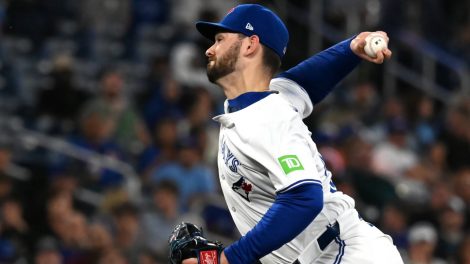
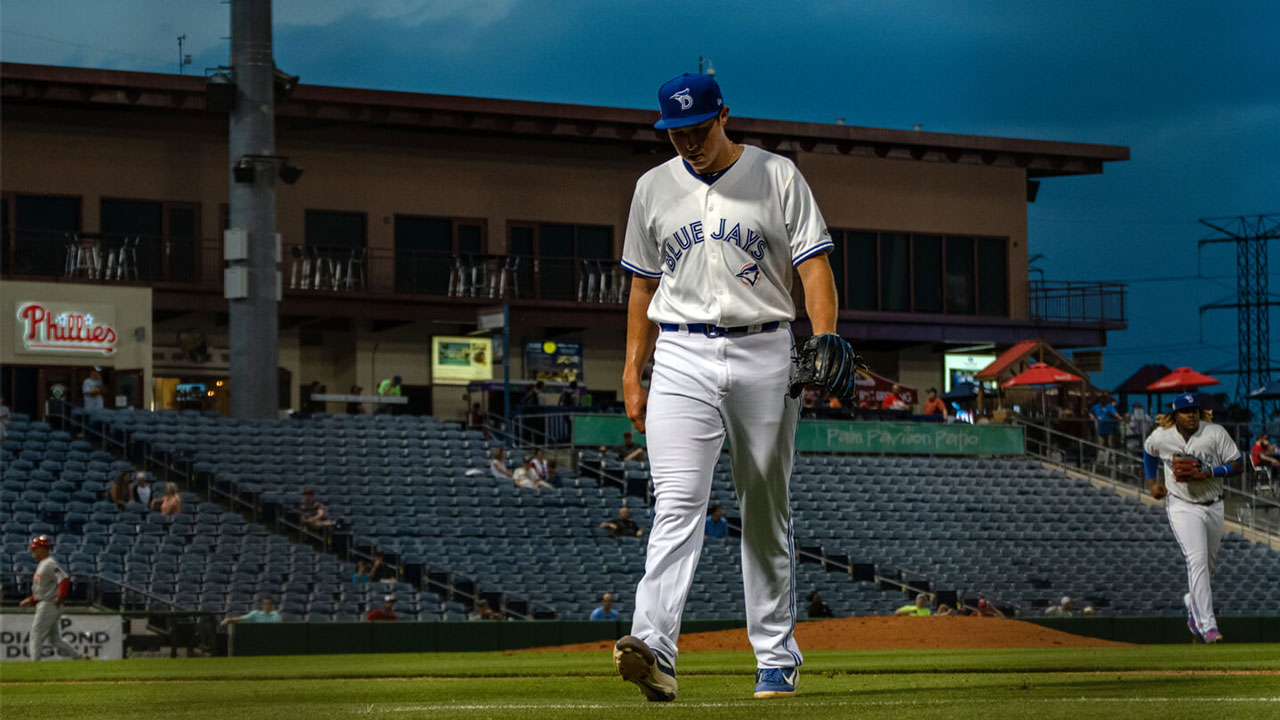
P Nate Pearson, Blue Jays
Pearson’s readiness is a hotly debated issue after an impressive 2019 season in which he surged through three minor-league levels. Pitching in big-league camp this spring, he posted a 1.29 ERA in four brief outings along with 11 strikeouts in seven innings.
Under normal circumstances, Pearson would’ve started the year in triple-A Buffalo and awaited a promotion from there. The Blue Jays have preached a focus on his development, but alongside those questions, service time can be another noteworthy factor for top prospects.
With that said, the 23-year-old Pearson has only made three starts at triple-A. Gaining more experience at that level would have advantages — though obviously he can’t do that right now.
What he can do in the meantime is continue honing his curveball, a tool dependent on subject more than situation. As Toronto Blue Jays general manager Ross Atkins alluded to last month, some adjustments are in fact easier to make in the off-season.
“This, for some players, will create extended opportunities and windows to really lock in an adjustment that they were working on,” Atkins told reporters. “And maybe not be as focused on trying to make the major-league roster, or not as focused on impressing our major-league coaching staff or front office.”
SS Wander Franco, Rays
The consensus top prospect in baseball is Franco, a 19-year-old who has slashed .336/.405/.523 in two seasons in the low minors.
He leads the Rays’ loaded farm system, which was ranked No. 1 by MLB.com last month, and could be ready to make his mark at the top level soon.
In February, Rays GM Erik Neander told reporters it’s “conceivable” that Franco could be a late-season addition for the team in 2020.
The problem for Franco is that his natural position, shortstop, is already filled by a very capable 24-year-old, Willy Adames (4.2 bWAR in 2019). Thus, it would make sense for the Rays to test Franco elsewhere on the diamond — but they can’t do that when no baseball is being played.
C Adley Rutschman, Orioles
For a floundering franchise like the Orioles, Rutschman provides hope.
Rutschman, the No. 1 pick in the 2019 draft, is expected to be a cornerstone of Baltimore’s future — which they certainly hope is better than their recent past, after losing an MLB-worst 223 games over the past two seasons.
As a college draftee, the 22-year-old Rutschman is on a fast track to the majors. He leapt through three minor league levels in 2019, recording a respectable .774 OPS along the way.
But age isn’t everything. His projected MLB arrival is 2021 because he needs more reps as a pro. This stoppage impacts that progression and, depending how long it goes, could mean 2022 becomes a more likely arrival date.
INF Carter Kieboom, Nationals
With Anthony Rendon out of the picture, Kieboom entered 2020 looking to become Washington’s everyday third baseman. He was also looking for some serious redemption.
Last season, Kieboom’s MLB call-up was a disaster. In 11 games, he went 5-for-39 (.128) and struck out 16 times.
“I understand that everything is amplified because it’s the big leagues,” Kieboom, 22, told the Washington Post’s Jesse Dougherty in February. “Everything should be amplified. But it did not show who I am as a baseball player, and I know that.”
In order to show who he is as a player, Kieboom needs to be able to play. His spring performance offered promise, with a .395 OBP, but now he’s unable to carry that right into a season.
OF Luis Robert, White Sox
Robert, already dubbed “the next Mike Trout” by teammate Eloy Jimenez, is the most MLB-ready prospect in baseball. The White Sox appear to think so too, which explains why they signed him to a six-year, $50 million contract this winter.
With that contract, Robert became a virtual lock to debut on opening day. And the 22-year-old has earned that, given his 1.001 OPS and 32 home runs across three minor league levels in 2019.
The White Sox are ready for Robert, and vice versa. But sadly, both parties will have to wait. Robert has proven everything he needed to at lower levels. Now his ascension to the majors is a matter of when, not if.