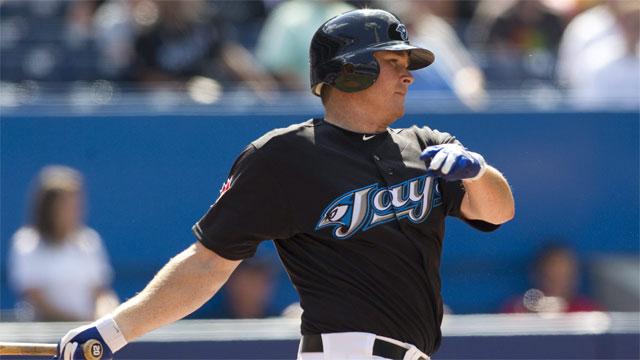

Toronto Blue Jays infielder Mark Teahen ran out to read "Moneyball" when the book first came out in 2003, and he is eager to see the movie now that it’s headed for theatres.
As a supplemental pick, 39th overall, from the 2002 Oakland Athletics draft class featured in author Michael Lewis’s polarizing work, Teahen was eager to find out what was said about him behind closed doors.
What he would have found was A’s scouting director Eric Kubota explaining that Teahen wasn’t discussed very often at draft meetings because he didn’t project well as "a corner guy who doesn’t hit a lot of home runs" although he was also described as "our kind of guy. He takes pitches."
After GM Billy Beane later says that good hitters can develop power, that pop can be acquired, Kubota adds, "I hate to say it, but if you want to talk about another Jason Giambi, this guy could be it."
Teahen recently sat down with sportsnet.ca to chat about the book and his experience as a member of the "Moneyball" draft.
sportsnet.ca: How much did you know about the book at the time and what do you remember about the experience?
Teahen: I remember thinking it was pretty cool to be able to have something following our draft class and tying us together.
My first memory was when we first got drafted, we might have been told about it, but then at our first instructs (instructional league camp) Michael Lewis came around and his wife Tabitha took some pictures of us. I then realized what it was going to be or whatever and obviously once the book came out I read it right away so I would know what people were saying about me and my draft class.
sportsnet.ca: When you read the part with the discussion about you and the comparison to Jason Giambi in the draft room, what was your reaction?
Teahen: I read enough Baseball America to know they always throw out a random comparison of what a guy potentially could be, it didn’t scare me that much, I was like, ‘Heck, I’d love to be putting up numbers like Giambi does one day.’
But at the same time I didn’t put it on me like, ‘Oh, I’ve got to be Giambi to have a good career.’
I definitely haven’t become a Jason Giambi, but I’m comfortable with how my career has gone to this point. Hopefully I’ve got a few more good years left in me. It was interesting for me to read what was said about me in the draft room and it was insight that nobody really gets unless you get a chance to be in a book like that.
sportsnet.ca: You ended up getting traded to Kansas City as part of the Carlos Beltran deal. Did you find the Giambi comparison followed you to the Royals, and raised some of the expectations upon you there?
Teahen: Not really. I think nowadays with so much coverage of the minor leagues, there are a lot of big hopes and big expectations put on young guys coming into the league before there should be.
I know Kansas City is always waiting for that next George Brett or whatever, so I don’t think the Giambi thing ever put any more pressure on me. I know I never looked at it because yes, it’s in a best-selling book, but every guy that gets drafted gets projected to be some type of superstar.
sportsnet.ca: The book portrays the A’s scouting players based on their numbers and not doing the more traditional legwork. Was there a scout that followed you through your draft year that was in touch with you often, or was the process much different than that of other teams?
Teahen: It was the same routine. You have the area scout that you meet, and he might introduce you to a couple of the higher-ups or whatever, I’m sure Billy Beane came and watched me play since I was right around the corner from them. I think the book separated it a little more because it was trying to push the whole new idea and how different it was and maybe didn’t paint a completely accurate picture.
I know they still used their scouts a ton, they just maybe put a little more emphasis on computer stats than other teams were at that point.
It didn’t seem like it was something completely different, but I do see the point that was trying to be made.
sportsnet.ca: Was the whole, for lack of a better term, Moneyball philosophy very foreign to you at the time, and when you read the book, did that strike you?
Teahen: I thought it was interesting, I think it’s always interesting to have an idea that maybe everybody hasn’t adopted quite yet. In the end, you look around and plenty of teams have adopted that philosophy, maybe not just valuing on-base percentage, but trying to find a value that’s undervalued across the board.
But they definitely did stress the walks and being selectively aggressive. It was part of my game all along and I didn’t realize it would help me get drafted higher by an organization like the A’s.
sportsnet.ca: Once the book came out, did you feel a sense that people were watching you and your draft class more closely than they would have otherwise?
Teahen: A little bit. You felt it a couple of times through where I think Billy Beane and the A’s really wanted that group to succeed to show their ideas were working. At the same point I think there were a lot of organizations cheering against some of those guys to have success just because we were labelled the guys that were this new way of thinking even though they’d been doing it for a few years, we were just at the forefront of it.
Early on there was a little bit of that, but now it’s been so many years I think people forget who was even in the Moneyball book.
sportsnet.ca: Did some of you in the draft class end up developing a bond over the book?
Teahen: Yeah, but I haven’t been a part of any other draft class so I don’t know how tight every other draft class is. I know that our draft class was very tight, especially early on, going through all the levels together. I still keep in touch with a few of the guys and definitely pull for all of them.
But maybe it was because we were all college guys and at about the same spots in our lives.
sportsnet.ca: You’ve kept in touch with Michael Lewis over the years and there’s been talk of a follow-up book examining the careers of the players from that draft class. How would you feel about that?
Teahen: I think I’ve got a pretty good idea of where everybody’s career has been, but you miss some of the stories of how they got there, how it went along the way, so I’m interested to see a follow-up book.
Ever since I read Moneyball I’ve read everything else Michael Lewis has written because I really enjoy his writing. I’m sure I’ll enjoy it even more when it’s about me. And just like with the draft stuff, it will be cool to have a take on my career and how things went. Hopefully it looks good on paper.