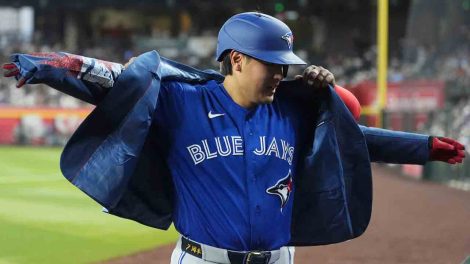
Halfway through a season that began surprisingly well, the Toronto Blue Jays are already coming to terms with a disappointing reality.
At 38-43, they’re not going to contend for the playoffs, as they had initially hoped. Instead, they’ll continue making trades to augment future editions of the Blue Jays, a process that began Thursday night with the trade of Steve Pearce to the rival Red Sox.
So why, exactly, are the Blue Jays struggling? In brief, their stars haven’t been on the field and the rotation has struggled despite entering the season as a perceived strength. But there’s more to it than that, so let’s take a closer look at the Blue Jays 81 games into their 162-game schedule.
OFFENSIVE IMPROVEMENT
Last off-season, the Blue Jays faced the challenge of improving the offence that ranked last in the American League in runs scored. They ranked 26th among the 30 teams with just 4.28 runs per game a year ago, when they were toward the bottom of the league in both on-base percentage and slugging.
Now, the Blue Jays are a slightly above-average offence thanks in part to newcomers Curtis Granderson and Yangervis Solarte plus Teoscar Hernandez, who didn’t make his Blue Jays debut until last September. They’re still not great at reaching base, with just a .311 OBP, but just eight teams have a better slugging percentage than Toronto’s .420.
All things considered, the Blue Jays rank 13th in on-base plus slugging (.731), 13th in weighted on-base average (.316) and 13th in runs per game (4.46).
WORSE RUN PREVENTION
The Blue Jays allowed 4.84 runs per game in 2017, but run prevention was expected to be a team strength this season thanks to the return of Aaron Sanchez and the addition of Jaime Garcia. Well, it hasn’t worked out that way, as the Blue Jays are now allowing 4.85 runs per game.
The bullpen includes some good stories, including low-risk signings Tyler Clippard, Seung-hwan Oh and John Axford, and yet Toronto’s relievers rank 20th in baseball with a 4.15 ERA. Of course, that’s still much better than the rotation, which ranks 25th in baseball with a 4.83 ERA.
As for the team’s defence, it’s not exactly helping. The Blue Jays rank 27th among the 30 teams at converting batted balls into outs, and they’ve allowed more stolen bases than any other team.
[sidebar]
STAR POWER SIDELINED
One reason for the Blue Jays’ disappointing start? Their best player, starter and reliever have all missed considerable time. Josh Donaldson has appeared in 32 games to this point, while Marcus Stroman has started nine and Roberto Osuna appeared in just 15 before being charged with assault and suspended.
All told, 13 Blue Jays have spent time on the disabled list, including Sanchez, Troy Tulowitzki and Randal Grichuk.
DOUBLE THE FUN
If Solarte replicates his first half numbers, he’ll end the season with 30 homers and a .759 OPS. Hernandez already has 13 homers and could challenge 30 as well considering he began the season in the minor-leagues.
On the pitching side, J.A. Happ would finish with 20 wins, 4.0 wins above replacement and 212 strikeouts in 194 innings if he replicates his first half. The Blue Jays probably won’t be the ones benefitting from that production, though, as Happ appears to be the team’s top trade chip.
Beyond that, the Blue Jays haven’t had many standout individual seasons. At this rate, they would have just three players reach the 20-homer threshold: Solarte, Hernandez and Justin Smoak.
As for the team as a whole, the Blue Jays are on a pace to finish 76-86 – the exact same record they had in 2017.
[relatedlinks]