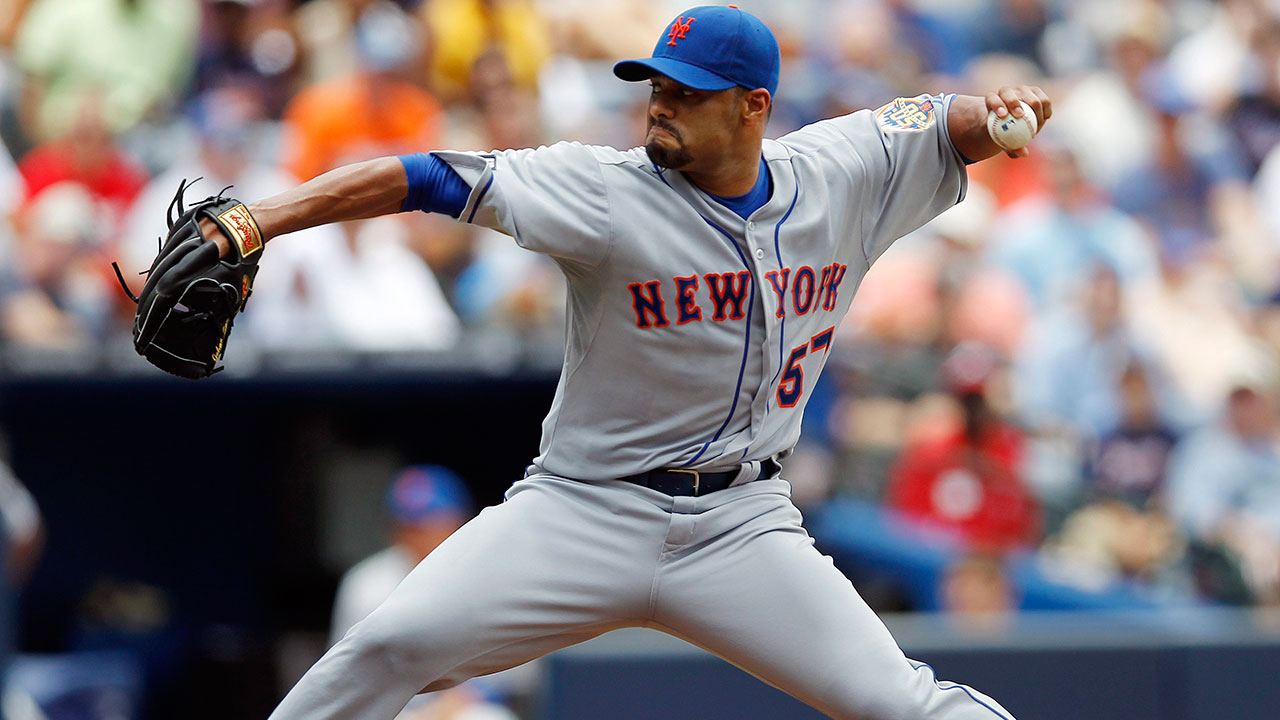

Hammering the Toronto Blue Jays medical staff is something of a cottage industry, but the agent for Johan Santana confirmed that the team’s record of patience with shoulder injuries made them an easy choice for the free agent.
“Definitely,” said Peter Greenberg, noting an affinity for the Blue Jays organization on the part of The Legacy Agency — formed when Greenberg, his brother Ed and Chris Leible had their Latin American-oriented firm purchased by The Legacy Agency, which included agents Greg Genske, Brian Peters and Scott Parker. The agency also represents Jose Reyes, Maicer Izturis, Ezequiel Carrera, Marcus Stroman and Aaron Sanchez. Greenberg is representative of former Blue Jays outfielder Melky Cabrera, as well.
In particular, the Blue Jays’ patience with Casey Janssen and Dustin McGowan was a selling point for the 35-year-old Santana, who hasn’t pitched since 2012. Santana is not a jury-rigged bullpen candidate; if healthy, general manager Alex Anthopoulos said Santana’s future with the organization will be decided on his ability to start.
What is clear is that for this to work, Santana and the Blue Jays will have to come up with a program and need to see some type of return by Santana’s opt-out date of April 28 — although both sides stressed after his signing that they were amenable to a more flexible time frame.
Santana’s bread and butter is his change-up, and to be effective it needs to sit 10-12 miles per hour slower than his fastball. One major league executive said his team’s major concern about Santana was what they perceived to be an inability to retain fastball velocity, which took away much of the “cover” for his change-up. Santana’s fastball hit 88 miles per hour regularly in 2012.
“We’re not going to be stuck on velocity,” Anthopoulos said. “The key for Johan will be health and command of his pitches.”
In the meantime, Santana remains an interesting sub-plot to a team that has remarkably few pitching questions — so much so that manager John Gibbons said one of the reasons it would be hard to schedule “B” games was “we don’t have a lot of pitchers in camp.”
That’s one reason Santana will get all the time he needs.
JUAN GONE? PITY.
Do this job long enough and you collect lessons as well as people. If you don’t, you aren’t trying, and you’re missing what makes this game so special.
I was reminded of this when Juan Pierre announced his retirement last week after 14 major league seasons with six different organizations. Pierre appeared in 1,994 games with 614 stolen bases and 18 — count ‘em — home runs. In his 2000 rookie season, I found myself in the middle of the Colorado Rockies clubhouse at Olympic Stadium wanting to interview him for one reason or another.
Pierre was from Alexandria, La., but for some reason (OK, because of his first name) I thought he was from the Dominican Republic.
“I don’t even know if the guy speaks English,” I said to one of the Rockies reporters. Tap on shoulder … Pierre was right behind me. “I’m from Louisiana … but if you want, I’ll try to speak English.”
Merde.
Pierre laughed. So did a group of his teammates.
“Man, y’all right,” he said. “Y’all right .”
Then we just kind of talked for, I don’t know, 20 minutes or so. I’ve always remembered that incident, and how he disarmed a moment of profound embarrassment for a guy he didn’t know and, for all he knew, would never see again.
When I was covering the 2003 Florida Marlins World Series — a series in which he hit .333 — Pierre came up to me and said, “Good news: my English has improved!”
Jean D’Vaughn Pierre’s ratio of one homer per 450 plate appearances is the fourth-lowest in major league history, and when he announced his retirement on Twitter he said:
Give him a follow on Twitter at @JPBeastmode and read some of the responses from fans and teammates such as Jacque Jones.
He will be missed. Hell of a career, hell of a man.
QUIBBLES AND BITS
- The Blue Jays, who had a majors-worst 33 percent success rate on challenges last season, will have a new set of eyes monitoring the clubhouse video replay machine this season. Former major leaguer Sal Butera, who handled that job in 2014, will return to professional scouting with the organization. Ryan Mittleman, who was the Blue Jays major-league advance scouting coordinator, will replace him.
- Part of the reason the Blue Jays have found themselves turned into an all-comers camp at first and second base has been the lack of minor-league prospects in the middle of the infield. Candidly, Jays people will tell you there isn’t one infield prospect in the organization with an above-average chance of making the majors.
Franklin Barreto, considered their best-hitting infield prospect, was traded to the Oakland Athletics in the Josh Donaldson deal, although the organization had real concerns about his ability to be a middle infielder. Privately, they’ll tell you that Barreto was kept at second base to build up value — that he was viewed for last year as a potential trade chip.
- Kudos to the NBA for its decision to make public the league’s evaluation of officiating decisions in the final two minutes of close games. Each play down the stretch of those games will be reviewed a senior referee manager and calls will be identified as “correct” or “incorrect.”
No other sport makes as many calls based on a players reputation — or, at least, that’s the NBA’s reputation even though you could get an argument from batters who swear some pitchers get an extra inch or two and pitchers who believe vice-versa. The next step is to have every sport make match officials available post-game.
THE END GAME
It’s nice that we all spent so much time celebrating the salary-cap loosening departure of David Clarkson, but it’s time now to consider what it means that a local guy who chose to play for his childhood team was essentially run out of town.
How the hell did this go so wrong? How did a kid from Mimico — the quintessential “good Mimico boy” — end up so unhappy playing for his hometown team? Isn’t It Don Cherry who keeps telling us that the Toronto Maple Leafs need to load up on local boys like Clarkson; guys who bleed blue and white and preferably have shed blood in junior hockey?
So, maybe we need to have a discussion about this city’s free-agent issue. You cannot build a team through free agency in a salary cap league, but proper use of that avenue — even adding a player on the cusp of free agency, the way the New York Islanders did with Nick Leddy and Johnny Boychuck — is a necessity for a successful franchise. And know this about professional athletes: they talk, especially when they’re represented by the same agent.
You know what? In that regard, last Thursday was a lousy day for your team, Toronto. It was also a lousy day for your city as a destination.