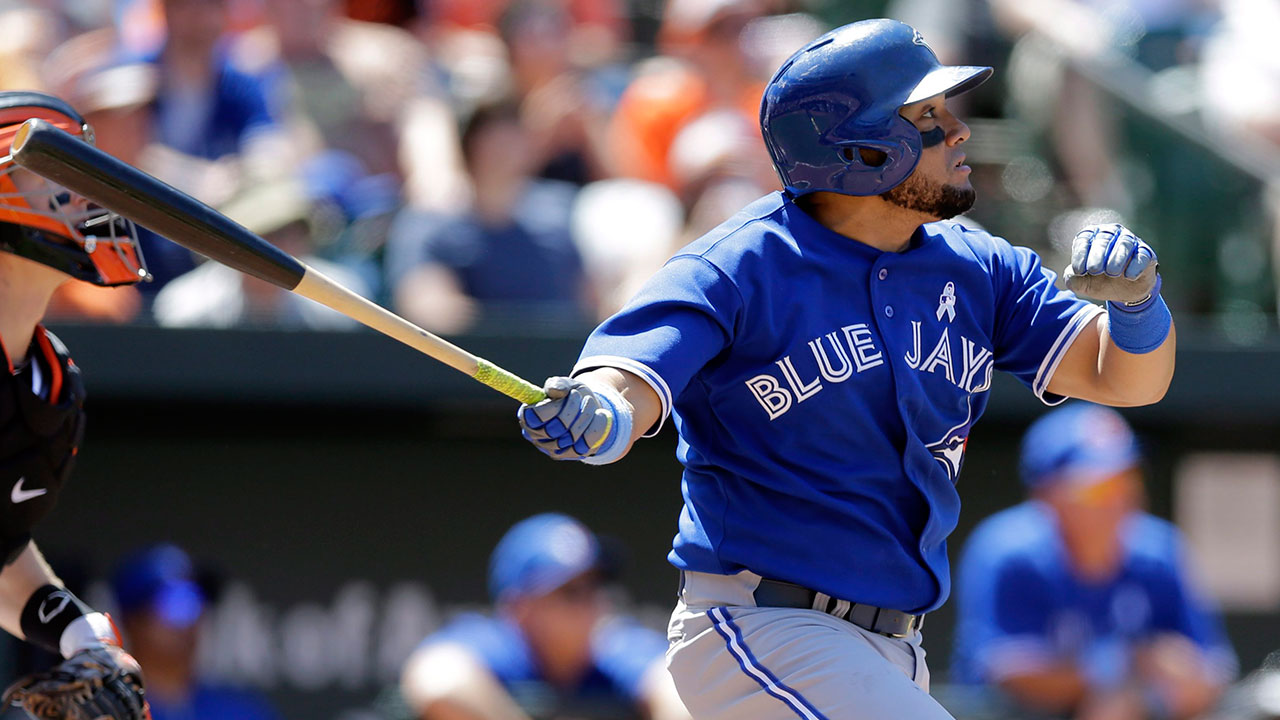

Unless the Toronto Blue Jays persuade Melky Cabrera to sign an extension in the remaining weeks before he hits free agency, the next step for the team will be deciding whether to make him a qualifying offer.
It’s shaping up to be an easy call.
In the two-year history of the qualifying offer, all 22 of the players to receive the offer have declined it. It’s tough to imagine that Cabrera, whose season ended with a fractured finger Friday, would be the one to break that trend.
After a tremendous season in which he batted .301 with 16 home runs, an .808 OPS and 2.5 wins above replacement, he ranks among the most accomplished free agents of the off-season. Along with fellow Biogenesis alum Nelson Cruz, he’ll be one of the top outfielders available.
When players hit free agency in their prime, they tend to think big. Scott Boras – not Cabrera’s representative, but baseball’s most prominent player rep – argued last off-season that the one-year offer worth $15 million or so is ‘really not an option’ for top free agents.
“A qualifying offer is not something that a premium free agent ever looks at accepting,” Boras said on Sportsnet 590 The Fan at the time. “I don’t see any player unless he’s maybe well on in years, well past the age of 35, accepting a qualifying offer.”
Cabrera, who turned 30 last month, would presumably decline a qualifying offer from Toronto in search of a multi-year contract. Perhaps that would lead to a long-term deal with the Blue Jays, Cabrera’s preferred team. If not, Toronto would at least obtain an additional 2015 draft pick and the accompanying draft budget increase. That has significant value for any club.
For context, outfielders who declined qualifying offers in recent years include Carlos Beltran (he eventually obtained $45 million, three years), Curtis Granderson ($60 million, four years) and Nick Swisher ($56 million, four years). Hunter Pence ($90 million, five years) and Rusney Castillo ($72.5 million, seven years) weren’t tied to draft pick compensation, which no doubt helped them secure even more lucrative deals.
In essence, Cabrera has put himself in the same conversation as some players who cashed in. And, as Jeff Blair wrote Monday, he fits on Toronto’s roster.
While no player has accepted a qualifying offer yet, that could change this winter given the unpleasantness that followed Stephen Drew and Kendrys Morales last off-season. They settled for modest one-year deals after declining qualifying offers, which might prompt agents to push for caution in some cases.
Still, it’s hard to imagine Cabrera getting frozen out in that way given that he’s a non-designated hitter coming off of a big offensive year. On the off chance he accepts a qualifying offer, the Blue Jays would get a productive player at a below-market rate for a position of need. Nothing wrong with that.
All things considered, there are plenty of reasons for the Blue Jays to make Cabrera the first qualifying offer in franchise history and there’s no compelling reason to withhold one. The challenge is figuring out how aggressively to bid if and when Cabrera declines the offer in search of a bigger payday.