
TORONTO – Major League Baseball and its umpires were working toward the introduction of in-stadium replay announcements as soon as this season, although the COVID-19 shutdown may end up pushing back the debut.
As part of the new collective bargaining agreement between the sides ratified in January, crew chiefs can be tasked with explaining replay rulings to fans the way referees in the NHL and NFL currently do, provided that everyone is comfortable with the new system.
To that end, crew chiefs had been undergoing training during the spring to become familiar with the process, the ultimate goal being more transparent and improving the fan experience. MLB was doing its part by preparing the necessary technology and broadcast elements for a 2020 launch.
Given the current uncertainty around if, when and where a season might take place, it’s unclear right now if the announcements can still begin this year.
There’s technological infrastructure in-place at all 30 big-league parks, but if games are played exclusively at spring venues or other neutral sites, there may not be enough time to deal with all the other logistical concerns plus new elements, too.
Word of the plan was first revealed by retired umpire Dale Scott during Sportsnet’s Blue Jays Rewind Watch Party on Friday.
“The new contract with the umpires this year, the crew chiefs will be explaining all replays just like the NFL, just like the NBA,” Scott continued. “It’s happening. In fact, the only reason it hasn’t happened yet is because of this virus.”
One common complaint about baseball’s replay system is that the decision-making process is opaque, particularly for fans in the stands. While they see replays on the board, there’s no explanation of why a call may stand or be overturned, which on close ones can leave them – and players – wondering why things happened.
The plan MLB had been working toward would have left the replay process largely as is – the crew chief and umpire who had made the call under review would go to headsets by one of the dugouts to take part in the deliberations at the replay centre in New York, with the decision made there.
At that point, the crew chief would go to a broadcast spot, turn on a microphone and make an announcement like this one, for example: “Upon further review, the runner’s foot did not touch the bag before the tag was applied, the call on the field is overturned, the runner is out.”
In certain cases, when an obscure rule is involved, the crew chief could also explain the reasoning behind a decision.
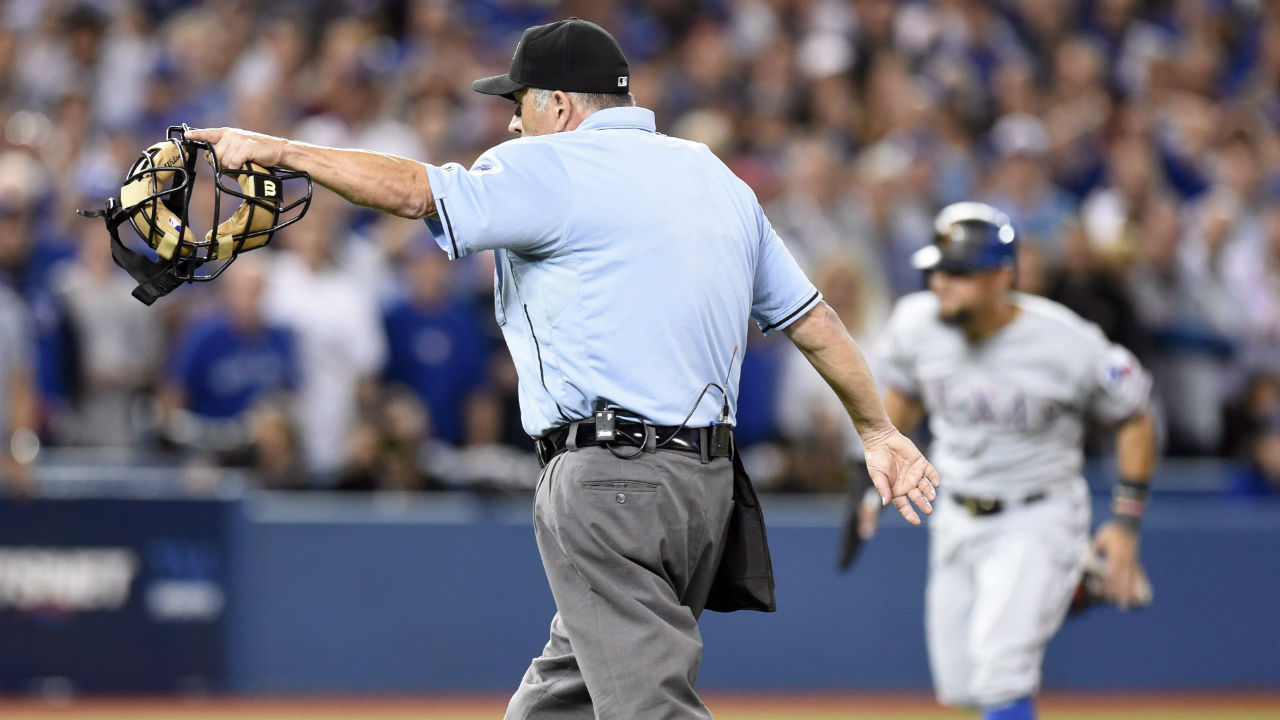
To use the controversial Blue Jays-Rangers Game 5 as an example, Scott could have explained why in the top of the seventh the ball was alive when Russell Martin’s throw back to the pitcher hit Shin-Soo Choo’s bat and allowed Rougned Odor to score the go-ahead run, citing the relevant rule: “If the batter interferes with the catcher’s throw to retire a runner by stepping out of the batter’s box, interference shall be called on the batter under Official Baseball Rule 6.03(a)(3) (former OBR 6.06(c)). However, if the batter is standing in the batter’s box and he or his bat is stuck by the catcher’s throw back to the pitcher (or throw in attempting to retire a runner) and, in the umpire’s judgment, there is no intent on the part of the batter to interfere with the throw, the ball is alive and in play.”
Whether it would have kept fans from chucking debris on the field is another matter, but at least people in the stadium would have understood that the correct call was made, as unpalatable as it might have been to the masses.
Implementing in-stadium announcements might have happened sooner, but it needed to be negotiated between baseball and umpires, which didn’t take place until the previous CBA expired.
[relatedlinks]