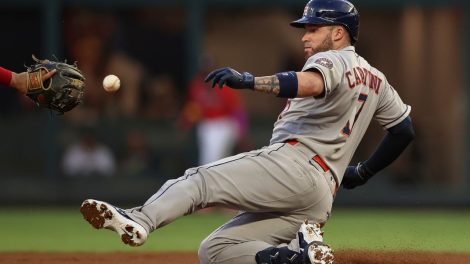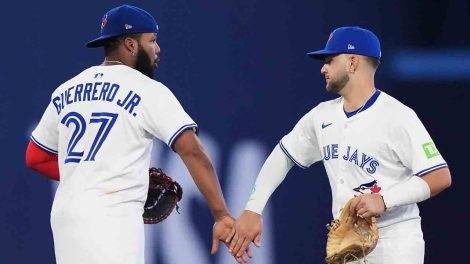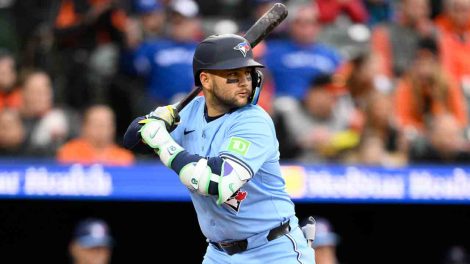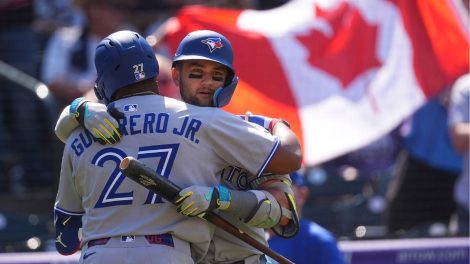

TORONTO – In the lead-up to the 2006 international signing period, Freddy Galvis attended a tryout at the Philadelphia Phillies’ academy in Venezuela. A slight yet slick shortstop at the time, he had long been on the radar of scouts Sal Agostinelli and Jesus Mendez, who kept tabs on him from the time he was 13 years old. Once July 2 arrived that year, the Phillies offered Galvis a contract, he accepted and started down the path to a very solid big-league career.
"When my time came to sign, I had a lot of opportunities and a ton of different scouts and bosses were going to Venezuela, they used to watch a lot of players," says the native of Punto Fijo who now plays for the Toronto Blue Jays. "Now, we don’t have the same window like we used to have a lot of years ago, where a lot of players can sign. With the situation in Venezuela, not a lot of people want to go there. There’s less opportunities for players there to sign."
On Tuesday, as this year’s signing period opens, Galvis will be thinking of the young players back home and how they’ve been impacted by the country’s ongoing political and economic crisis — exacerbated in recent months by the power struggle between President Nicolas Maduro and American-backed opposition leader Juan Guaido.
While a handful of 16-year-olds will be signed to lucrative bonuses by big-league clubs – the Blue Jays landed six players, headlined by outfielder Robert Robertis who signed for $750,000 – many will be left behind, unable to either get a coveted look that can change their lives, or even take a decent shot at it because they lack basic necessities like food and water.
People can’t be aspirational when mere survival is a struggle.
"It’s really bad for the young kids who want to make their dream come true, know what I mean?" says Galvis. "A lot of those kids love baseball but they don’t have anything to survive. They don’t have food, they don’t have electricity, they don’t have water, they don’t have money to buy spikes, money to buy gloves. Even the coaches. They like to coach, they like to teach but there are no opportunities to do that. No opportunities at all. They don’t have food. They don’t have money. They have nothing. So you’re killing a lot of people’s dreams."
[relatedlinks]
Baseball has long been a unifying force in Venezuela, a national passion played and obsessed over by young and old alike. And while the country certainly has far more significant and important concerns, a potential interruption of one of Major League Baseball’s most important supply lines — with 68 of the 882 players on opening day rosters, the country ranked second among players born outside the United States this year — is amongst the fallout.
That there are signings at all this year is in some ways remarkable. Venezuela has been in crisis mode for several years amid relentless political turmoil and debilitating hyperinflation that has led to a scarcity of food and basic goods, but a power crisis earlier in the spring impacting every facet of daily life led the Blue Jays to pull out their six local scouts and their immediate families.
The group was brought to Dunedin, Fla., in the spring, was later moved to the Dominican Republic and eventually, all but one returned home when things had somewhat stabilized. Still, the chaos created a lot of concern for the well-being of a tight-knit team, and for the families of players in North America, leading to an organization-wide fundraising campaign to try and help.
"At the beginning, there was literally no power for days (in Venezuela), then it would come on for an hour," says Andrew Tinnish, vice-president, international scouting for the Blue Jays. "We had no communication with one of our guys for a few days. It was pretty scary. There was one airline that was flying, Caracas was completely shut down, Valencia had a couple flights that were still running (which the Blue Jays used to get people out). And it’s a big country — they don’t all live in Valencia so how do you get there? You can’t just go to the gas station and get gas, right?
"Our guys there are really smart, they’re really hard working and resilient. And they’re like a family."
For example, last fall Jose Contreras, the club’s scouting supervisor in Venezuela, and scouts Franklin Briceno, Oscar Delgado, Miguel Leal, Alirio Ledezma and Francisco Plasencia set up a showcase in Maracay. A couple of the scouts brought their wives and kids along and after one day of work, Tinnish asked what they were going to do for dinner. They told him all was taken care of back at the hotel.
"Two of the wives made this huge homemade meal," says Tinnish. "The hotel let them go into the kitchen and cook it up. It was one of the best meals I’ve ever had but that’s one of the ways in which they look out for each other. It’s a really good group. You’d be worried about anybody (amid the turmoil), but it was tough."
[snippet id=4545751]
Their return home was staggered, and even now some areas are more stable than others. When the scouts returned, they brought back loads of goods and got to work unearthing players to sign, their work all the more essential now that big-league clubs have pulled their academies from the country.
Teams could once invite players to their complexes to watch them work out, the way the Phillies did with Galvis, but now scouts go to private academies, which have varying resource levels as they help train kids.
"Players who are part of bigger, more established academies are probably in a better position than most," says Tinnish. "You’re in an environment where your buscone (a trainer who also acts as an agent) is paid commission in U.S. dollars, and is probably in a better position to access food and water than most people. It’s not great by any means, but it’s still better than in March or April."
One of many fears is that the late-blooming talent, the kids who need a bit more time to develop physically, will get lost in the shuffle, as the private academies, seeking to manage costs, will lock in only on the players most likely to generate a return.
Families may try to take matters into their own hands because a baseball career offers such a transformational lifeline, but that’s becoming increasingly harder to do given the current circumstances.
"Right now, (the players who sign) are the biggest winners in Venezuela," says Galvis. "If you go to high school, if you go to college, after that what are you going to do? There’s nothing to do.
"If you sign, you can get some money and help your family."
Galvis didn’t return home this past winter but in previous years, he’d work with local kids and invite people in the neighbourhood to use a batting cage at his house. He says he and other Venezuelan players regularly get messages via text, Instagram and Twitter from kids, parents and coaches asking for assistance.
"It’s hard to help the whole country," he says. "We try to help them whenever we can but it’s not enough."
[snippet id=3305549]
The repercussions of the ongoing crisis from a baseball perspective may not be fully felt for another 5-10 years, especially if things don’t turn for the better relatively soon. As Galvis puts it, "if you want to go to practice you have to eat something. If they can’t have that, you’re killing their dreams bit by bit."
For now, though, the level of talent remains high and the Venezuelan brand of baseball still features smart, athletic players who show an advanced understanding of the game for their age.
And despite the myriad of challenges, the Blue Jays will continue to make scouting there "a high priority," says Tinnish.
"I’d be surprised and disappointed and sad if it got to the point that it wasn’t that No. 2 or close to No. 1 even country in Latin America when it comes to baseball talent," he continues. "Our goals and our focus remains the same. First and foremost, we want to make sure our staff and our players are safe, but beyond that, it’s continuing to look for and procure talent there because it’s definitely still there.
"Obviously the country is facing more challenges than it has. You hope that things will stabilize and get back to the way it should be."