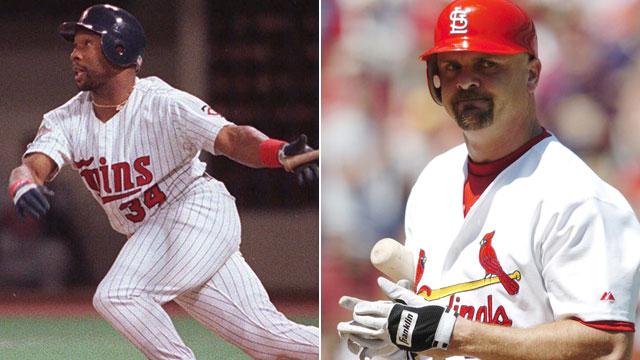

Who didn’t love watching Kirby Puckett play baseball?
How could you not love the way the ball would rocket off his bat as if it had been fired out of a gun.
How could you not enjoy seeing his 5′ 8″, 180-pound frame seemingly defy the laws of physics as he raced around the bases or patrolled centre field for the Minnesota Twins.
And who could argue that his gravity-defying catch in Game 6 of the 1991 World Series and subsequent walkoff homer to force Game 7 the next night, was anything but the stuff of pure legend.
Sadly, Puckett’s 12-year career ended abruptly in 1996 due to glaucoma and he later died in 2006 following a stroke, leaving him with a career batting average of .319 and 2,304 hits. But despite his hits total falling well short of the traditional bench mark for a Hall of Famer, the Baseball Writers’ Association of America (BBWA) cut him some slack and sent him there anwyay, on his first attempt no less, in 2001.
In Puckett’s case the voters decided to not only take into account his career totals, but also his decade of sustained excellence. Few argued with the decision or the logic behind it at the time, which is why Larry Walker deserves similar consideration.
If Hall of Fame voters were willing to judge Puckett based on a 12-year window, they should also take a closer look at the dozen year period in Walker’s career beginning in 1993.
And after taking a look at the numbers, not only does the Maple Ridge B.C. native stack up with Puckett, but an argument could be made that he was in fact the better player.
Consider:
In 7,831 career plate appearances Puckett posted a slash line of .318/.360/.477./837 with 207 home runs and 134 steals.
In 8,030 career plate appearances-or a what amounts to a just a third of a season more-Walker posted a career slash line of .313/.400/.565/.965 with 383 home runs and 230 steals.
Puckett won one batting title (1989). Walker won three (1998, ’99, ’01).
Puckett won six Gold Gloves. Walker took home seven.
And just to get extra geeky about it-and with the help from our pals at fangraphs.com–let’s take a look at how the two stacked up against their peers, Puckett over his entire career and Walker during the 12-season stretch beginning in 1993.
Walker’s total WAR (wins above replacement) of 57.7 over that period was seventh best in MLB, trailing with only Barry Bonds (110.8), Jeff Bagwell (74.6), Alex Rodriguez (70.7), Mike Piazza (63.4), Sammy Sosa (62.9) and Ken Griffey (61.0).
Puckett’s total WAR of 49.4 from 1984 through 1995 placed him 10th.
And as you may have gathered from their career slash lines above, perhaps the biggest disparity between the two was how often they reached base.
Walker’s .417 on-base percentage from ’93-’04 was the sixth best in baseball, trailing only Barry Bonds (.479), Todd Helton (.432), Mark McGwire (.430), Edgar Martinez (.425), and Frank Thomas (.424).
Meanwhile Puckett’s .360 career OBP was bested by 88 of his peers.
And finally, and because I know many of you have been waiting for for the Coors Field factor to be addressed, here are their career splits, home and away:
Walker:
Home: .348/.431/.637/.1.068
Away: .278/.370/.495/.865
Puckett:
Home: .344/.388/.521/.909
Away: .291/.331/.430/.761
No doubt about it: Walker was clearly a vastly superior player when playing in the high-altitude, but it’s also true that Puckett performed much better at home when surrounded by plexiglass and garbage bags. And for what it’s worth, Walker was a better player on the road than Puckett was at home.
Of course, Puckett’s resume also includes two World Series rings and that certainly carries some weight with voters despite how ridiculous it is to factor in the strength of a player’s teammates when evaluating them for an individual honour.
That and my suspicion that some voters still appear to be too preoccupied with the steroid debate to take long, hard looks at legitimate-albeit low-profile-candidates such as Walker, makes you wonder if the 1997 NL MVP will ever get his proper due.
Maybe what Walker needs is own Hall of Fame lobbying web site, such as the one for Tim Raines.
The former Expos star received just 24 per cent support in his first year of eligibility in 2008 but after receiving 37 per cent last year, there is a growing sense in the industry that voters are coming around on him and he’ll eventually get in, possibly as soon as Monday when the class of 2012 is revealed.
Walker received just 20.3 per cent support last year in his first crack at eligibility and should Raines get the nod on Monday, perhaps some digtially-savvy Expos fans can turn their attention towards him.