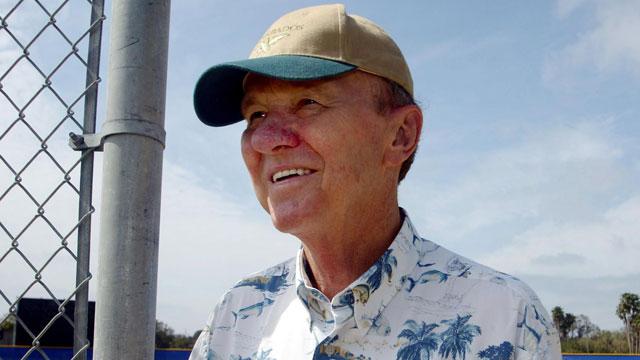

NASHVILLE, Tenn. – We did it!
After years of banging our heads against the wall, we finally broke through with Tom Cheek finally set to take his most deserving place among the all-time greats in the Broadcasters’ Wing of the National Baseball Hall of Fame and Museum in Cooperstown, New York.
The Voice of Summer across Canada from Day One in the snow, April 7th, 1977, until brain cancer stole him from us far too early in 2005 at the age of 66, Tom Cheek has won the Ford C. Frick Award for Broadcasting Excellence.
Take a bow, Blue Jays fans, because your perseverance and relentlessness made this happen. Every year, you were asked to get out and vote, and every year you did so in massive numbers, placing Tom first or second in fan voting and making sure the Frick voters were well aware of who he was, what he did and how much he meant to you, to us, to all of Canada.
Like a lot of you, I was one of those kids who went to sleep with the radio on, listening to Tom Cheek calling a game. That I got to work side-by-side with him for three years was a thrill beyond anything I could ever have imagined.
The first time I met Tom Cheek was in September of 1988. I was working for University of Toronto radio and covering a game at Exhibition Stadium when the late, great Len Bramson – one of the architects of what is now the Blue Jays Radio Network – struck up a conversation with me and wound up asking if I’d like to go into the booth and meet Tom and Jerry Howarth.
I went into the booth after the game – never in a million years thinking that I would have a seat on the broadcast years later – was introduced to them both, and could barely contain my excitement. I remember that Tom was doing the post-game wrap-up, and talking about Rob Ducey hitting into a double play (or something) and like an idiot, I tried to point something out to him from the stats pack – might have been a note about how many double plays he’d hit into for the season or something. Tom had no idea what I was trying to tell him, of course, and I had no business trying to tell him anything. Not a great first impression, but Tom was, as always, kind and generous.
I saw Tom many times over the next few years, but never really got to know him. He was a hero of mine, for one, an imposing figure (in later years, he would scare my young daughter simply with his height and big, booming voice) and one in whose realm I didn’t feel I belonged – after all, who was I? – but he always said hello and showed his playful side by nicknaming my fellow CIUT reporter, Aaron Lobel, "Dustin", thanks to his slight resemblance to Dustin Hoffman.
In 2002, everything changed. The Blue Jays’ broadcasts and with them, Tom and Jerry, returned to their proper place at what was then The Fan 590. I had been there a year as the Blue Jays beat reporter and became part of the broadcast, hosting the pre- and post-game shows.
Opening Day was at Fenway Park that year and I joined Tom and Jerry in the booth for the Chris Carpenter/Pedro Martinez match-up. I imagined that I’d be sitting up top, in the second row, with then-engineer Bruce Brenner, but when I got into the broadcast booth, I saw three mics set up in the front row and was told that the middle one was for me.
About a minute before we went on the air, Tom turned to me and said: "All these microphones are on, all game long. I don’t care if you’re Sadaam Hussein, if you have something to contribute to the broadcast, go ahead and say it."
That was completely unexpected as I had thought I was there just to funnel out-of-town scores to Tom and Jerry and handle the post-game show, not actually participate in the broadcast, but it was incredible to hear. I finally worked up the nerve to say something in the ninth inning when the Red Sox brought in Ugueth Urbina to pitch. I mentioned that his middle name is Urtain, that he was the only big-leaguer in history with the initials U.U.U. and how his brothers’ initials are also U.U.U. Tom liked the insert into the broadcast and let me know, which had me smiling for days.
Later that season, Cheek would give me the most important piece of advice anyone has in this business – Be Yourself. It’s easy to lose that once you get close to the pinnacle of the profession, to try to change who you are or how you do what you do in order to impress people or to make your way up the ladder that much easier, but Tom told me squarely that there was a reason I was in that booth with them and it was because of what I’d done on the way there. That my success was based on how I went about my work both on the air and off and that any future success would be based on the same thing.
The three years I spent in the booth with Tom Cheek were absolutely incredible. When I walked in before the game to start prepping, he would already be there, singing. I can still hear him belting out "TRAILERS for sale or rent……" as he put his scorecard together. He had a great baritone singing voice and wasn’t shy about cutting it loose in the booth. It would have been great if he’d had the opportunity to sing the national anthem before a game, I’m sure he was too shy to ask and I honestly don’t know if he’d have accepted an invitation to do it, out of shyness and modesty.
Tom always liked the fact that I had such a good grasp of young players and prospects around the major leagues and in one of our chats during the first segment of the pre-game show, he asked me about "that young kid Jose Jimenez" in some system, either the Devil Rays or the Rockies. I paused, because I knew that the Cardinals had a pitcher with that name, but he was already in the big leagues, and I didn’t want to correct him on the air. As I was figuring out what to say, Tom started to grin like, as he would say, the cat that ate the canary, and I knew he was pulling my leg. So I said "You made that up!" and he started to laugh.
Tom worked every one of the Blue Jays’ first 4,306 regular season games as well as countless post-season, Spring Training and all-star games. He never missed a day of work and I was stunned to hear that he wouldn’t be doing the Jays’-A’s game in Oakland on June 3, 2004, but he had an awfully good reason. He wasn’t going to miss his father’s funeral.
For Tom, the streak wasn’t a big deal. He just felt as though it was his job to go to work every day, so he did.
A week after he came back from the funeral, on his 65th birthday, he was in an operating room having surgery to attempt to remove the brain tumour that would take him from us 16 months later.
I remember being in the Blue Jays’ dugout with Tom before the game on the day he was honoured – August 29, 2004. Tom Cheek Day. He was sitting down, looking out onto the field, and I was standing facing him, when I saw him start to peer up into the stands, where he saw that there was a section on the Level of Excellence that was covered. I saw the look in his eyes as he began to realize that his name was underneath that covering and the complete and utter shock and surprise that followed. He shook his head and said "No, no, no, no. You have GOT to be kidding me, you have GOT to be kidding me." He genuinely could not believe that it would occur to anyone that his name should go up there, nor did he think he was worthy of it.
I talked to him about the Hall of Fame once or twice and both times had to try to convince him that he belonged. He didn’t think so. I knew he was wrong then and now the rest of the world knows it too.
The most difficult thing I have ever had to do in my entire broadcasting career was just to throw to a break after Tom spoke on the field that day. We all had tears in our eyes and just to get "We’ll be right back" out without breaking down took a ton of effort.
Tom and Jerry were late getting back up to the booth after the ceremony, having been stopped every step of their way back by well-wishers, and the game started with no one in the booth but me and Brenner, so I got to do some play-by-play. I tried to give Tom the microphone when he arrived in the booth, in the middle of the top of the first, but he wouldn’t take it. I tried to give it to him again for the bottom of the first, but again, he insisted that I continue to do the game, and as a result, I got to call a major-league home run for the first time when Reed Johnson took Mike Mussina deep.
The last time Tom Cheek called a baseball game was Opening Day, 2005 at Tropicana Field. The hope had been that Tom would at least be able to call some home games that season, but the disease had taken too much from him and he had to concentrate all his efforts on the battle. He lived in Oldsmar, Florida just outside Tampa, and visited the booth as the Blue Jays opened up against the Devil Rays.
The Blue Jays had gone nine up, nine down to start the game against Dewon Brazelton, and Jerry asked Tom if he would take the microphone and call some play-by-play in the fourth inning. Tom did, and as soon as he took over, the Blue Jays woke up – Frank Catalanotto led off the fourth with a double and Orlando Hudson and Vernon Wells followed with back-to-back home runs. The Blue Jays went on to a 5-2 win.
Tom passed away that October and on Opening Day of the next season, Bengie Molina hit a home run into the 400-level – directly over Tom Cheek’s name on the Level of Excellence.
Tom Cheek was my hero growing up and my greatest teacher and mentor. I miss him every day, as do many other Blue Jays fans. I visit his grave in Clearwater, Florida every year before the start of Spring Training and as of this summer, we’ll all be able to see him immortalized in baseball’s greatest shrine.
I know he would be in stunned disbelief at his election to the Broadcasters’ Wing of the Hall of Fame, even though we all know how deserving he is, just as I know his widow Shirley, children Tom, Jeff and Lisa, his sisters and all the grandchildren are thrilled beyond measure.
Thank you all so much for getting out the vote every year. Your massive contribution has ensured his immortality among the game’s all-time greats.