Lawrence Peter Berra, a stout 17-year-old catcher with big ears and kind eyes, played his first professional baseball game in Norfolk, Va., in the spring of 1943. He looked nothing like a ballplayer and acted nothing like one either, but he quietly went about his business and tried to keep a low profile as he made the transition from second base to catcher for the Norfolk Tars. He was a work in progress behind the plate but on some days he was downright unstoppable when standing beside it, like the day-night doubleheader when he drove in 23 runs. Berra finished the season batting .253 in just over 100 games for the New York Yankees affiliate, which was the last time he would hit below .270 for more than a decade. But it was not the last time he would see Norfolk. Soon after, he would return to learn how to fire barrages of rockets from the side of a boat. As Berra is often attributed with saying, “it was déjà vu all over again.”
Before Yogi Berra could become Yogi Berra—undoubtedly one of the best all-around catchers to ever play baseball—his Hall of Fame career was momentarily interrupted. It was 1943 and 750,000 young men and women descended on humble Norfolk to concentrate on America’s burgeoning war effort. One of those young men was Berra, who was in town just months earlier playing for the Tars in the Class B Piedmont League. He was drafted into the Army mid-season—on May 12, his 18th birthday—but received a deferment so he could finish his first year of professional baseball. The day after the season ended he reported for duty in Bainbridge, Md., where he spent six weeks in boot camp before being transferred to the navy and sent back to Norfolk to take part in the amphibious training that would eventually be put into action on D-Day in Normandy less than a year later.
Of course, Berra didn’t know that at the time. None of the troops knew the greater plans Uncle Sam had in store for them as they ran through daily training sessions and drills. Berra, like many, grew bored of the routine and jumped at the opportunity to volunteer for a new ship being tested called the Landing Craft Support Small Rocket Launcher. The opportunity to fire rockets, Berra would later admit, was far too intriguing to pass up.
With no nautical or military background, Berra was tremendously under qualified for the job; just as he was for a long career as a baseball player. Standing just five feet, seven inches, and swinging fearlessly at pitches well out of the zone, it was easy to say the shy kid from St. Louis simply was not big enough, strong enough, or disciplined enough to last. But as he did in his 19 seasons in the majors and two years in the navy, Berra had a way of making it seem like qualifications don’t really matter.
“He was a guy who was always doubted,” said David Kaplan, the director of the Yogi Berra Museum and Learning Center at Montclair State University in New Jersey. “He’s one of those guys who really makes you believe anybody can be anything they want to be if they really work hard at it.”
Berra trained vigorously on the rocket boats in Norfolk for five weeks in early 1944 before orders came down in February for the crew to set sail for the Atlantic Ocean and Operation Overlord, the code name for the Allied invasion of northern France. Berra and company were loaded onto the hulking USS Bayfield and spent the next two months off the coast of Scotland preparing. The plan was so secret that Berra wasn’t even allowed to tell his mother Paolina, to whom he wrote often, that he was about to be a part of one of the biggest military operations in history.
Then, the invasion orders came. It was the night of June 5 and just like he would years later when the pressure and anxiety of playing in the World Series spurred bouts of insomnia, Berra lay wide awake in the hull of the Bayfield unable to sleep through the nervousness coursing through his veins. Of course, Berra wanted the pressure. He could have stayed a regular seaman back in Norfolk when he was training. He could have never chased his dream of playing baseball professionally. He could have listened to the countless fans, writers and even teammates who told him he was too small to play, too ugly to be a star. He could have faced none of it and simply worked his existence away in the shoe factory that employed him when he dropped out of school as a teenager. But the pressure, the anxiety, the demand to perform—that is what he signed up for.

Pressure and heightened stakes only seemed to fuel Berra, who may be baseball’s greatest clutch hitter. During his career he made more than 1,500 plate appearances in what baseball statisticians call high leverage situations; occurrences where the chances of winning can fluctuate wildly such as having the tying or go-ahead run on base late in the game. Berra hit .312 under that pressure and struck out just 84 times.
He would also step to the plate more than 1,000 times over his career in the seventh inning or later with the Yankees tied, up by one or down by one. He hit .308 in those situations—23 points higher than his career average. Even simply putting a runner in scoring position for Berra was as sure of a bet as you can make in a game predicated on failure. When the bases were empty Berra hit just .265 but in plate appearances with men on his batting average soared to .293. “It ain’t over till it’s over,” wasn’t just something Berra said—it was something he lived.
Of course, hitting baseballs seemed easy when compared to what Berra had to do on the morning of June 6, just off the coast of northern France. What happened in those cold, dark hours would shape modern history and a sleepless Lawrence Berra had a front-row seat. In the middle of the night Berra and the rest of the six-man crew that manned the 36-foot rocket boat—a part-wood, part-steel vessel outfitted with six twin-fifty machine guns and more than 5,000 rockets—were slowly lowered into the English Channel. Swaying unsteadily in the choppy waters, still uneven from a storm that had delayed the invasion the night before, Berra’s ship inched closer and closer to the shore of Utah Beach, the westernmost flank of the Allied assault on D-Day.
The mission was to bombard the beaches and wipe out any German defences, clearing the way for the impending storm of Allied forces that would follow closely behind. Berra’s boat and dozens of others fanned out in a line and slowly crept toward the shore, firing a rocket every so often to see if they were yet in range of the beach. About 300 yards out a rocket finally hit land, and then another and another, and before he knew it, Berra was sticking his head up over the bow watching the most majestic firework display he had ever seen. He was transfixed by the strange artistry of thousands of pounds of fiery steel punishing the coastline, lighting up the frigid night air. Berra was so lost in the grim beauty of it all that he could barely hear his commander bellowing for him to get his head down if he wanted to keep it.
“He was a little in awe of everything,” Kaplan said. “He always said it reminded him of the Fourth of July.”
Berra never did reach the shore as part of the D-Day invasion, remaining on water for almost a month. It was fitting for a guy who, for all the fanfare and attention he received during and after his Hall of Fame career, was always more comfortable as an observer than a participant. He would truly prefer—as he did in his later years during his annual visits to Yankees spring training—to slink into the background and simply watch the fireworks explode around him. “You can observe a lot by watching,” he famously said.
Berra was especially shy even as a child growing up in a small Italian neighbourhood called the Hill in southwest St. Louis. It was the heart of the Great Depression and money was scarce, meaning Berra had to learn to play baseball with bottle caps and broomsticks. It also meant that Berra–an avid soccer player and boxer—was forced to drop out of school when he was just 14 to work at the Johansen Shoe Company and earn money for his parents and four siblings. Berra always contended that his three brothers were much better ballplayers than he was, especially his older brother, Tony who, at the behest of the boys’ father Pietro, forwent a promising baseball career to work as a baker. But Tony begged Pietro to let young Lawrence—known best as “Lawdies” back then—play American Legion ball, which is where he was discovered as a second baseman and pitcher when he was 15.
It was also in the Hill that Berra lost the Lawdies handle in favour of a new one that would stick for the rest of his life. There was no money for dugouts or even benches at the time, so Berra would sit on the ground in between at-bats with his legs and arms crossed, patiently waiting for his next chance to swing. Robert Hoffman—an American Legion teammate who would go on to play seven seasons as an infielder for the New York Giants—told Berra he looked like a South Asian snake practitioner like they saw in the movies: a yogi.
No one saw much of a future for Berra in baseball at the time. Sure, he could hit and had a decent arm but the real star of that American Legion team was a young catcher by the name of Joe Garagiola who grew up just down the street from Berra on Elizabeth Avenue. Garagiola attracted plenty of attention from major league teams and in 1942 signed with the St. Louis Cardinals for $500. The Cardinals also offered Berra a contract—$250 to fill a seat on one of their minor league teams. Berra scoffed, saying if Garagiola got $500 then he should get at least the same amount. Cardinals general manager Branch Rickey told Berra that, unlike Garagiola–who went on to play nine major league seasons—ogi would never play pro ball and that he would top out at triple-A. You’re wrong, Berra told him, he was going to play pro and do it for the New York Yankees.
“Yogi always understood his value,” Kaplan said. “He always had a firm grip on his values, his convictions and [he] really never changed. That’s really the essence of him—who he was.”
A 21-year-old Berra was discharged from the navy in 1946 and rejoined the Yankees farm system, playing triple-A ball for the Newark Bears. After nearly three years at war Berra was not as rusty as you would expect, having started a baseball team at the New London Naval Base where he was stationed after D-Day. This was no slouch team—Berra played with a number of other servicemen who would eventually go on to play in the majors, including Jim Gleason, Walter Johnson and Junior Thompson. So when Berra got to Newark he was more than ready to resume his career, hitting .314 with 15 home runs and 59 RBI in 77 games. The impressive numbers earned him a late season call-up to the Yankees in 1946, and he appeared in seven games, hitting two home runs.
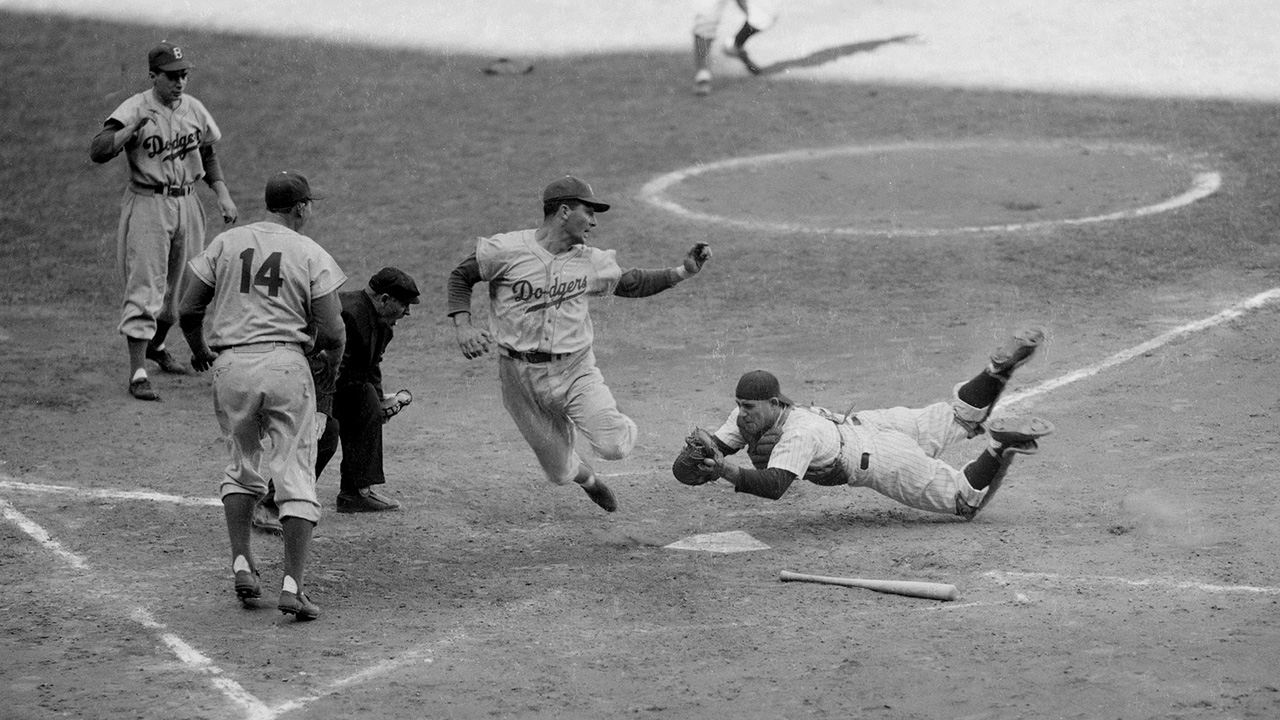
Berra’s first full season with the Yankees was 1947 when he made just $5,000 and hit .280 in 83 games. Despite being a reliable hitter and filling gaps behind the plate and in all three outfield positions, Berra was harshly criticized by the media and New York fans. They called him “ape” and dismissed the five-foot-seven, 190-pounder as an aberration—a stocky introvert with no patience at the plate. Many believed, and in most cases rightly so, that swinging madly at pitches well out of the strike zone was not a formula for sustained success. Hitting .158 in the 1947 World Series as a 22-year-old didn’t help Berra’s popularity, but his shortcomings at the plate—he went 3-for-19 in that series against Brooklyn with a homer and two strikeouts—were overshadowed by the fact the Yankees won the World Series for the first time in four years.
That particular playing of the Fall Classic was actually a remarkable one of firsts. It was the first time the World Series involved an African-American ballplayer—Brooklyn’s Jackie Robinson. It was also the first time the World Series was shown on television and the first time the league used six umpires. And it was the first time Yogi Berra played in and won the World Series. Over the next 16 years he would run those totals to 14 appearances and an unthinkable 10 wins. Both are still records. Neither has ever been challenged.
Berra was as humble as they come but he became fiercely proud of his accomplishments during contract negotiations, bargaining vehemently for pay raises with Yankees general manager George Weiss after each World Series appearance. While playing in Norfolk before the war, Berra made just $90 a month and frequently wrote home to his mother, asking her to send what little money she could so he could eat. Those trying times in Norfolk were always fresh in his mind when it came time to talk contract.
According to The Sporting News, Berra earned a $4,000 increase after the 1947 World Series when he was just 23. Then he convinced Weiss to bump his salary up by $5,000 every season for the next three years after that. By 1957, when he was 32 years old and on the downward plane of his career, Berra’s pay went up to $58,000, tying him with that year’s American League MVP, Mickey Mantle, for the highest salary on a team that included eight All-Stars and four future Hall of Famers.
It seems like a lot to pay for a guy who never led the majors in home runs or RBI, never won a batting title and never cracked 200 hits in a season. But what Berra did do was make the accomplishments of players who set single-season records look frivolous. He won as many championship rings as he had fingers, appeared in 15 consecutive All-Star games, caught the only perfect game in World Series history and finished in the top five in MVP voting a staggering seven times, winning a trio of MVP awards. That’s not to mention that less than a year after he retired from playing he was hired as the Yankees’ manager and led the team to its 29th AL pennant and a World Series appearance with absolutely zero coaching experience. Berra would continue coaching for years and, as the manager of both the Yankees and Mets, became one of just six managers to take a team from both leagues to the World Series.
By the end of his career, Berra had appeared in 21 World Series as a player and a coach, winning 13 of them. That is more appearances and wins in the Fall Classic than any single MLB franchise ever had, except for Berra’s Yankees. Think about that. The Dodgers, Giants, Cardinals, Cubs, Reds, Phillies, Pirates and Braves have all played baseball yearly since the late 1800s, yet none have appeared in the World Series more times than Yogi Berra. Twenty-five teams have not even appeared in the World Series as many times as Berra has won it, including 11 that have been playing since 1901 or earlier. Any fee for Berra was a bargain when you’re in the business of winning baseball games.
Unlike home runs, the statistics that stick out in Berra’s career are the ones he didn’t put up. Berra, one of the best bad ball-hitters in the history of the game, learned early on that he hated the feeling of walking away from the plate without putting the ball in play. So he simply stopped doing it. In 17 major league seasons he never once struck out more than 38 times and five times had more home runs than strikeouts in a season. During arguably his most successful period—a five-year stretch from 1949 to 1953 when the Yankees won five consecutive World Series titles—Berra was the toughest out in baseball, hitting 132 home runs and striking out just 113 times in 687 games. He was the league MVP in 1951—two more MVP titles would come in ’54 and ’55—which was a good year but maybe not as good as his 1950 season when he hit .322 and struck out just a dozen times in 656 plate appearances, a rate of one strikeout per every 50 at-bats that is simply unheard of.
“The Brooklyn Dodgers used to say that he was the one guy they feared more than anybody in the Yankees lineup because of what he did in late innings,” Kaplan said. “And because he was so hard to strike out.”
But much of Berra’s career was dictated not by the yogi-isms or the mind-bending stats but by the dogged determination of an unlikely baseball legend who just wanted to work. Berra rarely rested, catching both games of a doubleheader 117 times in his career and doing it on back-to-back days an astonishing seven times. In the seven seasons from 1950–57, Berra led the league in defensive games played by a catcher every year. Often, a day off for Berra meant playing in the outfield.
Of course, there was little conversation for much of what Berra did—he was a creature of habit and once a decision was made there was no looking back. He boycotted the old Yankee Stadium for 14 years after the team fired him as manager in 1985, something the late Yankees owner George Steinbrenner had promised would not happen. It took more than a decade and a personal apology from a hat-in-his-hands Steinbrenner to both Berra and his wife, Carmen, for the Hall of Famer to return to Yankee Stadium. He did it on July 18, 1999, when he caught the ceremonial first pitch and then watched as Yankees starter David Cone tossed a perfect game against the Montreal Expos. Berra and winning, clearly, were inseparable. The same goes for loyalty. Greatness, too.
Berra was seldom asked about Norfolk, where his military and baseball careers intersected decades ago. His time spent there—learning both the finer points of playing catcher and the intricacies of rocket fire—likely won’t even register with most. But at that time Yogi Berra was not Yogi Berra. He was just a stout 17-year-old from St. Louis with big ears and kind eyes who wanted to swing at every pitch he saw. There was never a guy less likely to be a baseball legend. And there will never be another one like him.
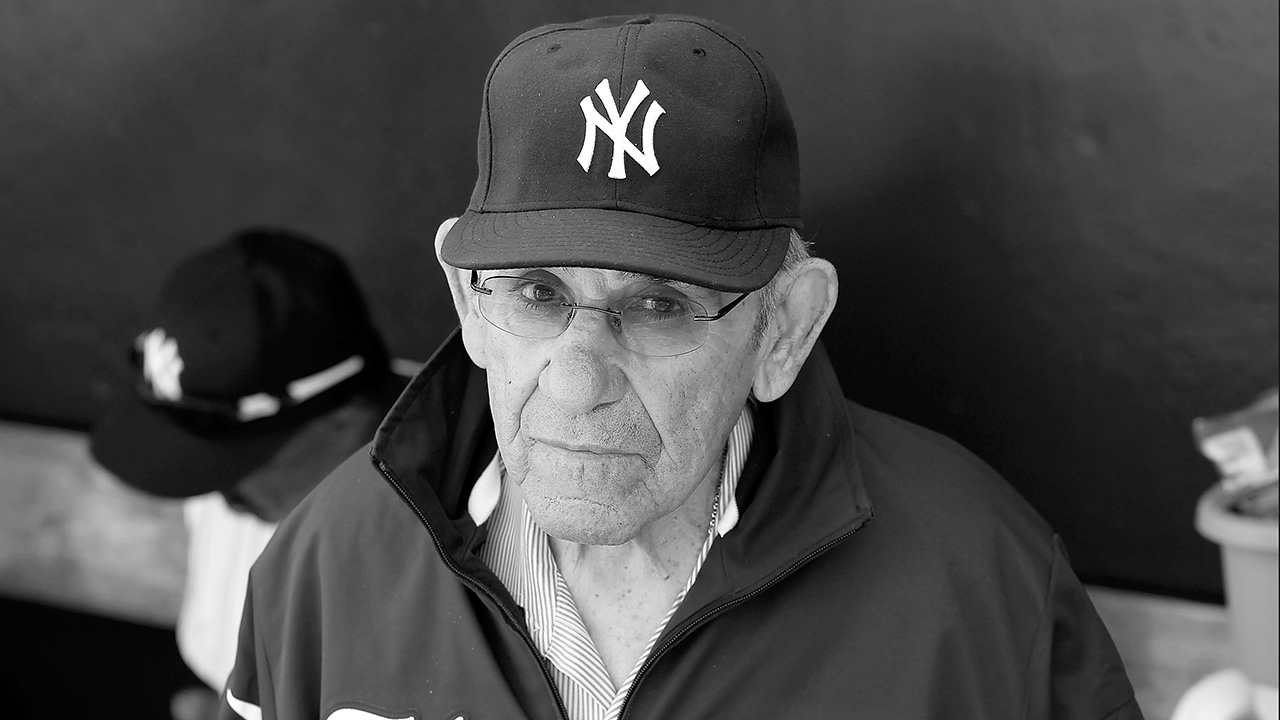
Yogi Berra died on Sept. 22, 2015, at the age of 90.