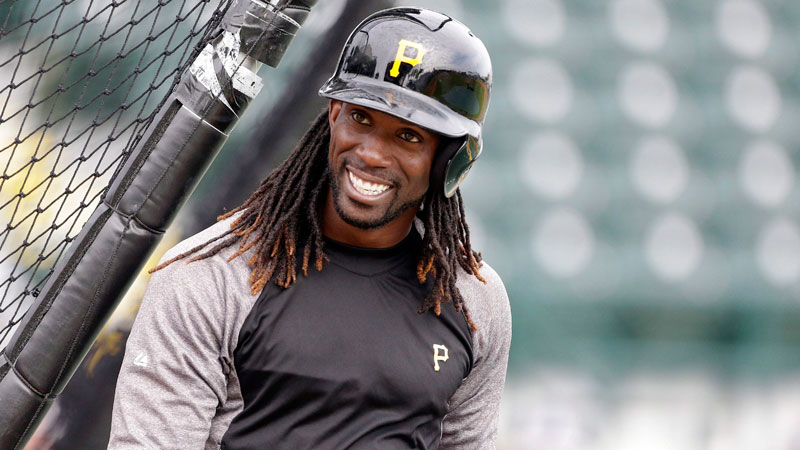

It was March 2005 when the Pittsburgh Pirates invited an 18-year-old outfielder named Andrew McCutchen to spring training in Bradenton, Fla., for a workout. McCutchen had already had a remarkable high school career—he hit .507 as the starting shortstop when he was 14 years old; by senior year he was hitting .709—but the Pirates wanted to see for themselves.
McCutchen couldn’t wait. He arrived early—with an entourage of family from his nearby hometown of Fort Meade—and took batting practice with Rajai Davis (who was then a 24-year-old in the Pirates system). Davis had four seasons of pro ball under his belt—he should have shown McCutchen a thing or two. It didn’t go down like that, and Davis still remembers.
“Man, how could I forget? He embarrassed me,” says Davis, now an outfielder with the Blue Jays. “He was in high school and hitting balls out to deep centre; I was in double-A and I couldn’t even reach the warning track.”
The Pirates took McCutchen 11th overall in the 2005 amateur draft and handed him a $1.9 million bonus out of high school. So began the odyssey of a young man who has become the one of the best centrefielders on Earth.
The Pirates were blown away by the teenager’s swing, but they would never have imagined he’d be this good. At 22, McCutchen was in the majors, and has gotten better in each of his four seasons since. Last season, he put together one of the best years a Pirate has had since Barry Bonds, leading the National League in hits, swatting 31 home runs, stealing 20 bases and getting on base in 40 percent of his plate appearances. He finished third in MVP voting and was worth seven wins above replacement, second only to Mike Trout among all outfielders.
If he improves his numbers again this year—which, as he knocks on the door of his prime at 26, is not just possible but likely—he should be a front-runner for NL MVP and set himself up for a massive payday when he hits free agency.
But that’s the most surprising part of the rise of Andrew McCutchen: Last year, he signed a remarkably below-market-value contract extension—six years, $51 million. To stay in Pittsburgh, of all places, and lose two years of free agency. If that wasn’t enough, he gave the Pirates a team option at the end of the contract for $14.75 million, which would buy out a third season of free agency—and even if he simply stays consistent, the Pirates undoubtedly will exercise it—keeping him in Pittsburgh until he’s at least 32.
Economically, it makes no sense. McCutchen is an elite player: a young, power-hitting, base-stealing, defensively skilled centrefielder who can bat .300. This is rare in the major leagues, to the point where just three men can claim all those things: Matt Kemp, Trout and McCutchen. That’s it.
Two winters ago, Kemp signed a long-term extension with the Dodgers for eight years and $160 million in his final year before hitting free agency. Meanwhile, former Texas Rangers centrefielder Josh Hamilton—who is a better power hitter than McCutchen but worse at everything else—just signed a five-year, $125-million contract with the Angels. Both Kemp and Hamilton will earn more than $20 million a year. McCutchen tops out at less than $15 million.
When you consider the current going rate for a single win above replacement—about $5.5 million—it’s clear McCutchen is being severely underpaid. The seven WAR he was valued at in 2012 should be worth $38.5 million. But last season he made just $700,000. And this season that only goes up by $4 million. So what gives?
“It’s plenty of money, you know?” McCutchen says, large diamond chains hanging from his neck. “I don’t do this just for the money. I do this because I love the game. The money is a bonus.”
To McCutchen, who came from incredibly poor beginnings in Fort Meade, where his father worked as a youth pastor and his grandfather ran a corner store, a guarantee of $51 million over the next half-dozen years was worth more than the mere promise of a better deal come free agency.
And McCutchen is savvy enough and surrounded by enough intelligent people to know how to handle it. He’s got the white Lamborghini and the custom Range Rover with the oversize rims. But he’s carefully invested the majority of the money he’s made, and he aims to stick to a $10,000-per-month allowance for non-essentials like clothes, jewellery and nights out. So many athletes get their first big contract and blow their bank accounts; so many get greedy and wait for free agency only to blow out a knee or see their performance fall off. McCutchen saw all that and decided the wise move would be to cash in.
“I play this game and I get paid to do it—I don’t want to take any of that for granted,” McCutchen says. “When the offer presented itself, I knew I had to jump on it.”
Okay, that’s fair. But what about sticking with the Pirates? This is a team, as you may be aware, that has not enjoyed a winning season in 20 years, the longest such streak in North American professional sports history. The ’92 Pirates—with a young Barry Bonds hitting 34 homers and ace Doug Drabek pitching to a 2.77 ERA over more than 250 innings—was the last Bucs team to win more games than it lost. Since then, the franchise has been mired in a perpetual cycle of failed rebuilds, poor drafting and sub-par development, and has traded anything resembling a star player as soon as he became too expensive to employ.
But Pirates GM Neal Huntington is trying to turn the club around, and re-signing McCutchen is a major part of that. As meagre as McCutchen’s deal may seem in comparison to others, it is the second-largest guaranteed contract in team history and will be the largest if his option year is exercised. And the club has spent a great deal in other areas, namely the amateur draft, where they doled out an MLB-high $52 million in bonuses from 2007–2011, harvesting everyday players Starling Marte and Pedro Alvarez and high-end prospects Jameson Taillon and Gerrit Cole—one of the best pitching prospects in the game. There is hope on the horizon.
Of course, it always comes back to McCutchen. He’s standing at his locker in Bradenton—where this all started eight years ago—in nothing but his boxers as a Pirates PR staffer tries to get him in motion for a commercial shoot across town that was scheduled to start 15 minutes ago. It used to be no one wanted a Pittsburgh Pirate in their ads; used to be a Pirate would never be cocky enough to be late. Now, McCutchen is one of the most sought after interviews and endorsers in the game. He’s the team’s first true superstar since Bonds. So McCutchen is in no rush, shrugging his shoulders at the club employee and taking his time getting his gear together before wandering off for a shower.
He’s Andrew McCutchen. They’ll wait.
This story originally appeared in Sportsnet magazine’s MLB Preview issue: