
I’ve already taken my stance on who the NBA Finals MVP should have been. And that’s the man who, for the first time ever, led both teams in scoring, rebounds, and assists (hint: he’s the self-proclaimed “best player in the world”).
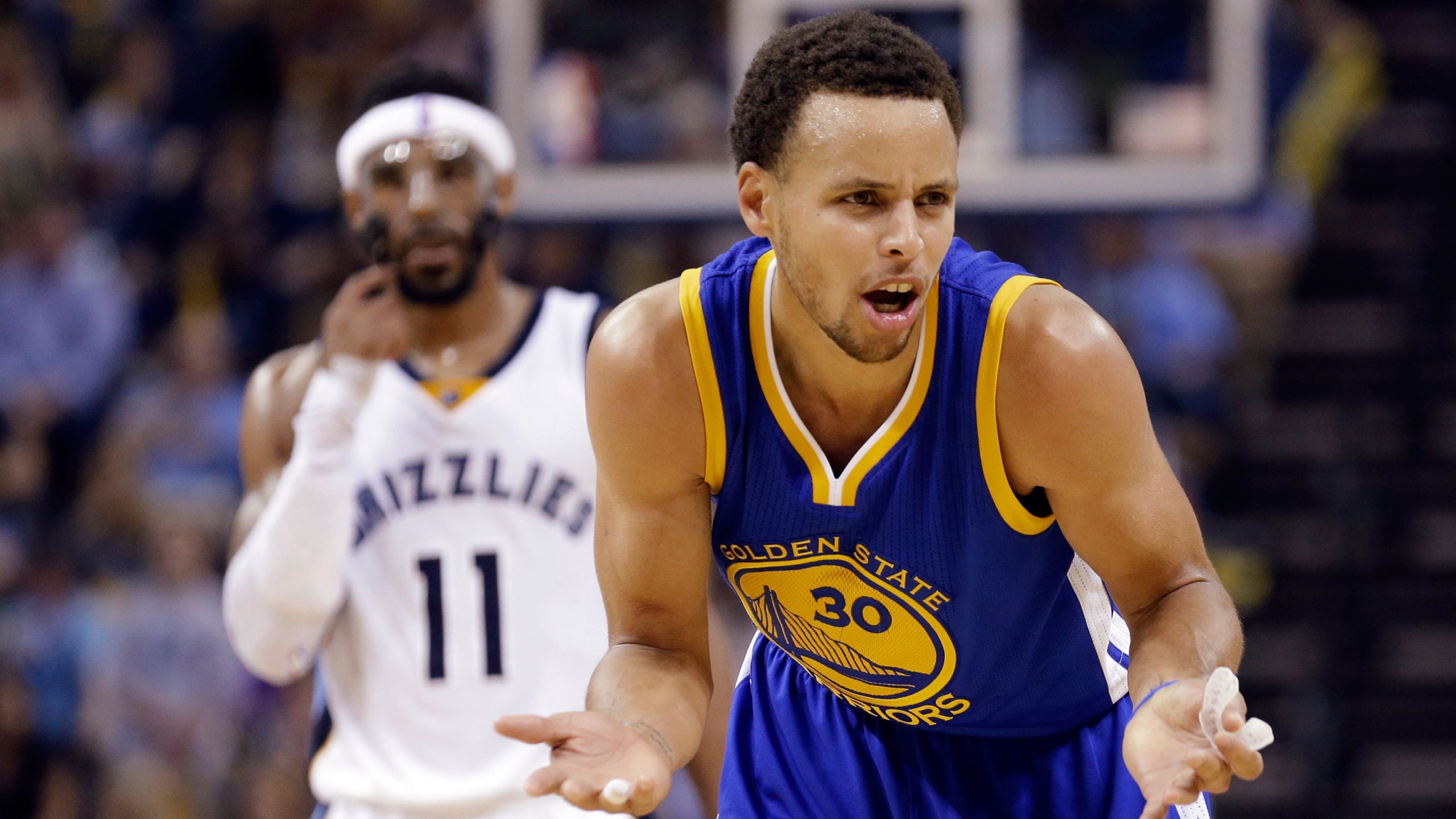
That said, the most clutch player in the series and throughout the playoffs was Steph Curry.
The sharp-shooting Curry put together arguably the most clutch performance we’ve ever seen during a post-season, starting with a seemingly-impossible game tying 3 pointer at the end of regulation in game 3 of the first round versus the New Orleans Pelicans. It only continued from there, with clutch shot after clutch shot in game after game, either putting an end to an opponents’ run or sparking one of his own.
There is this perception that Curry slumped in the Finals, but in actuality his averages of 26 points, six assists and five rebounds while hitting 38.5 percent of his threes are nearly identical to his numbers during the previous three rounds. And both those stat lines are slightly better than his regular season numbers that earned him his first-ever MVP award.
Curry joins Magic Johnson and Bob Cousy as the only point guards to win regular season MVP and then a championship in the same season. Unlike Magic, Curry wasn’t also named the Finals MVP. I suppose Curry’s toughest opponent wasn’t Mathew Dellavedova’s defense, but voter fatigue.
2015 has become the “Year of Curry”. He was the leading all-star vote recipient, a unanimous first team All-NBA member, and after Tuesday night became the first player to defeat all 4 other members of the All-NBA ‘teammates’ on the way to a title. Curry became the sixth player to win his first MVP & his first NBA title in the same season. Meanwhile, his daughter, Riley, became a trending topic for her cuteness, and her daddy’s first-ever signature shoe from Under Armour is flying off the shelves.
FIRST NBA MVP AWARD & NBA TITLE IN SAME SEASON
But it wasn’t supposed to be this way.
This was supposed to be Kevin Durant’s stage—not just as the player to push LeBron to the brink, but as the new face of the Western conference. Durant passed on a lucrative sponsorship with Under Armour who then reinvested their attention toward Curry.
For his part, Curry took his game to a historical level.
Before this year, Reggie Miller held the NBA record for made threes in one postseason with 58. Curry had 98 on his title run. And he wasn’t just jacking up shots—his effective field goal percentage was .567.
Fighting through a shooting slump early in the Finals, Curry was consistently great when his greatness was needed most. He twice posted 17 points in the fourth quarter in the Finals. In the series clinching Game six he hit two late 3-pointers to extend the lead and give the Warriors enough cushion to weather a late surge from the Cavs.
Late in games and late in the shot clock most players’ percentages go down. These were the scenarios Curry took the bulk of his shots in the postseason, and yet he maintained his incredibly efficient level of play.
His ability to connect from deep creates havoc for defenders, who are forced to drag toward him whether he has the ball or not. In the Finals, when he was left one-on-one he put Cleveland folk hero Matthew Dellavedova on skates and nailed a barrage of step-back threes, like toward the end of Game 5. When Curry’s was trapped on the high pick and roll and the Cavs elected to stay with the double team, he continued to make the correct pass.
No matter the degree of difficulty he found the weakness in the D by moving the ball, affording the Golden State offence the ability to essentially play 4 vs 3, as we saw to close out Game 6. It was out of these sets that the man who won Finals MVP instead of Curry, Andre Igoudala, got the majority of his wide-open long range shots.
And how did the Cavaliers perimeter defenders, tasked with expending their energy keeping up with Curry throughout the Finals, fair? Dellavedoa, J.R. Smith, and Iman Shumpert shot a combined 28.9% in the series.
But what really sets Curry apart is the degree of difficulty of his shots. Frankly, it is difficult to quantify because we’ve never seen it before.
Never before have we seen a player who carries the ball on a string like Curry, a player who doesn’t just create unthinkable shots off the dribble, but hits them consistently. Most great players wouldn’t even dare try them. It’s as if you had a player with Isiah Thomas’s handles, Larry Bird’s balance to rise up, Ray Allen’s quick release, and Reggie Miller’s no-fear attitude to take big shots in big moments. Curry is a Frankenstein of clutch shot making.
Tuesday’s victory was the Warriors 83rd win this season, becoming just the third team in NBA history to reach that mark. The two others are the best versions of Jordan’s Bulls (1995-96 Bulls and 1996-97). No, Curry’s stewardship of the Warriors was not Jordan-like; the Warriors didn’t need to rely on many game-winning shots. But Curry’s knack for making the right play at the right time was just as impressive.
“Strength in numbers” was the Warriors motto all year. Sure enough, when it mattered most their strength was counting on Curry to put up numbers. The clutch Curry had a postseason for the ages and while he didn’t hoist the Finals MVP trophy, there’s no doubting it: he’s the reason the Warriors are champions.