David Joel Stern, the NBA Commissioner Emeritus, passed away on Jan. 1, 2020 at the age of 77.
Depending on who you talk to, Stern was either a kind-hearted saint or a tyrant who ruled the NBA across his 30 years on the job with an iron fist, and oftentimes both.
Regardless of where you fall on that spectrum, however, it’s undeniable Stern left an indelible mark and lasting legacy on not only what we know as today’s NBA, but all of modern pro sports.
Here’s a look back at 21 of the most resonant, impactful moments of Stern’s tenure as commissioner.
The salary cap and free agency
Stern took over from Larry O’Brien as the fourth commissioner in NBA history on Feb. 1, 1984, but during his early years before taking the helm he made landmark moves that would decide the course of the league as we know it today.
In 1976, Stern was a lawyer for Proskauer, Rose, Goetz & Mendelsohn – the firm that represents the NBA to this day – and acted as the lead attorney in the league’s legal dispute with star player Oscar Robertson.
In the lawsuit, Robertson sought to block any merger between the NBA the American Basketball Association (ABA), end a contract clause that bound a player to a single NBA team in perpetuity, end the NBA’s college draft binding a player to a single team and ending restrictions on free-agent signings.
During this case, Stern negotiated a settlement that not only allowed the NBA and ABA to merge, but also facilitated the adoption of free agency by abolishing the option clauses that Robertson sought to remove.
But Stern wasn’t done re-shaping the league’s financial structure. In 1983, as the NBA’s executive vice president, Stern created a salary cap for the league and ushered it into the revenue-sharing model we see across virtually all professional sports leagues.
Looking back, it’s staggering how future-focused that salary cap idea was — a common theme among many of Stern’s moves — in that teams could use exceptions to circumvent the cap in some cases, such as to retain star players like the Boston Celtics did first to keep Larry Bird and, thus, create the Larry Bird exception that is so integral to how business in the NBA works now.
[relatedlinks]
Magic vs. Bird and the beginning of the NBA’s superstar-era
Speaking of Bird, he along with arch-rival Magic Johnson are inextricably linked to one another partially because they both played an epic 1979 NCAA Championship game that captured the imagination of the United States, but also because they went to the Los Angeles Lakers and Boston Celtics, the league’s two biggest rivals.
This was a marketing opportunity Stern couldn’t and wouldn’t pass up, and as such, the NBA’s shift towards marketing its superstar talent began when he took office officially in 1984.
Stern definitely got lucky in that first year, as it marked the first time that Magic and Bird would face off in the NBA Finals. But it was just the pilot Stern and the NBA needed to kick off an era of basketball defined by star talent that was just about to come in with names such as Hakeem Olajuwon, Charles Barkley, John Stockton, Karl Malone, Chris Mullin, Patrick Ewing and, of course, Michael Jordan.
From that fertile, starry ground, Stern sowed the seeds of the modern superstar-driven NBA of today, and transformed a league that once had its Finals shown on tape delay in the wee hours of the night into a multi-billion dollar behemoth and an organization with players who now far transcend what they can do on the court.
The draft lottery
Another innovation of Stern’s during his earliest days as commissioner came in 1985 when he spearheaded the creation of the original NBA Draft Lottery.
Used as a means to prevent teams from outright tanking for the No. 1 overall selection, Stern also believed having an event before the actual draft would help stir up interest among fans and media, alike.
He turned out to be right, of course, as the draft lottery has transformed into a highly anticipated event in the NBA and other leagues that have adopted the format.
For all its benefits though, the draft lottery also offered fuel for conspiracy theorists who alleged that Stern would rig the lottery for big market teams. Those theories began during the first-ever lottery, when the New York Knicks — historically the league’s highest-valued franchise and the team Stern cheered for growing up — won the right to draft Ewing, a generational, franchise-changing centre at the time.
The banning of Michael Ray Richardson
When Stern took over as commissioner, the NBA was neck deep in both a health and image crisis after a report surfaced claiming anywhere between 40 and 75 per cent of players in the league were using cocaine.
During his time as the league’s executive vice president, Stern had managed to reach an agreement with the Players’ Association on drug testing, something that, in February 1986, directly led to the lifetime ban of New Jersey Nets all-star guard Michael Ray Richardson after he tested positive for cocaine three times.
At the time, the NBA was criticized for waiting so long to ban Richardson, exacerbated by the fact that later in 1986, No. 2-overall pick Len Bias died of a cocaine overdose just two days after getting drafted by the Celtics. Just one year later, the Phoenix Suns would also be nearly completely torn apart after three players were indicted for conspiracy and trafficking in cocaine and marijuana.
Stern would ultimately take a hardline stance on drugs in the league, which included adding marijuana to the list of banned substances and giving Chris Andersen a two-year ban from the league in 2006 for violating the league’s drug policy.
Magic Johnson’s HIV announcement
When Magic Johnson suddenly retired from the NBA prior to the 1991-92 season and announced he had received an HIV diagnosis, Stern emerged as a willing and vocal supporter, and that support helped raise awareness regarding the virus and AIDS.
Despite retiring, Johnson wound up being the leading all-star vote-getter that season (partially because all-star votes needed to be printed well in advance). Magic asked to play in the 1992 All-Star Game in Orlando, a request Stern granted and then campaigned to make happen, even telling owners they would be subject to a lawsuit if they didn’t allow him to play.
The result was one of the most memorable all-star games in NBA history, and a moment Johnson says was a landmark moment for HIV and AIDS awareness.
Gary Bettman becomes NHL’s first commissioner
NHL commissioner Gary Bettman got his start as a sports executive with the NBA under Stern.
Bettman was instrumental in the salary cap system Stern devised for the NBA in 1983, so it shouldn’t have come as a surprise when Bettman eventually implemented the system in the NHL — even if it did come 12 years into his tenure as the NHL’s first-ever commissioner.
Upon Stern’s passing, Bettman released a statement in honour of his mentor and friend.
The Dream Team and the NBA’s increased international reach
Oddly enough, Stern, the NBA and USA Basketball never really wanted this team to happen — the the U.S. going as far as voting against participating in the 1992 Olympics.
However, since the rest of the world wanted it, Stern didn’t kick up a fuss and allowed 11 future Hall of Fame players, plus a very highly touted Christian Laettner, to go to Barcelona for the 1992 Games and change basketball forever.
Thanks to the international exposure the NBA and its stars received because of the Dream Team, the league’s – and, thus, basketball’s – reach began to extend out to all corners of the globe.
At the beginning of the 2019-20, 108 non-U.S. players from 38 different countries took the court, and players from Greece and Slovenia leading all-star voting after the first returns.
It all started with the Dream Team.
The NBA’s expansion into Canada
On the heels of the international reach provided by the 1992 Games, the NBA officially expanded internationally in 1995 with the creation of the Toronto Raptors and Vancouver Grizzlies as the league’s 28th and 29th franchises.
Obviously, things didn’t work out for the Grizzlies as they eventually re-located to Memphis, but it all went according to plan for the Raptors, relatively.
Stern had a vision that his neighbours to the north could also contract hoops fever if they just had an entryway. He wasn’t wrong.
Beginning with the memorable Vinsanity years and culminating with a championship last season, the NBA’s Canada experiment was not only an on-court success but also kick-started the golden generation of Canadian basketball we see now.
On just about every night of the week this country can watch a Canadian hooper doing his thing in the NBA. That doesn’t happen if Stern doesn’t decide to expand to Canada.
The WNBA
The NBA has been an advocate for women’s athletics having a larger platform, and Stern played a major role in this.
In 1996, an eight-team women’s league was approved by the NBA owners and launched a year later. The WNBA has gone through many ups and downs since, but it’s become relatively stable, having expanded to 12 teams – including the first major professional basketball franchise in Las Vegas.
As much praise as should be given to Stern for opening the doors to the game internationally, the same should be said for what he did for the women’s game. There aren’t many professional women’s sports leagues in North America, but Stern and the NBA paved the way for basketball players of all nationalities and genders to dream.
Maximum contracts and the 1998 NBA lockout
The 1998 NBA lockout was bad for business as 32 games and All-Star Weekend were lost, while fan interest waned with dropping television ratings even when the league finally came back.
Still, it was seen as a win for Stern and the NBA because they managed to implement something that still affects players now: a maximum-salary limit.
The term “max contract” is thrown out all the time these days when discussing star players and free agency, but without Stern locking the players out in 1998, max contracts wouldn’t exist. The reason Stern wanted to implement this was to strike back against escalating payrolls, an obvious positive for the owners.
An unforeseeable — and likely unintended — side effect of what Stern did here with max salaries, though, was take the first step towards the player empowerment era we find ourselves in now, with star players knowing they’re going to get the same amount of money no matter where they go, opening up an unprecedented freedom of choice in free agency.
The NBA D-League
The NBA is one of the most exclusive clubs in the world. With only 17 maximum roster spots across 30 teams and just two rounds in an annual draft to reload, there’s not a lot of room out there for a growing base of elite basketball players from all over the world.
In 2001, the NBA attempted to help solve this problem with the creation of the NBA D-League. Now called the G League (thanks to a sponsorship with Gatorade), the NBA’s minor league still isn’t all the way there yet as not every team has a G League affiliate, but it’s getting close. It also provides an opportunity for either young players on NBA rosters to get valuable development time they wouldn’t get otherwise or to give undrafted players a shot at making the big leagues.
The G League has become testing ground for rule experiments that could come in the NBA, such as the one free throw for all foul points rule this season.
Beginning in the 2020-21 season, that experiment will see a team call Mexico City home — the first time the NBA will be expanding outside of the U.S. since the Raptors and Grizzlies came to be.
This is all in large part possible now because Stern saw a gap that needed filling within his league.
Yao Ming and the NBA’s lucrative (and controversial) foray into China
“With the first pick in 2002 NBA Draft, the Houston Rockets select Yao Ming from Shanghai, China and the Shanghai Sharks.”
After saying those words, Stern brought the NBA into a relationship with China that would prove to be immensely successful and lucrative, with stars such as Kobe Bryant and LeBron James hailed as heroes in mainland China because of many goodwill missions the NBA took to China in off-seasons.
However, given the politics of the ruling Chinese Communist Party, the NBA’s deep business dive with China was always going to have repercussions.
Those manifested visibly just before the 2019-20 season tipped off, when Rockets GM Daryl Morey incited a fire storm by tweeting (and then deleting) support for the Hong Kong protesters.
The result put the NBA into a moral quagmire as it’s had to weigh both its financial interests in China with its own moral values. It’s a battle the league is still fighting today, even if it’s fallen out of the news cycle for the time being.
The hand-check rule and the beginning of the NBA’s offensive explosion
Before the start of the 2004-05 season, a major rule change was implemented that seemed pretty small at the time.
The act of hand-checking – when a defender makes physical contact with the ball-handler to impede progress – was outlawed and would have defenders called for a foul if a player was caught doing it.
This ended up being a big deal because in 2003-04 teams only averaged 102.9 points per 100 possessions, a full six points per 100 possessions less than the 108.9 average of today. This hand-check rule, plus a huge difference in offensive ability thanks to teams fully understanding the value of three-pointers versus mid-range shots allows the league’s speediest, most athletic players to play far more freely than they ever have before.
The Malice at the Palace
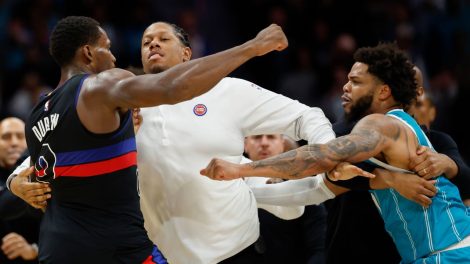
The most infamous brawl in NBA history – maybe even in the history of North American sports.
In the wake of this black mark on the NBA, Stern came down harshly, suspending then-Ron Artest, now-Metta World Peace for the remainder of the season, Stephen Jackson for 30 games and Jermaine O’Neal for 15 — and, in turn, decimating an Indiana Pacers team that had championship aspirations.
It also sparked debate over whether the NBA’s signature no-barrier experience should end and barriers should be put up between fans and players.
Thankfully, that didn’t happen and the league hasn’t seen an incident like this since.
The dress code
There’s an argument to be made that this implementation of a dress code – one mandating players wear business casual attire at team and league events – was racially driven when it was implemented in 2005, especially after comments made by then-Lakers coach Phil Jackson to the Los Angeles Times following its inception.
“The players have been dressing in prison garb for the last five or six years,” Jackson said. “All the stuff that goes on, it’s like gangsta, thuggery stuff. It’s time. It’s a good time to do that.”
A rule that seemed to stem from a supposed vendetta Stern had against Allen Iverson – the poster child for the hip-hop-inspired attire many players sported back then – resulted, predictably, in backlash and rigorous discourse at the time.
Eventually, players accepted the rule and, in time, turned it into an opportunity for expression — resulting in the creative outfits occasionally seen now.
Oddly enough, you can probably thank Stern for social media accounts like Leaguefits.
The Tim Donaghy scandal
The greatest threat to Stern’s tenure came in July 2007 when reports surfaced that an NBA official was under investigation for betting on league games that he had officiated.
A month later, the referee in question — Tim Donaghy — pleaded guilty to two felony charges, saying he did, indeed, pass on information to bookies.
This was an outright disaster for the NBA, which always struggled with image issues that a “fix” was in for certain teams. Now there was apparent proof.
However, after an independent investigation by the NBA came up with the result that Donaghy acted alone and was a singular rogue referee, as opposed to being part of a larger operation.
Following the investigation, the matter faded from the public discourse, and Stern emerged having successfully navigated a scandal that threatened to destroy the league’s credibility.
The Supersonics leave Seattle
There are only 20 teams that have won an NBA Championship, and the Seattle SuperSonics are one of them. That’s among the reasons why, when the Sonics left Seattle in 2008, it could only be viewed as a bad day for basketball.
One of the lowest moments of Stern’s tenure, the Sonics relocation to Oklahoma City happened when it was clear that Howard Schultz, Starbucks CEO and then-team owner, couldn’t get an arena deal done and decided to offload the team to Oklahoma businessman Clay Bennett, who helped out the New Orleans Hornets during Hurricane Katrina.
It was very obvious that relocation was Bennett’s endgame, but Stern allowed it to happen anyways and after one more season in Seattle – Kevin Durant’s rookie year, no less – Bennett pulled the trigger on the inevitable and moved the team to Oklahoma City.
Stern, rightfully, was – and probably still is – viewed as a villain in Seattle because of the franchise leaving the city.
The Decision
On July 8, 2010, the echo effect of the max salaries Stern implemented about 12 years earlier was finally felt.
LeBron James announced on a live ESPN television special his intentions to take his talents to South Beach and play for the Miami Heat, joining forces with fellow superstars Dwyane Wade and Chris Bosh – who would join a couple days later – to usher in a decade defined by super-teams and kick off today’s unprecedented era of player empowerment.
This television special was like the zenith of everything Stern had been trying to build dating back to when he first took the job: A star player far bigger and brighter than any one team commanding the attention of the world, giving publicity to both himself and, of course, the NBA.
Like it or not, “The Decision” will be remembered as an important moment in league history.
Chris Paul trade to Lakers blocked
Another bizarre situation near the end of his tenure, Stern and the NBA were directly involved in blocking a trade that would’ve sent Chris Paul to the Los Angeles Lakers.
At the time, the NBA owned the New Orleans Hornets, having purchased the franchise from George Shinn and Gary Chouest in December 2010 and eventually selling to New Orleans Saints owner Tom Benson in April 2013.
But during the time when the NBA owned the Hornets, then-franchise cornerstone Chris Paul asked to be traded and made it clear his destination be either New York or Los Angeles. In December 2011, a three-team deal was put in place that would’ve seen Paul join the Lakers, only to have it squashed by Stern and the NBA for “basketball reasons.”
As the story goes, owners were angry that the Lakers were getting a superstar player for what was viewed as effectively nothing and demanded Stern trade Paul somewhere else. Stern did just that, sending Paul to the Los Angeles Clippers.
So, thank Stern for Lob City.
The 2011 NBA lockout
Just before he retired, Stern presided over one more league lockout in 2011. It didn’t last as long as the one in 1998, as only 16 games were missed, and when the league did return it didn’t drop in popularity as interest in the Heat and their new Big Three was still very high.
In a sense, this was validation for all Stern had done. The league looked to be more popular than ever, and in negotiations he was able to increase the owners’ revenue share from 43 to 50 per cent. All would be right with the NBA, even after he retired.
Adam Silver named as Stern’s successor
Lastly, in one final show of power, Adam Silver was named Stern’s successor as the NBA’s next commissioner in October 2012.
Obviously, Silver had been groomed for the role for years, but for there to be no fuss kicked up over Stern’s hand-picked successor illustrated the power he wielded.
And like with most things Stern did, Silver has worked out well as the new commissioner, navigating the league through a tough situation with Donald Sterling before giving him a lifetime ban and signing a $24-billion television deal that’s now seeing the NBA reach further heights than ever before.