
Now that was a scorching start to the NBA Finals—and I’m not talking about the conditions inside AT&T Center.
In Game 1, the San Antonio Spurs shot 58.8 percent from the field, 52 percent from deep, and put up a 36-point fourth quarter in which they went an outrageous 14-for-16 from the field, including a perfect 6-for-6 from three-point range.
So, yes, the Miami Heat did get torched, just not by the arena’s sweltering conditions.
LeBron James’s cramping and the temperature of the building ended up becoming the story of the game, and that’s a real shame.
Up until James’s exit with four minutes left in the fourth, Game 1 was looking every bit like last year’s Finals, with stupendous spacing and dynamic offence being run on both sides and contributing to a torrid pace.
Unfortunately, after James left, the Spurs completely took over, going on a 16-3 run to end the game and leaving us all wondering “What if?”
Sloppy Spurs still found a way
So, what would have happened if James hadn’t cramped up?
We obviously don’t know for sure, but the fact that the Spurs certainly didn’t play their best and still pulled away should give us some indication.
Though their offence was certainly clicking, San Antonio still turned the ball over a dreadful 22 times leading to 28 Miami points. They also put up 10 fewer field-goal attempts than the Heat.
That would normally bury a team, but because of how well the Spurs shot the ball, they were able to overcome this glaring problem and actually ended up making three more field goals than Miami.
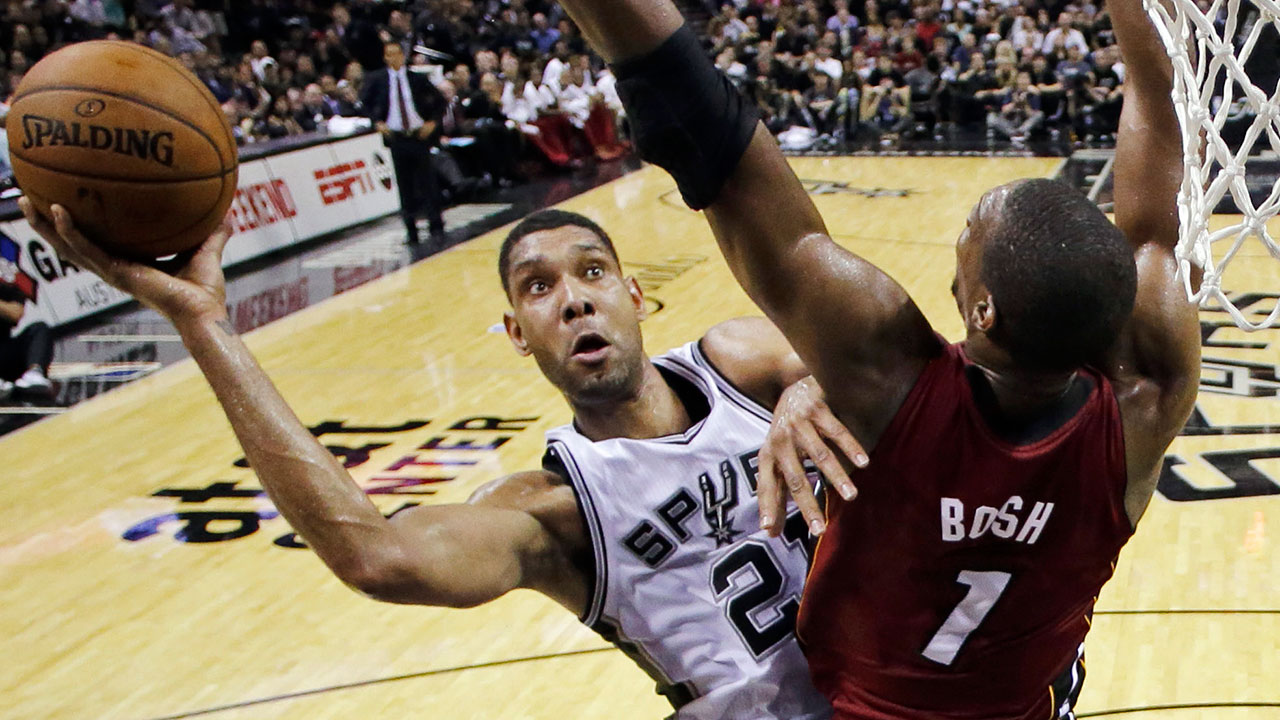
Even if James had remained in the game, then, it’s difficult to say the Heat would’ve won. Miami successfully forced turnovers, but did nothing to stop the interior passing to Tim Duncan (who finished 9-of-10 from the field for 21 points) and the red-hot deep stroke the entire Spurs team seemed to have all game long.
The Heat were on and still lost
Even more concerning than James’s late-game cramping is the fact that the Heat actually played a solid game, executed their game plan well and still lost.
Yes, Miami was right there before James was forced out, but given the turnovers they created, and the percentages they shot (FG%: 47.4, 3P%: 41.4) this was a game the Heat probably should’ve had.
The percentages Miami allowed San Antonio to shoot are absolutely unacceptable, particularly from deep. The Heat have one of the fastest, most athletic defences in the league and while they proved that with the amount of turnovers they forced, they were soft on their closeouts to three-point shooters and their normally lightning-fast rotations and recoveries didn’t come close to the speed we’re accustomed to seeing.
Most importantly, however, is the fact that James had 25 points, Dwyane Wade had 19, Chrish Bosh 18 and Ray Allen 16. The Heat’s stars all played well. Poor defence aside, when Miami has Allen going coast-to-coast for a one-handed flush, Wade busting out the dream shake on a drive to the basket and Bosh going 3-for-4 from downtown, including a four-point play, they shouldn’t lose.
Miami’s Game 2 adjustments
In light of how well the Heat played and the fact they still couldn’t come away with the W, coach Erik Spoelstra is probably going to have to make some adjustments on the fly.
The most notable one may be to insert Norris Cole into the starting lineup over Mario Chalmers.
Chalmers only played 17 minutes last night, mired in foul trouble because he simply couldn’t keep up with Tony Parker, Manu Ginobili and Patty Mills. The point guard platoon that Spurs coach Gregg Popovich ran continually beat Chalmers off the dribble and forced the sixth-year man to foul.
As a result, Spoelstra was forced to play Cole for 29 minutes and the backup looked a whole lot better guarding at the point of attack than Chalmers. In fact, dating back to the Indiana series, Cole has looked like the better overall option at point guard for Miami.
Against the Pacers, Spoelstra’s biggest adjustment was to put Cole on Lance Stephenson in crunch time, giving the third-year guard burn in the entire fourth quarter (a time normally reserved for Chalmers). Cole’s physicality on defence and naturally quick feet made him a much better option than Chalmers against Indiana, and that looks to be the case again here in the Finals.
Chalmers is definitely the better three-point shooter, but that doesn’t matter when the guy he’s supposed to be guarding is continually blowing by him. The Heat didn’t lose because they couldn’t score. They’re going to need Cole’s defence a lot more than Chalmers’s shot-making ability in Game 2.