After getting drawn into Group H for the 2019 FIBA Basketball World Cup, there’s been talk about how Canada is in the Group of Death and that their quest to qualify for the Tokyo 2020 Olympic basketball tournament may have already ended before it even got a chance to get off the ground.
Yes, Australia and Lithuania are both very formidable foes, and Senegal is no slouch either, but this isn’t to say that the task presented in front of Canada in China will be impossible.
Far from it, actually.
Remember, during the course of this near two-year qualification process to reach the World Cup in the first place, Canada’s been nowhere near close to fully loaded, and yet it still crushed the qualifiers with an Americas-best plus-282 point differential.
And yes, while it’s true that basically every team was handicapped to a certain degree during the World Cup qualifiers, Canada Basketball was especially so because the program’s big-time guns simply couldn’t show up because the most meaningful games happened during the NBA season.
With the World Cup taking place from Aug. 31 to Sept. 15, however, all of that NBA talent Canada has at its disposal should be available, meaning, despite the No. 23 world ranking, the Canadians could realistically be seen as Group H favourites.
That all begins with what the roster looks like, however, so here’s a look at a mock roster that, in this author’s opinion, would be the strongest possible.
| Player | Position | Current Team | Hometown |
|---|---|---|---|
| R.J. Barrett | Forward | Duke (NCAA) | Mississauga, Ont. |
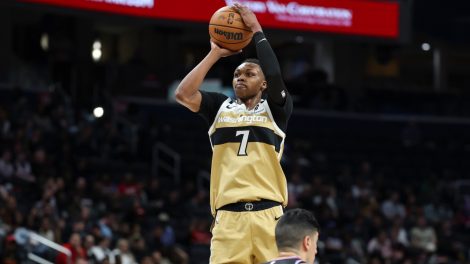
| Dillon Brooks | Guard | Memphis Grzzlies (NBA) | Mississauga, Ont. |
| Melvin Ejim | Forward | BC UNICS (VTB United League) | Toronto, Ont. |
| Shai Gilgeous-Alexander | Guard | Los Angeles Clippers (NBA) | Hamilton, Ont. |
| Brady Heslip | Guard | Istanbull BŞB (Turkish Super League) | Oakville, Ont. |
| Cory Joseph | Guard | Indiana Pacers (NBA) | Ajax, Ont. |
| Jamal Murray | Guard | Denver Nuggets (NBA) | Kitchener, Ont. |
| Kelly Olynyk | Forward | Miami Heat (NBA) | Kamloops, B.C. |
| Dwight Powell | Forward | Dallas Maverick (NBA) | Toronto, Ont. |
| Nik Stauskas | Guard | Cleveland Cavaliers (NBA) | Mississauga, Ont. |
| Tristan Thompson | Forward | Cleveland Cavaliers (NBA) | Brampton, Ont. |
| Andrew Wiggins | Forward | Minneota Timberwolves (NBA) | Vaughan, Ont. |
Starters
Cory Joseph, Jamal Murray, Andrew Wiggins, Kelly Olynyk, Tristan Thompson
Taking a closer look at this theoretical roster, the five gentlemen you see above are who should be the starters.
With the exception of maybe Gilgeous-Alexander instead of Joseph at the one, these are the five most talented Canadian players at their respective positions. More importantly, however, is this is a very balanced unit with the ability to stretch the floor with three-point shooting, buckets on the inside from either the post or with slashing and just enough defensive responsibility.
And for those who are down on Wiggins even being on the roster, let alone starting, don’t get things twisted. While there’s no doubt he hasn’t lived up to his No. 1 overall pick billing, that doesn’t take away from the fact he’s still supremely athletic and can create his own shot like no other Canadian would be able to on the roster. Traits that will be important in crunch time.
Lots of guards
Dillon Brooks, Shai Gilgeous-Alexander, Brady Heslip, Cory Joseph, Jamal Murray, Nik Stauskas
One thing you may have noticed about that mock roster is how guard heavy it is. This is on purpose.
There’s no more important skill in basketball than shot-making, therefore, in a short, every-game-matters tournament like the World Cup it will be vital for Canada to find its stroke early and try to ride that to success.
Every guard on this roster with the exception of Gilgeous-Alexander has the ability to go off from deep in any given game, and Canada’s going to need to find who that person is. Therefore, by having a lot of options from the guard position to find that sparkplug, the team’s chances should increase.
Roster versatility
The entire roster
Of course, if Canada can’t find its outside stroke from its backcourt it could still find it up front as well.
This is because of how flexible this roster can be, in terms of shooting and much more.
Up and down this roster you have players who can play multiple positions. This is best evidenced by Ejim, one of only three non-NBA players on this mock-up. Ejim is a wrecking-ball-like player in the international game because of his ability to play both forward spots with equal effectiveness. On top of that, he can shoot threes, put the ball on the floor post-up, slash to the rim and make smart, on-time passes.
Defensively, this team would be able to switch just about everything because of how long and athletic everyone is. Switching on defence will be important for Canada because of the myriad of high-skill shooters and the prevalence of pick-and-roll/pop in the international game. Switching can help mitigate this, especially on the perimeter where Canada would have a number of hard-nosed athletes – guys like Brooks, Gilgeous-Alexander and Joseph.
Every player on this roster except for shooting specialist Heslip was chosen for some of the positional versatility they bring, and that is a big reason why Barrett is on this roster.
There’s a lot more players with a lot more experience and probably more ability at this point in their careers than Barrett does that Canada can choose from, but he comes with the X factor of winning a world championship as a junior, and also because he can play two or maybe three positions right now.
His size, athleticism and shooting ability all make him special, and even if he doesn’t see the floor as the 12th man off the bench in China, a guy who will be a top-five pick in the draft and just set an ACC freshman scoring record isn’t a bad trump card to have in your back pocket.
[relatedlinks]