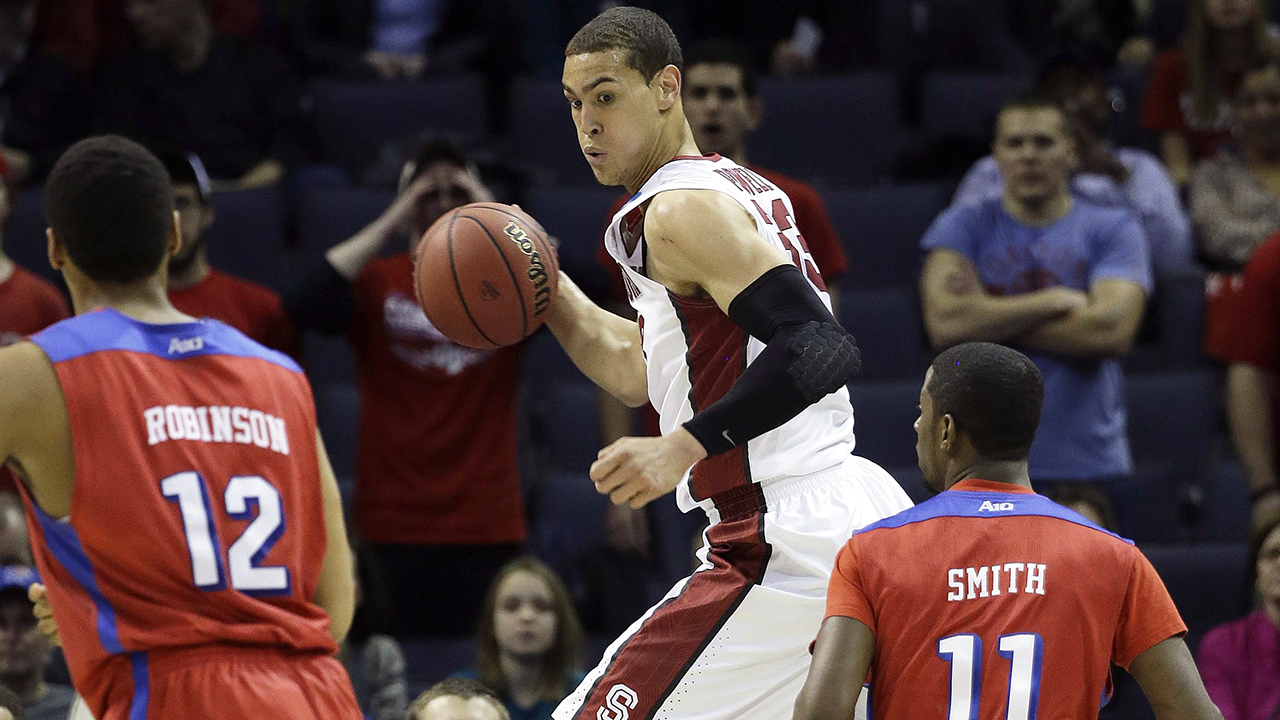

While the headlines at tomorrow’s NBA draft will deal mostly with Andrew Wiggins, there is a sizable list of Canadian players with a shot at breaking into the league. One of those Canucks played a role in upsetting the Kansas Jayhawks and knocking Wiggins out of March Madness—Stanford’s Dwight Powell. The six-foot-11, 233-lb. forward with a seven-foot wingspan caught the attention of pro scouts after a breakout junior year, but stayed to complete his education.
This season, Powell averaged 14 points and 6.9 rebounds per game en route to being named a first team all-star and the Pac-12’s athlete-scholar of the year. He helped Stanford get to the Sweet Sixteen in the Cardinals’ first tournament appearance since 2008.
Going through the workouts with pro teams, facing the draft—has this been the most nerve-wracking thing you’ve had to do?
I don’t know if I would say nerve-wracking, but definitely exciting. If all the NBA teams were on one street and I could just go next door, I think it would be the most amazing experience. But the fact that I have to zig-zag across the country, I think that’s the worst part—having to get on planes every single day. And I don’t think that there are planes that aren’t delayed in North America anymore—I haven’t been on one.
How many teams have you worked out with?
I think 11 or so—Chicago, OKC, Phoenix, Minnesota, Utah, Cleveland, Dallas, San Antonio, Philadelphia, Atlanta, Washington, Toronto. It started right after the combine in Chicago, I went to the Bulls’ facility.
What’s it been like making the jump from NCAA competition to working out with NBA teams?
It’s been great. To see that side of the NBA is very rare, something that opens your eyes to the business side and not just the lights and the glam of the game. It’s been cool to see the different ways teams approach these workouts, who’s involved and what you do, even the facilities are all very different. So it’s been really interesting to see it from that angle.
Who’s the toughest guy you’ve matched up with during these workouts?
At the combine, I got to see all the top guys that are on the circuit right now—Jordan Bachynski obviously impressed me, but I’ve been playing with him for a while, Melvin Ejim played real well, but there’re so many talented guys in this draft. It’s ridiculous. There’s a good group.
With so many talented Canadian guys in this draft, what are your thoughts on being part of that group?
It’s exciting. Definitely exciting. You can ask any players from Toronto, going back to who knows when, and they would say their class had just as many talented guys—and I would agree. Toronto is a basketball powerhouse. They always had good players and they’ve always had good competition. I would have to say the level of exposure has increased a lot over the last few years—with Team Canada, with different guys going down to prep schools and, obviously, Division-1 schools and the NBA. It’s the perfect storm for this class. We have the talent, and pretty much have the right timing and we’re all coming out at the same time. I’m very grateful for all those who came before me because they laid the ground work and now they’ve set up this path for us to be successful.
How often do you guys connect?
Definitely through the Canadian national program we’re always catching up and everything. But guys have their own stuff going on. I saw Cory [Joseph] when I was with the Spurs last week, caught up with him a little bit—I didn’t see his ring, but he’s happy to be the champ, for sure. But guys can lean on each other if they need too, so it’s good.
You started up with the Grassroots AAU program. How important was that for you?
It was really important. The OBA program is important and the stuff we have going on here is really important in terms of grassroots-level development. In order to get the exposure to get to the Division-1 level and the NBA, to get on that right path you have to have your game put on stage in the right areas, and most of those areas are in the U.S. So being able to play on a Canadian team that’s in the AAU program and is a well-known team, for me, that helped my career tremendously, that started my career. Not only to be on a team, but to be on a team that’s recognized as something good. I think because we had so much success, that helped me a lot.
If basketball doesn’t work out, what do you plan to do?
I have no idea. My major is kind of a potpourri of classes, concepts and theories that don’t really mesh into one career. It’s a foundation for learning—they called it a development of intellectual bilingualism between the fuzzy and the techy sides the world.
That sounds very “Stanford.”
Yeah [laughs], it is very Stanford.
What did you gain there, outside of basketball?
I grew as a person, I developed new tools off the court that are going to stick with me for the rest of my life. They taught me a lot about how to be independent and self-motivated. I think that’s very important for any young person. Nobody holds your hand at Stanford. They present you with a set of tools and expect you to have the wherewithal to do what’s right and get things done. I think most people do, and we also push each other. It’s competitive but it’s great.
Growing up, what player did you look up to the most?
Well, you probably have heard this from everybody [Toronto prospects], but Vince Carter. All of us were like, “What is this guy?” He ran Toronto for a while. He was definitely a big influence.
What about Steve Nash?
He’s been great. He is great—obviously as a player, but also as a person. He’s just a cool guy, easy to talk to, definitely a great role model. He’s set the tone for Canada Basketball as far as what’s possible and what you should aspire to be.
How do you feel about Canada’s national program?
We’ve got a massive pool of guys now that are starting to grow up and become men and are ready to play. I think everyone wants to be part of the program, which is the most exciting part—everyone wants to be part of the program and wants to push Canada Basketball even further, as far as we can push it, and put it in the best light possible.