There’s been no shortage of addition-by-subtraction moves in the NBA in recent years. Masai Ujiri alone has both Carmelo Anthony to the Knicks in 2011 and Rudy Gay to the Kings last season on his resume. But the purest has to be the Pistons’ decision to straight-up release Josh Smith and use the stretch provision to eat the kajillion dollars remaining on his contract (spreading the $25-plus million over a handful of years, so it takes up less cap space each season).
Detroit waived Smith on Dec. 22, 2014 and promptly went on a seven-game winning streak. They’ve come back down to Earth since then, but they’re certainly better off without J-Smoove. Ujiri’s moves netted similarly positive results: In the four years since Melo’s departure, the Nuggets have won 21 more games than the Knicks—they also made the playoffs in three consecutive seasons—and we all know how the Gay trade panned out.
So, when the Utah Jazz chose to move promising young Turkish big man Enes Kanter at this season’s trade deadline, it was clear what was going through their heads: ADDITION BY SUBTRACTION!
The Jazz moved Kanter and bench-warming sharpshooter Steve Novak for Kendrick Perkins (immediately waived), Grant Jerrett, the rights to Tibor Pleiss, a protected 2017 first-round pick, and a 2017 second-round pick.
Kanter is set to become a restricted free agent this summer and will undoubtedly want a boatload of money for his continued basketball services. The Jazz clearly weren’t eager to commit a significant amount of their cap to Kanter, since he and Derrick Favors failed to find consistent success together in Utah’s starting frontcourt. The team had already inked Favors to a four-year, $49-million extension at the start of the 2013-14 season, and the emergence of Rudy Gobert as a defensive stud and starting-calibre centre (more on him later) made Kanter expendable.
Kanter was by far the best player to change sides in the deal, and he’s been great for OKC as a low-post scorer, pick-and-roll partner for Russell Westbrook and D.J, Augustin, and gobbler of rebounds. But the Jazz are better off having dealt him than they would’ve been letting him walk for nothing or signing him to a long-term extension this offseason. And considering how obvious their motives were when making the deal, they pulled in a pretty decent haul.
Sure, Grant Jerrett doesn’t move the needle much, but Tibor Pleiss—a seven-foot, twenty-five year old German currently playing for European powerhouse FC Barcelona—is an intriguing prospect who has expressed interest in coming to the NBA sooner than later. Additionally, the two 2017 picks are valuable assets for a front office that’s proven itself capable of nailing late-round picks.
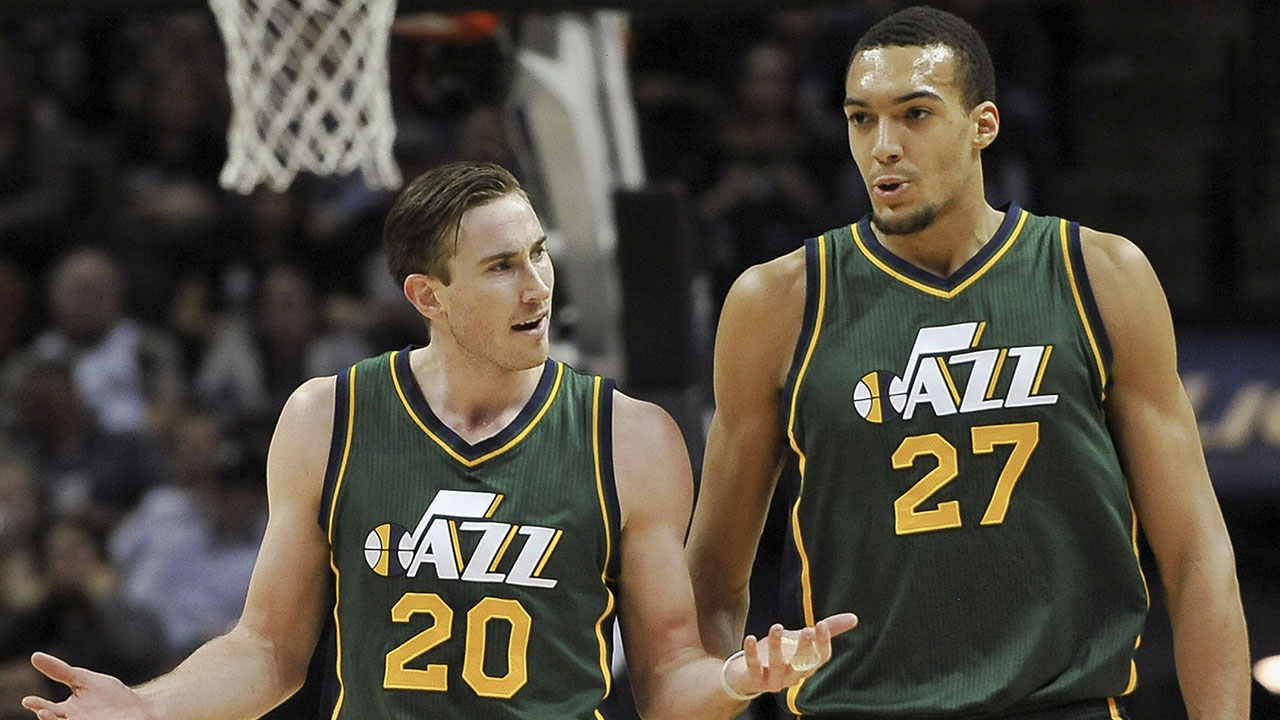
For proof, look no further than Rudy Gobert, the 27th pick of the 2013 draft. Denver technically made the selection, but basically gave him away to the Jazz for Erick Green and some cash.
How Gobert stayed on the board so late in the first round is mystifying in hindsight. He is a seven-foot-one, 245-lb. 22-year-old with a standing reach of nine-foot-seven. If he stands under a regulation hoop and raises his arms, he basically just has to go up on his tippy-toes to touch the rim. How did a team not take a chance on him earlier based on that stat alone?
Since he took over as starting centre (after the All-Star break), Gobert’s defensive rating has improved from 102.3 to 93.0, and the Jazz have collectively transformed from the 26th-ranked defence in the league prior to the all-star break (allowing 106.1 points per 100 possessions) to the NBA’s best unit since (allowing only 91.1 points per 100 possessions).
Trading Kanter and allowing Gobert to take over had a lot to do with that jump.
Gobert is already an elite rim protector. According to Nylon Calculus, he is the NBA’s stingiest defender at the rim—opponents shoot just 40.1 percent at the rim when Gobert is there to contest. He also leads the NBA in points saved per game and per 36 minutes with 2.52 and 3.69, respectively. Those are incredibly impressive numbers for anyone, let alone a 22-year-old at the very beginning of his career. He’s earned every nickname he’s been given: The French Rejection, The Stifle Tower, The Gobert Report, and so on.
Gobert’s offensive game is still a work in progress, but when you watch him play, it’s easy to envision him evolving something approximating Tyson Chandler’s attack—setting hard picks then crashing the rim for lobs and bounce passes galore, or catching the ball at the elbow and firing a short jumper or taking a dribble and cramming it home. He’s nowhere near Chandler’s level of productivity at that end yet, but he’s taking large baby steps to get there.
So, how have the Jazz fared since the Kanter trade?
Since the Feb. 19 deadline, the Jazz are 12-6—tied with the Rockets and Clippers for the third-most wins in the West over that span, trailing only Oklahoma City and Golden State. They’ve lost their last two by a combined five points, against the Wolves (in OT) and the Trail Blazers. They could very easily be 14-4.
Of course, the turnaround isn’t just Gobert. Gordon Hayward is a borderline all-star and his play continues to justify the extension he signed last off-season. He’s been out with a shoulder injury for the past two games, but is listed as probable to return tonight against the Nuggets. Favors is another borderline all-star, averaging 18.3 points, 8.8 rebounds and 1.8 blocks per game, while shooting 52.7 percent from the field. He benefits immensely from playing alongside Gobert because it allows him to play a more natural power forward role. Rookie wing Rodney Hood has shot a phenomenal 46.7 percent from three since the break, fellow freshman Dante Exum has shown flashes of play-making creativity despite being stuck in a rut much of the year and sophomore guard Trey Burke has been progressing steadily since last season and can provide quite a spark for the Jazz on any given night.
Most impressive may be the fact that Utah has had this recent string of success despite the fact that Alec Burks—an underrated shooting guard—has been out since the end of December after undergoing season-ending shoulder surgery.
All of these guys are between 19 and 25 years old and are under contract with the Jazz for the next several seasons. Utah will have another lottery pick this June and some cap flexibility to work with. That’s a solid ensemble—one that looks ready to make some noise in the league sooner rather than later.