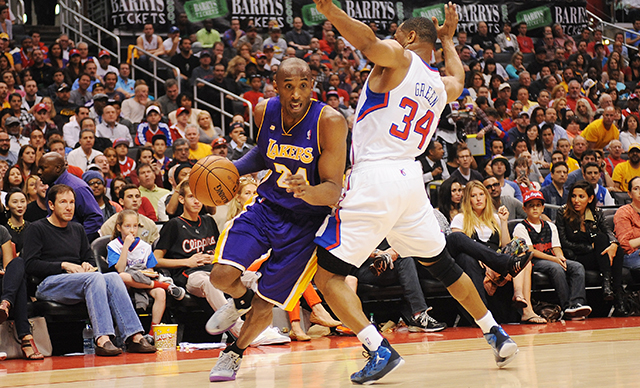

When Kobe Bryant’s new two-year, $48.5 million contract extension was first announced many—well, pretty much everybody—in the basketball community were shocked. An aging superstar who has not yet returned from a devastating Achilles injury gets $4 million more per year than LeBron James? Would this not be an onerous contract for a team already hampered with salary-cap woes? Even though the Lakers have 10 players with expiring contracts, the Mamba deal only gives them enough cap space to sign one other close-to-max-level player rather than shoot for the Big Three blueprint that has been adopted most notably in Miami.
We’ve long seen Kobe from afar as the poster boy for the win-at-all-costs sports persona. He plays through pain. He demands of his teammates often far more than they can offer. He wants the ball in crunch-time. But as we get closer to his on-court return at Sunday’s home game against the Raptors, we have to ask: Is the portrait we’ve painted of über-competitive Kobe inaccurate?
Seen another way, however, the deal could be an affirmation of his competitive drive. He’s not just competing with the players of his age. He’s competing with those who came before him. He’s competing with the NBA’s collective bargaining agreement. He’s competing with himself. He wants to win—he seems simply to want to do so on his own terms.
If there is one thing we know about Bryant it’s that everything he does is calculated. He gave himself the Black Mamba nickname only to use it to refer to himself in the third person. He took the jersey number 24 because it was one more than Michael Jordan’s 23. As a kid he would study basketball cards for hours to learn the intricacies of how players positioned their bodies on the court.
He’s always seen things through his own particular lens. Wanting to move more like his friend Lionel Messi, he had Nike make him a low-cut sneaker designed like a soccer cleat as opposed to standard NBA high-tops. Kobe is not just a beautiful mind—he’s an antithetical mind.
Although we measure athletes with rings, the elusive sixth to tie Jordan isn’t the only thing Kobe’s chasing. First off, this deal solidifies him as a one-franchise superstar—something becoming more and more rare in this era. Jordan, Barkley, Shaq, Garnett and LeBron have all worn multiple jerseys. Aside from Tim Duncan he will be the only all-timer of this generation to finish his career with one franchise, putting him in rarified air with Magic and Bird. And he’s already won as many championships as the former and two more than the latter.
What’s more, he currently sits just 675 points behind His Airness for third place on the all-time scoring list, but could reach an even higher plateau. Playing under Mike D’Antoni’s seven-seconds-or-less offensive system without another dominant scorer on his team will give him an outside shot at getting the 6,771 points he needs to eclipse Kareem Abdul-Jabbar for first. Lost in the 2012–13 Lakers’ lack of wins was the fact that Kobe had one of his best offensive seasons under D’Antoni last year, putting up more than 27 points per game for a total of 2,133.
Does this move enhance the Lakers’ chance of winning a championship? No. But that’s the Buss family’s burden—not Kobe’s. What it does enhance—or at least maintain—is the team’s marketability in a Los Angeles marketplace where television rights continue to soar. As exciting as Portland and Indiana are with up-and-coming stars like Damian Lillard and Paul George, neither has the Kobe cache. Those are two fiscally responsible franchises built for long-term success, but celebrities and Fortune 500 companies aren’t lining up to be associated with that product. It’s not a coincidence the Lakers’ 320-game home sell-out streak ended while Kobe was on the IR.
Kobe won his negotiation by demanding what he is worth, but it’s not like the Lakers are big losers in this arrangement. Regardless of whether they hang another banner in the Staples Center over the lifetime of his contract, the Lakers are also winning. They are going to make considerably more off of Kobe Bryant than the $48.5 million they are in line to pay him. Bryant himself said as much when he defended himself on Twitter. Imagine having to send out 140 characters to explain a right that you collectively bargained for. The sports world of all places should not be an anti-capitalist space.
Furthermore, why is our default position to blame Kobe? We blame the player for wanting out and taking more money (see Carmelo Anthony), we blame the player for leaving and taking less money (see LeBron James), and now in Bryant’s case we are blaming the player for staying and taking less (he’s making $30.4 million this season). Is the only way to win with the public when signing a new deal to stay with your current franchise and accept far less? Maybe play for free? Apply that logic to your own career. Is that an arrangement you’d applaud?
No, Kobe is as competitive off the court as he is on it. And despite what the public reaction to his contract will tell you, none of this is to say that Bryant is now indifferent to team success. He is supposed to have the irrational confidence that he can win with any supporting cast. He has been selfish from day one: more celebrity; more money; more points; more wins; a bigger share of the spotlight in the NBA’s brightest market. The new contract doesn’t change any of that. He wants it all. And that’s what makes him great.