
By now you’re probably aware that the Golden State Warriors planned to stage a walkout if the NBA didn’t drop the hammer on Tuesday and hand Los Angeles Clippers owner and slumlord Donald Sterling a max sentence. The notion had crossed the Clippers’ minds since the girlfriend of the guy who signs their checks took her now infamous audiofile to TMZ and all hell broke loose.
Rookie NBA commissioner Adam Silver broke his maiden crisis in fine style with various and sundry prohibitions on Sterling and thus averted a disaster—the only way you could describe a team forfeiting a playoff game on a matter of conscience. We don’t know how this plays out in the long run. Will Silver and the owners force Sterling to divest himself of a team or land in the courts trying? Yesterday looked like a total victory for Silver, but you have to suspect that a handle will fall off the trophy the pundits handed him at some point. Hard to think of it as a total victory if Sterling makes a half-billion on the sale of the franchise.
In the meantime, let’s rewind to the idea of the teams walking out in protest of a plainly and painfully racist owner, one whose view of life is in line with 19th-century plantation owners and 21st-century rebel ranchers who pass, momentarily anyways, as Tea Party patriots.
Over the past few days, the media has evoked the protests of games past, notably those at the Olympics in Mexico City back in ’68. Harry Edwards, a catalyst for those protests and others back in the late 60s, was returning a lot of calls. Yesterday it was black gloves and raised fists, today practice tops turned inside out and black socks.
Kareem Abdul-Jabbar, a Hall of Famer and, very briefly, a Clippers’ employee, had an interesting take on the Sterling affair but, somehow, he didn’t broach the idea of a walkout. Sort of interesting given that he opted not to play for the US Olympic team in ’68 for the same reasons that Tommie Smith and John Carlos protested in Mexico, a matter lost in the mix if not missed by social historians.
Walking off the floor before Game 5 would have been hard to do, maybe more so for the Clippers than their opponents. After all, players walking out would have been in breach of contracts they signed with Sterling. It’s bad enough working for a racist but worse to be sued by an infamously litigious one who already beat down a Hall of Famer in court. This is to say, the players who have made millions from Sterling would likely have had to defend their case in a civil proceeding. Somewhat inconvenient, but ultimately not putting their careers at risk, especially with the rising tide of public opinion.
Just by chance last week I had a conversation with a gentleman who back in the late 60s made a stand, walked off the floor and put a lot on the line—his playing career not to mention his professional career after basketball.
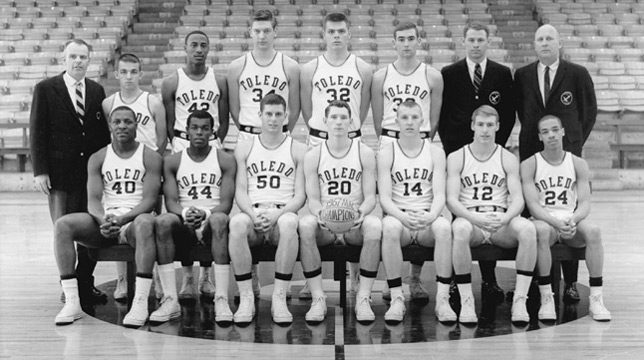
John Rudley was the starting point guard on the University of Toledo Rockets back in 1969. In the early- and mid-60s—just before Rudley’s time—Toledo, like a lot of teams in the northeast and midwest, had a soft colour line. Nothing on the books, just a code. Toledo would put one black player on the floor at a time. Maybe one more, but never more than two. It was integration in name but not spirit, a quota system not a meritocracy. But when the program went sideways and fans and boosters started complaining loudly, the Rockets’ coach, Bob Nichols, began aggressively recruiting black players, Rudley among them. Nichols rewrote the code somewhat—or at least relaxed it. There wouldn’t be five black players on the floor at any one time—not like the Texas Western team that beat Kentucky’s all-white team in the ’66 NCAA final—but still, the quota was heading in the right direction.
Rudley and the incoming recruits pounded the upperclassmen in the varsity-freshmen game. (Back in those days freshmen weren’t eligible.) “They had to take us off the floor because we were beating them by about 50 points,” he says. When that class finally stepped on the court in NCAA play, they were similarly impressive. In ’68, the Rockets were in the national top 10 for much of the season and lost only two games.
Nonetheless, there was an undercurrent of unrest among Rudley and his black teammates. “The focus of our offence was Steve Mix, who was white and happened to be the son of a well-known sportswriter in Toledo,” Rudley told me. “A couple of our guys [black players] were every bit as good as Mix, but the ball went in to Mix. We weren’t comfortable with that. There were a few things that we weren’t comfortable with. I felt like I had come to the wrong place pretty soon after I arrived on campus, and I’m sure others did too, but I made my mind up I was going to get an education and make the best of it on the court. Others fell by the wayside and left the team.”
The crisis came at the end of January in 1969. “Bob Miller, our sixth man, missed a class and Nichols kicked him off the team,” Rudley says. “Just like that he pulled Bob’s scholarship. We thought we were being held to a standard that other students on campus weren’t. We also thought that Bob had been denied due process—it was just arbitrary. One class; not failing grades or anything like that.”
It might have ended there, just more discontent on the varsity squad. It became something more when the black-students union took up the cause. “We had a nationally televised game against Villanova,” Rudley says. “Before the game, the black-students union—about 50 or 75 students—went out onto the floor to protest how Bob was treated. When the crowd, mostly a white crowd, booed and when they finally came off the floor, I thought, ‘I can’t play the game. And I didn’t.’”
Nor did Jim Miller, another black player (not related to Bob Miller). Some newspaper accounts of the game managed to mention the absence of Rudley and Jim Miller as well as Bob Miller’s dropping, but didn’t bother to mention the black-students union. The local paper gave a cheer-for-the-home-team treatment of the players who soldiered on against Villanova.
Ultimately, though, there were no winners. Toledo lost the game, Bob Miller was gone from school and Rudley and Jim Miller were left with a memory of a hard time. Both considered quitting the team. Both stayed on with heavy hearts. Both finished their schooling after putting their scholarships at risk with a symbolic gesture that seemingly accomplished nothing.
Whether there was any racism in Nichols’s decision to drop Bob Miller was never entirely clear. Nichols always maintained it wasn’t a factor. It looked like it was at the time, though. “You have to understand the times,” Rudley says. “We’re not long removed from the civil rights movement, from Dr King’s assassination. It looked like race was a factor to us and it definitely did to other black students.”
And the white players? “We never heard anything from them when Bob Miller was kicked off the team,” Rudley says.
Just that fact makes the issue a racial one.
I asked Dr. John Rudley, these days the president of Texas Southern University, why he risked so much. “In that moment I felt it was all that I could do in good conscience after others had taken their stand,” he says.
Toledo is a long way from L.A., and 1969 is a lifetime ago. Still, there’s an object lesson to be drawn: To stage a walkout, a really meaningful protest, the Warriors and Clippers would have needed stronger support from other players around the league, from coaches and owners, from others who have a stake in the NBA. If players in other games were prepared to walk out in sympathy, if owners and broadcasters were to sign off on it, then both teams would have heard their consciences calling before tip-off and followed them off the court.
All of that, however, is what you call a big ask.