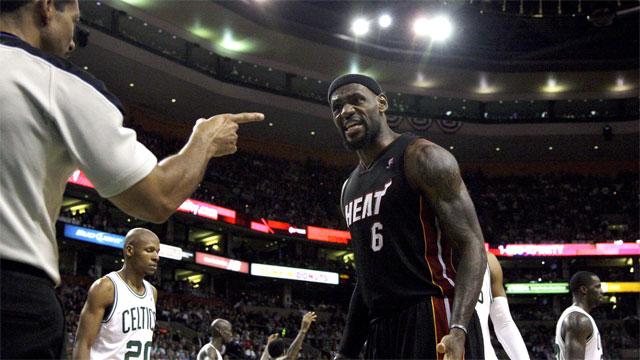

I have always maintained that, in these eyes, basketball is the most difficult of the four major sports to officiate. I’m up for the debate because with the exception of the NFL, where pass interference and holding are also complex judgment calls, there are so many variables that need to be watched and considered in basketball adjudicating is very complicated.
The game of basketball moves so quickly that there isn’t time to throw anything that’s the equivalent of a challenge flag in the NFL. As an aside, the best challenge to a questionable call comes from tennis where it’s quick and definitive.
To make matters even more problematic, the recent rule changes in the evolution of the game have been tailored to attract fans and are catered toward the offense. Just imagine if athletes like Julius Erving and Michael Jordan could have played in this era where contact on an offensive player was limited. Larry Bird’s great “off the ball defence” would have been just fine in this era of modified zone defences. But unlike any other major sport, basketball is one, perhaps the only one where, without any egregious actions, a certain number of common violations of the rules can have you banished from the game.
You don’t always get disqualified from a hockey game for a fight; and 5 offensive holding calls, or pass interference calls in football doesn’t get you tossed from the game. It often has me wondering if the NBA should just employ the summer league rule with graduated punishment. In other words, no player shall foul out but after six fouls on a particular individual, the other team gets one shot and then the ball back. Perhaps after nine fouls, it’s two shots and the ball and the team that is fouled can have any player shoot the shots after the sixth personal foul.
Basketball officials will tell you the toughest call in the game is the quick judgment that has to be made on a blocking or charging call. As retired veteran NBA official Steve Javie said the officials watch the defence and look to see if an offensive player has his rhythm, speed, balance and quickness disrupted. To make it even tougher, the biggest epidemic in hoops right now is the flop. In the NBA, you can thank the advent of the international players who have brought their soccer mentality to basketball.
The charge/block used to be a clear cut call. If the offensive player hit the defender in the sternum, the middle of the chest, it was a charge. If there was contact that was questionable, if the offensive player’s head and shoulders were past the plane of the defenders shoulders, it was a block. But it’s not that simple any more as we now have the floppers. You know those players that are supposedly set with their feet planted but shift ever so slightly while the offensive player is airborne and then hit the deck as if they were felled by a sniper in the arena’s upper deck. They don’t give the offensive player enough room to land as they come under them on a drive to the hoop. On occasions, officials are making the call on the basis of the defender’s reaction as opposed to what really happened on the play.
It’s shameful, deceitful and upsetting to NBA Commissioner David Stern. I was up in arms about it a while back when I chronicled this musing, and the NBA’s competition committee has discussed penalizing floppers retroactively. Hey why not? Everyone watches game video, including officials. No need for fanfare, just notify the offending flopper that they have received an unsportsmanlike technical foul the next day. Let the coaches tell the official scorer to mark the time of the dive and let the league review it the next day.
But to help officials, and the game in general, I would make these changes to the rules. While the restricted area right now consists of a small semi-circle under the basket where no secondary defender can draw a charge if the play starts outside the lower defensive box (LDB), I would expand the “charge free zone” for an airborne player to the entire lower defensive box. In other words, if a player is driving to the basket and starts outside the LDB, no defender can draw a charge. This way, officials only have to look at where a player started his drive to the goal. The only charge that can take place in that box is one where the player starts a foray to the hoop from inside the box and the secondary defender, player not guarding the ball handler, is outside a smaller restricted area (semi-circle)
Another change to make officiating more transparent and consistent would be to go back to the college and high school roots regarding traveling. Call it closer and tighten it up. Players will adjust. The same should be done for the discontinued dribble, or as we called it back in the day, palming or carrying the ball. Anytime a players hand touches the ball below the equator, middle of the ball, nine o’clock to three o’clock, it’s a carry. That would force a change. Heck some of guys best crossover and hesitation moves are lethal because this rule has been so relaxed.
If adapted, these changes would make it easier for referees entrusted with officiating the toughest sport of the them all.