By Sportsnet magazine
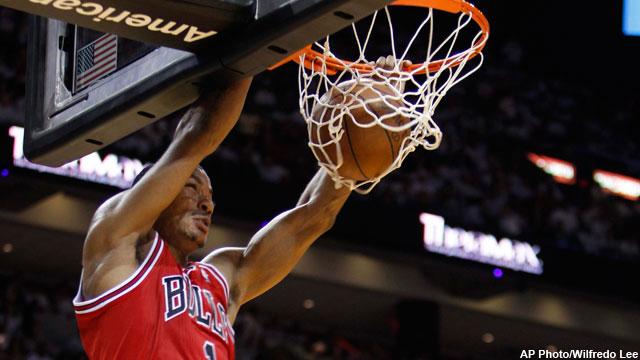
Derrick Rose, Chicago Bulls, Guard
6-3 | 190 | Years pro: 3
What kind of expectations do you set for yourself going into your third season?” Derrick Rose was asked at the Bulls media day press conference before the start of the 2010–11 campaign. “They’re high,” Rose said. “The way I look at it, why can’t I be the MVP of the league?”
Flash forward eight months, and Rose is handed the MVP trophy before an Eastern Conference semifinal game against Atlanta—an 86–73 win in which D-Rose scored 25 points, and added 10 assists, six boards and two blocks. At 22, the Chicago native is the youngest player in NBA history to win the award, after leading the Bulls to a league-best 62 wins.
Records like that suit Rose, who, as the first overall pick of the 2008 draft, was unlike any point guard the league had ever seen—and nobody has come close since. Physically, there’s nothing he can’t do on the court. Rose’s blazing speed (he ran the three-quarter court sprint at the draft combine in just 3.05 seconds—faster than speedsters Russell Westbrook, Dwyane Wade, John Wall, and just about any other relevant player in basketball), explosive first step, and raw athleticism is matched by a fearlessness usually reserved for Hollywood stuntmen, throwing himself in the lane and manoeuvring his six-foot-two, 190-lb. frame amongst the trees. Plus, he’s a tenacious competitor, the guy you want on your side when it’s on the line. “We got to win,” Rose has said. “Win no matter what. Trip, kick somebody, fight, bite. Whatever. Win.”
As much as he likes to talk, time after time, he’s backed it up. Like the night after he received his MVP trophy, when he dropped a career-high 44 points on 60 percent shooting against the Hawks. Or the monstrous two-handed slam on then-Suns point guard Goran Dragic (sending the memo to the rest of the NBA: when I’m heading to the hoop, move out of the way). Or when, in the second half of a tight game against the Miami Heat last season, Rose took off past both LeBron James and Dwyane Wade on a fast break before sandwiching himself between the two Heat superstars at the rim and finishing with an impossible reverse layup.
The NBA’s elite—of which Rose is already a part—aren’t surprised at his success. “I can tell when a player truly wants to be better and improve, and I admire that,” Kobe Bryant said. LeBron went one better: “I love Derrick Rose. He’s an awesome talent and a guy you want to play hard for. The sky’s the limit for him.”
Rose is proving LeBron right: he’s steadily improved in each of his three seasons (16.8 ppg as a rookie to 20.8 as a sophomore to an even 25-per last year, and his three-point shooting has spiked 11 percent in that span), singlehandedly bringing the Bulls back to relevancy for the first time since Michael Jordan and the gang were hanging championship banners from the United Center rafters. He spent the summer improving his outside shot and developing a post game, and promises to return this season better than ever. The fans’ expectations for Rose are high. His are higher.
— Dave Zarum, Sportsnet magazine
Kevin Durant, Oklahoma City Thunder, Forward
6-9 | 230 | Years pro: 4
The running joke all summer was that if you wanted to get a hold of Kevin Durant, just set up a basketball net. He’ll show up.
The 23-year-old Durant cemented his role as a leading face of the NBA’s next generation—if he hadn’t already done so by leading the league in scoring in each of the past two seasons—by fronting the “Basketball Never Stops” charge, the mantra adopted by NBA players participating in a series of glorified pickup games during the lockout. From Rucker Park in Harlem (where he dropped 66 points) to the Goodman League in his native Maryland (44 points and MVP honours), to the game he hosted in Oklahoma City (a triple double, registering 42 points, 26 rebounds and 11 assists), the ‘Durantula’ was clearly in his natural habitat.
On the morning of Nov. 26, when it was announced that the lockout was effectively over, Durant took to Twitter and proclaimed to his more than one million followers: “If this is true I am bouta go wake my mom n grandma up and put on a suit and thunder hat and cry! Please be tru!”
If his image away from the game is that of a basketball-loving choirboy, on the court Durant transforms into a cold-blooded killer. Opponents enter games with one game plan: shut down KD. But it rarely works. After all, how can you shut down a six-foot-nine talent with the scoring touch of George ‘The Iceman’ Gervin and Larry Bird-like range? More than any player in the NBA, he’s a total match-up nightmare—the skills of a shooting guard in the body of a power forward. And despite his skinny frame and accusations that he’d rather pull up and shoot from deep instead of drawing contact, Durant was second only to Dwight Howard in free throw attempts last season, where he converted 88 percent of his shots.
Behind Durant, the Thunder have the makings of a perennial title contender, something they proved by reaching the Western Conference finals last season before losing to Dallas, the eventual champion, in five games. But Durant wasn’t satisfied. In the post-game press conference after game five, he was asked if he felt happy for Mavs star Dirk Nowitzki. “I’m not happy at all,” he said. “I’m a competitor, man. I’m sure he’s happy now that he’s going back to the Finals, but I’m not happy for him at all because I wanted to be there.”
Durant is the future of the NBA; that he’s the present as well is a testament to how quickly he’s adjusted to the big stage. This is the same guy who claims his career-high scoring mark in high school was 33 points. He topped that six times in his one and only college year at Texas, and has topped it a whopping 58 times in four seasons as an NBA starter. That number will continue to grow, but there’s only one stat Durant cares about: wins.
— Dave Zarum, Sportsnet magazine
Blake Griffin, Los Angeles Clippers, Forward
Dave Zarum
6-10 | 251 | Years pro: 2
Blake Griffin had already embarrassed Timofey Mozgov once in the third quarter of an L.A. Clippers-New York Knicks matchup last year with a nasty one-handed putback dunk over the seven-foot-one Russian’s back. So when Griffin, in just his 14th NBA game, received a pass on the baseline minutes later with only Mozgov between him and the basket, the entire Staples Center crowd braced for impact. Griffin—six-foot-ten and 255 lb. of muscle—took off, planting his palm on the right side of the centre’s face, ferociously throwing the ball through the basket like a full-grown man slamming on a Playskool hoop. When Knicks star Amar’e Stoudemire—who knows a thing or two about posterizing dunks—took to the free throw line on the next play, he and Griffin locked eyes. Stoudemire raised his eyebrows and nodded his head in approving awe, while the two big men tried, and failed, to hold back their smiles. No words were spoken, but the message was clear: Welcome to the NBA, kid. You’ll do just fine.
The Blake Show might be the biggest thing in Hollywood these days, but superstardom wasn’t always a slam dunk for the 2009 No.1 pick. After missing what should have been his rookie year in 2009–10 with a devastating knee injury, many questioned if Griffin—a player known for his high-flying and reckless abandon—could return to form. He answered his critics the first chance he got, dropping 20 points and ripping down 14 boards on opening day. And he didn’t look back, recording one of the most dominating debut seasons ever, finishing 0.2 assists per game away from becoming just the third player in NBA history to average 22 points, 12 rebounds and four assists in his rookie year.
But it’s not just about the numbers—it’s how he gets them. Like a young Shawn Kemp, Griffin careens around the court with all the subtlety of a wrecking ball, flying in for rebounds and slams, regardless of who or what’s in his way. He’s shown flashes of a post-game and is working on developing a dangerous Duncan-inspired bank shot, but he’s still very much a raw product. Charles Barkley put it best, after watching Griffin catch a pass off the side of the backboard and windmill it home during last year’s slam dunk contest: “When he learns to play basketball, it’s gonna be scary.”
In his first season, Griffin and the Clippers—yes, those Clippers— suddenly became must-see television, and all season long he drew fans to whichever arena the Clippers played in (he was even able to sell out a Nets game in New Jersey—a team with the league’s second-worst overall attendance last season). With the Mozgov dunk, The Blake Show went into syndication around the world—the YouTube clip of the play has nearly 4.5 million views to date. Suffice it to say, season three (and four, and five…) will be required viewing.
— Dave Zarum, Sportsnet magazine
Eric Gordon, Los Angeles Clippers, Guard
6-3 | 215 | Years pro: 3
No one said it would be easy playing for the other team in L.A. But forcing Eric Gordon to play in the shadow of a hype machine like Blake Griffin just seems cruel. Transplant Gordon onto the star-hungry Raptors roster, for instance, and he’s an instant sensation. But because of where he plays, and who he plays with, you may have never heard of him.
That’s going to change. Gordon actually paced Griffin on offence last season, scoring just 0.2 points per game less than the Rookie of the Year and shooting 20 percent better from the line. Plus, Gordon averaged more than 20 points a game last year, hit more than 80 percent of his free throws and shot 44 percent from the field and 35 percent on threes. Just one other player has ever done that before turning 23: Chris Paul in 2008–09. The greatest shooting guards in history—Jordan, Bryant, Allen—can’t even claim that.
But what coaches really love about the kid from Indiana who turns 23 on Christmas is that he does something productive every time the ball is in his hands. He’s a pure shooter from all over the floor, with an effortless jumper, but he finishes hard at the rim as well, and gets to the free-throw line plenty for a guard. Add in a serious mean streak (check his dunk over James Anderson on YouTube) and you get the sense Gordon won’t be playing second fiddle much longer.
— Arden Zwelling, Sportsnet magazine
Russell Westbrook, Oklahoma City Thunder, Guard
6-3 | 187 | Years pro: 3
People shook their heads when the Oklahoma City Thunder drafted Russell Westbrook fourth overall in 2008, doubtful about how NBA-ready he was. They’re still shaking their heads, but now it’s with awe. The 23-year-old leads the charge, along with Derrick Rose and John Wall, among a new breed of point guards who can crash through defences and score thanks to pure athletic power.
Westbrook’s offensive output took a huge bump last season, increasing from 15.3 and 16.1 points per game in his first two seasons to 21.9 in 2010–11—good enough to rank him 14th in the league—along with 8.2 assists per game. A late bloomer who didn’t reach his six-foot-three height and learn to dunk until his last year of high school, he now levitates over other players and slams home highlight-reel dunks on a nightly basis.
But Westbrook’s defining characteristic may be the speed he pours on to blow by other players. Teamed with Kevin Durant, Westbrook and the Thunder are legitimate title threats. The duo led their team to a 55-27 record and a Western Conference finals matchup against Dallas. Not that he’s perfect: Westbrook led the league in turnovers last year, committing an average of 3.9 sins a game. If he can mature past the sometimes selfish play that leads to those mistakes, he’ll be an even scarier weapon.
— Shannon Proudfoot, Sportsnet magazine
Kevin Love, Minnesota Timberwolves, Forward
6-10 | 260 | Years pro: 3
With only 17 wins last year, you’d need a pretty persuasive reason to sit down for a Timberwolves game. Enter Kevin Love. In 2010–11, Love became the first man to finish a season averaging 20 points and 15 rebounds a game since Moses Malone in 1983. He also notched the first 30-30 game in 28 years, the most rebounds in a game since 1996 (31), the longest double-double streak since the NBA-ABA merger (53 games) and an awkward handshake that has 2.7 million views on YouTube.
Stephen Curry, Golden State Warriors, Guard
6-3 | 185 | Years pro: 2
Last season, Ray Allen—the NBA’s all-time leader from behind the arc—put up the best field goal and three-point percentages of his career. Stephen Curry’s shooting numbers? Better. In fact, had he shot just two percent better from the field, he would have become the youngest member of the 50-40-90 club, joining Dirk Nowitzki, Steve Nash, Mark Price, Reggie Miller and Larry Bird.
— Evan Rosser, Sportsnet magazine
Five more whose future is now
Tyreke Evans
He recorded 20 points, five assists and five rebounds per game in ’09 as a rookie. The only other rookies with those numbers? Michael Jordan, LeBron James and Oscar Robertson.
DeMar Derozan
Arguably the best player on the 2011–12 Raptors (which is sad) and a key to the club’s future, DeRozan should have a chip on his shoulder after getting jobbed at last year’s dunk contest.
Serge Ibaka
In just his second year in the league, the 21-year-old Congolese forward averaged 2.4 blocks per game—good for 3rd in the NBA, and more than reigning Defensive POY Dwight Howard.
Brandon Jennings
Jennings is still trying to live up to the hype after dropping 55 points as a rookie in ’09. A rough sophomore year didn’t help, but here’s hoping the flashy guard returns to form this season.
DeMarcus Cousins
After averaging 14 and 8 as a rookie last season, Cousins showed why he could be the next Rasheed Wallace (in a good way), but he could just as easily wind up as the next Eddy Curry.