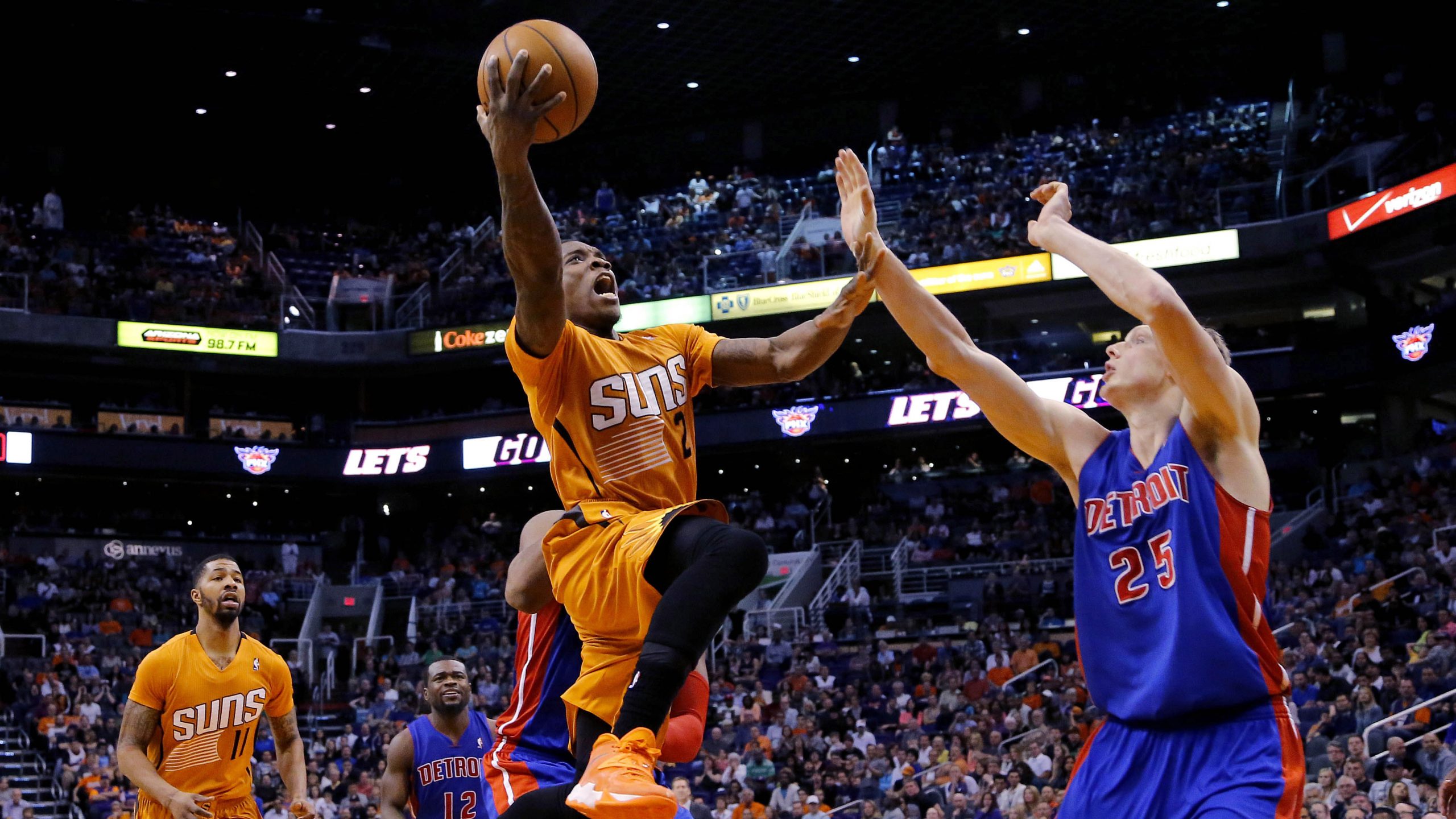

Nearly a full month into NBA free agency, most of the big names are long off the market. But Suns guard Eric “Mini-LeBron” Bledsoe is still available, having turned down a four-year, $48-million dollar offer from Phoenix. He wants a maximum-salary contract, but it doesn’t look like the Suns are prepared to budge anytime soon—even though they have the money. Let’s go to the FAQ to this sort this one out.
He wants the maximum salary, and Phoenix has it to give. What’s the hold-up?
To be clear, the Suns want Bledsoe back and are confident he’ll be on the team going forward. But they’re just in fantastic bargaining position. They already had Goran Dragic. Then they got Canadian point Tyler Ennis in the draft and snagged Sacramento’s Isaiah Thomas at a bit of a discount early in free agency. So they’ve got backcourt depth covered with or without Bledsoe, and can afford to play chicken a bit.
Why doesn’t someone steal him away then? Are other teams just lukewarm on him, or what?
Not exactly. Bledsoe answered a lot of questions about his ideal position last season in Phoenix, proving he’s athletic and effective on offence and defence whether running the team or filling the two-spot. If he were an unrestricted free agent, it stands to reason he would’ve signed a max contract (or close to it) with someone already, but restricted free agency in the NBA limits players’ bargaining power, especially the later it gets into the off-season.
Back up. What’s restricted free agency?
Essentially, he can negotiate and sign with whomever he likes, but then that contract gets sent back to the Suns to give them a chance to match (something everyone talking about Bledsoe believes they’ll do, no matter the dollar figure on the contract). They can take up to three days to make a decision.
How’d he get saddled with that?
He’s not alone. Unless there’s a pre-arranged extension already on the books (as in the case of Bledsoe’s former Kentucky backcourt mate John Wall), restricted free agency kicks in for every first rounder after the fourth year of a rookie deal—all the player’s team needs to do is extend a one-year qualifying offer based on draft slot.
So what’s Bledsoe’s qualifying offer?
He was selected 18th, so his annual salary is below the league average: $3,0726,966. (For comparison’s sake, Greg Monroe’s qualifying offer is $5,479,934.)
Why the hell would he sign that?
Freedom. If he accepts it, then he’s an unrestricted free agent next off-season, meaning he can sign with whichever team he wants, regardless of Phoenix’s plans. That said, it doesn’t seem like he’s all that interested in that route. Everyone with knowledge of the situation says he’s looking for a max contract, similar to what the Charlotte Hornets offered Gordon Hayward before Utah matched.
What kind of money are we talking about here?
The maximum annual salary for players with zero to six years of experience is $14,746,000, so that’s Bledsoe’s potential starting salary. If he signs with the Suns, he can get a maximum of five years with 7.5 percent raises between each of the years—the total value of the contract would be $84,790,000. If he signs with anyone else, he can get only four years with 4.5 percent annual raises (so the value of the contract tops out at $62,970,000).
So who’s got the cap space to offer him $14,746,000?
That’s where things get tricky for Camp Bledsoe. Philadelphia and Phoenix are currently the only teams that have that much space, but the former is angling toward next year’s lottery—getting Bledsoe at a big dollar figure doesn’t necessarily fit in with that plan.
Didn’t I hear Milwaukee had interest in offering him a max deal?
Yeah, you probably did. But the most they can offer him right now is about $10,000,000 (and that’s not factoring in any money carved out for Jerryd Bayless…). According to the latest numbers from Sham Sports, the Bucks can get as much as $13,000,000 under the cap by dumping three non-guaranteed contracts. But there’s a problem with that, too.
…Yeah?
I was pausing for dramatic effect. One of the non-guaranteed players Milwaukee would have to cut in that scenario is Khris Middleton, a six-foot-eight small forward making just $915,000 next season. Not only is he a bargain, but he’ll be a restricted free agent next off-season, when the Bucks will have bargaining power over him the way the Suns do with Bledsoe.
I’m sorry. Khris Middleton is no Eric Bledsoe.
True. But let’s say the Bucks waive Middleton and the others, and throw down every available cent into a Bledsoe offer. All the Suns have to do to foil the plan is match the offer, and the Bucks have given up an asset for nothing. Same goes for a salary-dump trade. They could feasibly flip someone like Ersan Ilyasova (getting paid $7,900,000 next season) to a team with $8,000,000 or more in cap space (and there are still a few of those out there…) and take back nothing in return, but if the ensuing Bledsoe deal falls through they’re weaker for it.
So he’s going to be a Phoenix Sun next year.
Yeah, probably.
Last question: What does that mean for Ennis?
With Thomas on board, he could spend more time in the D-League than originally thought, but that’s not such a bad thing. Cory Joseph actually requested to go down to the D-League early in his NBA career, simply because it offered him more reps. If Ennis stays up with the Suns, though, expect some serious small ball. Like, smallest ball ever.