
Highlights are awesome on their own. But they’re even better with a little context. Here’s a look back at the best of week five.
“You know where he got that from? LeBron!”
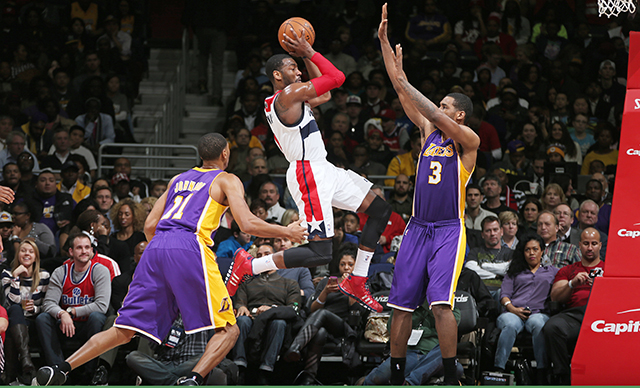
John Wall was named the Eastern Conference Player of the Week for the stretch of games from Nov. 18-24, and his numbers since the 18th are straight-up ridiculous. He’s played near-as-makes-no-difference 40 minutes a night; hit 50 percent of his shots from the field and behind the arc; shot 88 percent from the line; and averaged 24.3 points, 8.8 dimes, 4.8 boards and 2.8 steals a night. Damn.
Crazier still: There’s still huge room for improvement in Wall’s game.
The Kentucky alum has taken 41.6 percent of his shot attempts from mid-range this season and has hit on just 33.3 percent of them. He takes the eighth-most mid-range Js in the league per game and has the lowest success rate of any player in the top-15. (Making things worse for Washington, Bradley Beal takes the third-most mid-range looks and at 33.9 percent, doesn’t convert much better than Wall.)
Since the 18th, Wall has actually taken more mid-range shots (10 per game) and hit less of them (32.5 percent). So where is all the offensive efficiency coming from?
For the season, Wall has taken 27.8 percent of his shots in the restricted area and made a very sweet 66.2 percent of them. The boy can finish at the rim.
Since Nov. 18th, that number has gone up… a lot. Wall has taken 5.8 shots per game at the tin and made 82.6 percent of them. That number is absolutely insane.
Considering he’s hitting 50 percent of his downtown looks over the same span, it might be wise to consider cutting out (or at least down on) the mid-range attempts and sticking with what works.
“With evil intent”
It’s pretty clear through 16 games that Paul Millsap and Al Horford aren’t having much trouble coexisting. Both are shooting better than 52 percent and averaging more than 30 minutes, 15 points and 6.5 rebounds. And here, the threat Horford poses at the top of the key (especially with Avery Bradley guarding him) causes Boston’s Vitor Faverani to close late, get juked by Millsap and own a bit of responsibility for the subsequent destruction of his help defender, Jared Sullinger.
Atlanta, then, is basically fine—even if they’re just 8-8. But how is the Celtics’ interior D faring without Kevin Garnett or Doc Rivers?
Boston is currently allowing 44.2 points in the paint per game—the sixth highest number in the league. That’s up from last season’s 42.7, but the Celtics have held opponents to a lower shooting percentage in the paint.
Overall, the defense has fallen from the league’s sixth-ranked squad last season into a tie for 13th. That’s on par with the Clippers slide under Rivers (ninth to a tie for 16th) and nowhere close to the ghost D being played by Garnett’s and the Nets (from a tie for 18th to 30th).
Brooklyn is holding steady inside, allowing 4.3 less points in the paint per game and holding opponents to just 56.2 percent shooting in the restricted are (the NBA’s fourth-lowest mark). The Clippers are getting eaten up inside, spotting their opponents 45.3 points in the paint per game, the second-most in the league.
So, yeah, Millsap made the Celtics’ interior D look pretty bad on this play. But I guess things could’ve been worse.
“The 50-foot bounce pass right on the money”
It’s safe to say that when Manu Ginobili throws a lazer-guided, 50-foot bounce pass, he throws a context-rich, lazer-guided, 50-foot bounce pass.
This beauty came in last Friday’s 102-86 win over the Grizzlies, the game in which Memphis lost Marc Gasol to what eventually turned out to be an MCL sprain on a play that also began with a pretty Ginobili bounce pass (eerie, right?).
Ginobili remains the face of the Spurs’ second-unit, which has been excellent through the first month-and-a-bit of the season—ranking among the league’s five best benches in field-goal percentage (second, 48.2), three-point percentage (fifth, 41.3), points per game (fourth, 43.5) and offensive rating (second, 108.6).
They’re a bit more porous than San Antonio’s starters on the defensive end, allowing 97.7 points per 100 possessions (up from the first five’s remarkable 88.6). But that number is still good for seventh among bench units, a rank that’s made more impressive when you consider that the Spurs’ bench logs the second-most minutes of any back-up squad in the NBA (21.5 per game) and therefore spends a good chunk of its time guarding opponents’ starters.
After a handful of poor playoff performances had many declaring Ginobili dead last season, he’s bounced back nicely in limited minutes (it should be noted that the concept of limited minutes is a bit laughable in San Antonio, as only Tony Parker, Tim Duncan and Kawhi Leonard log more than 25 per). The tradeoff for the Spurs has come from Duncan’s uncharacteristically poor play.
The Big Fundamental is 58-for-148 on the season, and at 39.2 percent is one of just three Spurs shooting less than 45 percent from the field (the other two are Aron Baynes, who’s taken just 22 shots all year, and Cory Joseph, who’s only taken 17). Considering Duncan’s transcendent post-season play last year, it’s probably safe at this point to spread the rumour that he and Ginobili can’t perform up to expectations at the same time. So, spread away.
Oh, and Marco Belinelli (looking dope in transition here) has hit 50 percent of his threes this season.
“That’s a big boy dunk”
This sweet, sweet jam aside, 2013-14 hasn’t been great for Victor Oladipo. Forced to play some point, he’s turned the ball over 4.1 times a game and his 13.1 points, 3.9 boards and 3.6 assists are, at best, passable numbers for a No. 2 pick logging almost 30 minutes a night.
Group the class of 2013 together and things look pretty abysmal. Currently, Michael Carter-Williams and Mason Plumlee are the only two rookies with a PER higher than 15 (generally considered the mark of an “average” NBA player). A quick look at 2013’s top 10 basically sums up the state of things:
Player, PER
1) Anthony Bennett, 2.32
2) Victor Oladipo, 12.56
3) Otto Porter, Injured
4) Cody Zeller, 7.50
5) Alex Len, 9.17
6) Nerlens Noel, Injured
7) Ben McLemore, 10.65
8) Kentavious Caldwell-Pope, 9.48
9) Trey Burke, 7.62
10) C.J. McCollum, Injured
Here’s last year’s numbers for 2012’s top 10 for reference:
Player, PER
1) Anthony Davis, 21.80
2) Michael Kidd-Gilchrist, 14.04
3) Bradley Beal, 13.69
4) Dion Waiters, 13.77
5) Thomas Robinson, 10.97
6) Damian Lillard, 16.45
7) Harrison Barnes, 11.08
8) Terrence Ross, 10.48
9) Andre Drummond, 21.69
10) Austin Rivers, 5.95
Ouch.
“Oooo, he slams it!”
Paul George is a joy to behold.