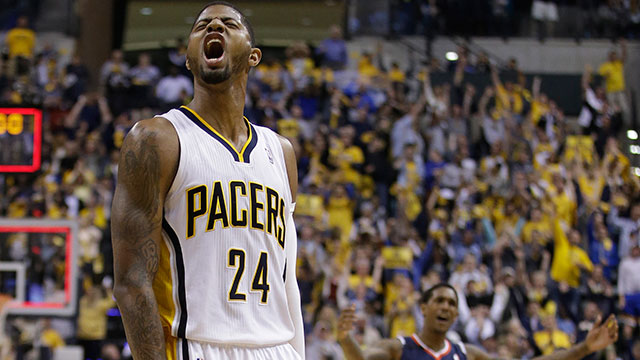
With a middling 16-14 record after the all-star break, a narrow first-round win and a jarring loss of home-court advantage early in the second round, the narrative of the unravelling Indiana Pacers has been marching toward a grim crescendo with little interruption for a while now.
Long the standard-bearers of defensive fortitude, Frank Vogel’s squad endured a final 30-game stretch in which they were outscored by an average of 2.1 points per 100 possessions. Then, in the opening stanza of the 2014 Playoffs, the Pacers flirted with elimination (and humiliation)—undressed by a zealous Atlanta unit that had stumbled its way into the Eastern Conference’s eighth seed. In Indianapolis for Game 7, though, the Pacers managed a comfortable 92–80 win to close out what had been an uncomfortable series. Fittingly, the deciding victory came on the back of Paul George, who put up 30 points and 11 rebounds in the contest.
Despite the parade of uncertainty that has surrounded the team, and the Pacers’ penchant for anything-but-aesthetically-pleasing basketball, George has been excellent this post-season. And though many have labelled fellow all-star Roy Hibbert the most important piece in the Indiana locker room, it will be George’s ability to sustain that excellence that ultimately determines how far this team can go.
Having elevated himself to the next echelon of stardom with a few standout games against the Heat in last year’s playoffs, George has defied his teammates’ trajectory this year by redefining the peak of his abilities. In Game 4 against Washington he posted a line—39 points, 12 rebounds, and seven three-pointers—unequaled in a playoff setting in the past 30 years. Through 12 post-season games, his lethal offensive play—headlined by a PER of 21.0 and 75.6-percent shooting in the restricted area—has swelled Indiana’s once-fading hopes for a second-consecutive Conference Finals ticket.
Not that they don’t still have a fair way to go.
The Pacers were hopelessly outrebounded by Washington in Game 5 on Tuesday, conceding a differential of 39 boards. That kind of showing can handcuff any team’s chances, and it’s a glaring concern for a group that was outmuscled on the glass by double digits only four times during the regular season.
It’s also ironic for a team whose playoff mantra—emblazoned on every available inch of Bankers Life Fieldhouse—is “Blue Collar, Gold Swagger.” Capitalising on just 8.3 percent of their offensive rebounding chances in Game 5, there seemed to be little truth to that bravado.
Frank Vogel meticulously crafted Indiana’s stubborn defence around the “verticality” of the behemoth lurking by the goal (Hibbert), and the unity of a starting lineup that shared the floor for heavy segments all year. In April and May, Hibbert has proven to be an unknown commodity and, while the patented starting core of George, Hibbert, David West, George Hill and Lance Stephenson has held opponents’ field-goal shooting to 38.2 percent in the post-season, the numbers on five-man units featuring reserve bigs Luis Scola and Ian Mahinmi are unflattering—to put it mildly.
Any concerns on D, though, are secondary to the mess on the opposite side of the ball. There aren’t too many ways to sugarcoat things when an offence fails to register 99 points per 100 possessions, something Indiana’s has managed in its past 12 outings. It’s a number that would have ranked 29th in the league in the regular season. Tuesday night’s showing—47 missed field goals and a paltry four offensive rebounds—was a particularly nightmarish one for Indiana, but there are solutions and, unsurprisingly, they begin with Paul George.
Save for a subpar shooting effort in the Game 5 defeat, the former Fresno State forward is in the midst of the best individual playoff run of his career. For context, consider how George’s remarkably efficient scoring and fluid rebounding compare to previous years:
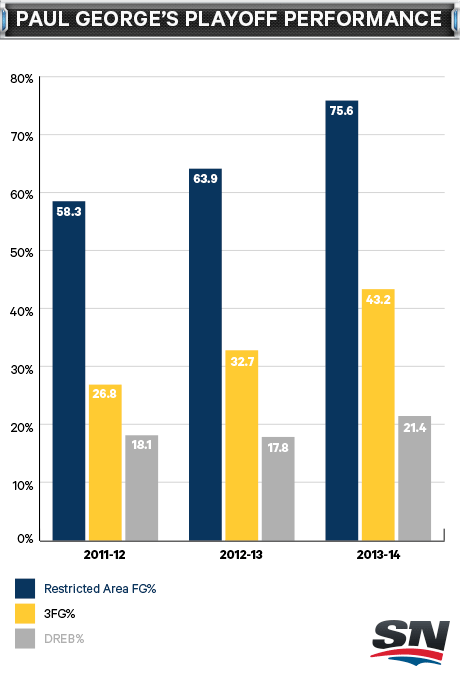
The Pacers have been flattened by a whopping 24.1 points per 100 possessions in 81 total minutes of non-George playoff lineups, per NBA.com. On Tuesday, George did lead the team in minutes with 38, but his 46 touches were only the third most of any Pacer (behind David West and George Hill). Contrast that to Indiana’s back-to-back road wins in Games 3 and 4, in which they netted around 31 percent of their points in the painted area and thrived with the offence passing through George’s hands. George had at least 80 touches in each win in D.C., a model that Indy would be wise to emulate in Thursday’s Game 6.
At six-foot-eight, George also has a claim to the title of the team’s chief rebounder, allowing Vogel to bump each player up one slot in the position column as a Band-Aid solution for spot minutes in the remainder of the series. Slicing the largely ineffective floor time logged by Hibbert, Scola and Mahinmi—even if only by a hair—should help put an end to the dire stretches that leave Indiana languishing. There may be few moves left to make on the coaching chessboard, but the time for Vogel to acknowledge the startling flaws of some of his routine cast members is rapidly approaching.
A pointed revision of the team-defining defence, paired with a couple of careful offensive adjustments, should improve the Pacers’ chances at seizing a series victory against the lively Wizards. If Paul George is afforded the liberty to dictate Indiana’s play on offence, then the team could even pose a threat in the Conference Finals.
The Pacers exhausted themselves this season clamouring for the conference’s No. 1 seed and the attached fringe benefits. And yet, for all of the recent theatrics, this roster remains a solitary win away from avoiding an early exit, and arriving at the series that it was manufactured for.