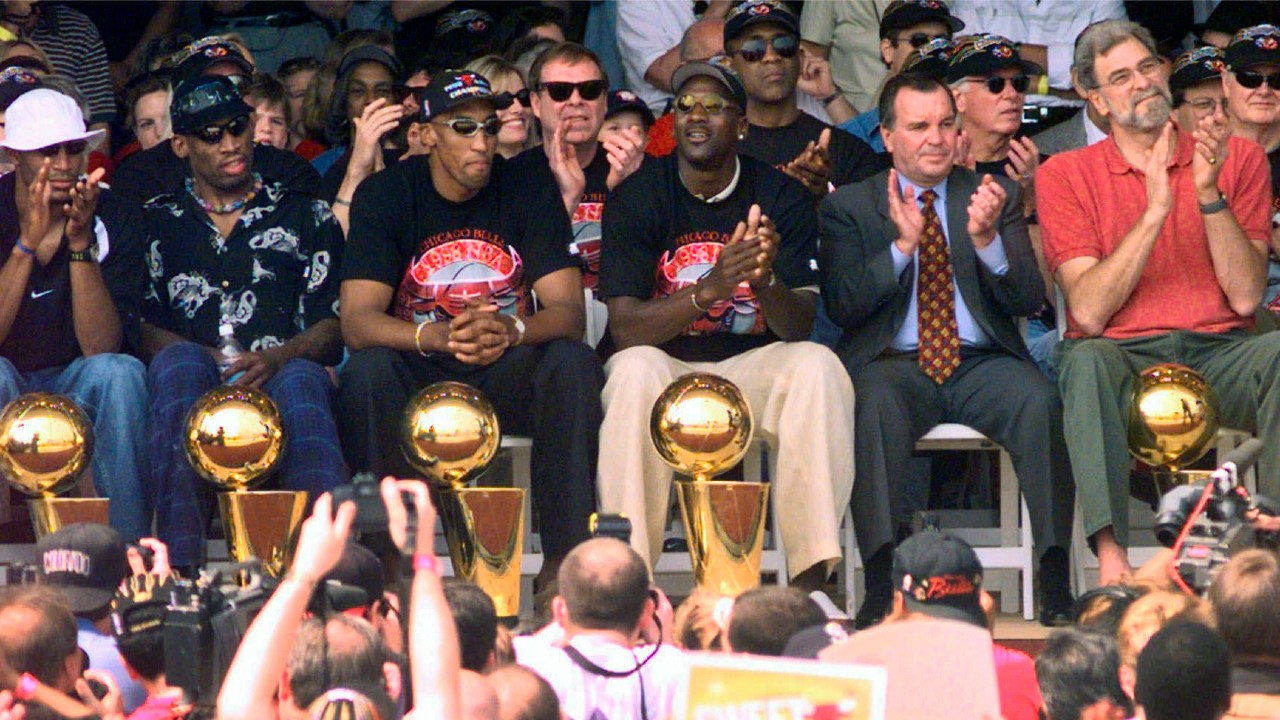

The day Michael Jordan threatened to kill him was when Bill Wennington knew that his working relationship with the greatest basketball player who has ever lived was going to work out just fine.
The Montreal-born center had nine professional seasons under his belt when he signed with Chicago in 1993-94 and ended up teaming with Jordan for the last three titles of the Bulls’ dynasty.
But he still had to be tested by Jordan, who was focused on winning first, friendship second and was known to put teammates through an on-and-off-court wringer, testing them to see if they had the mettle he believed they needed to compete for titles.
Wennington remembers brutally competitive practices and an even more unforgiving locker room environment where Jordan – like the meanest kid at recess — would almost systematically pick out teammates to tease and bully. It was not always in good fun, with Jordan leading the pack as they ganged up.
“The training room, it was like a barber shop where he would get on different players from time to time and challenge you mentally. Are you going to fight back,” says Wennington, who played 720 NBA games over 11 seasons and is now part of the Bulls broadcast team.
“I understood that and that when it started it was going to be 13 guys against one. And I knew one day it was going to be my turn…You can’t win that argument. I realized that I had to do something different.
“So, when they started on me I just let it go. And within five minutes they were bored because I wasn’t fighting back. But I knew it couldn’t end there because I couldn’t let Michael and the rest of team for that matter think, ‘Fine he’s not gonna fight back.’”
[snippet id=4888368]
Wennington timed his move.
“And so, about an hour later when we’re all showered up I went across the room and said, ‘You know Mike, I have been here now for a while and it’s a lot of fun when you guys start chirping on everyone but I’m going to tell you what: I’m smart enough — because I went to St John’s, not North Carolina – that I can’t win a debate 14 against one…But here’s what’s gonna happen the next time you start that argument or started on me: You’re gonna come into this locker room the next day and there’s gonna be a 12-foot snake in your locker’ – because I understood that he doesn’t like snakes.
“He says, ‘You’ll be a dead man; you’ll be the dead man down on the floor, I’ll kill you.’
“I said, ‘That’s fine. I’ll be the dead man lying right here, and you’ll be the (expletive) with a snake in your locker.’ He just looked at me and he was like, ‘Get the (expletive) out.’
“And nothing ever happened.’”
What did happen behind the curtain of one of sports great dynasties is about to be revealed in The Last Dance – an eagerly awaited 10-part documentary that debuts Sunday night in the United States on ESPN and Monday night on Netflix in Canada.
The 10-hour film is based on never-before-seen, behind-the-scenes footage gathered by NBA Entertainment cameras embedded with the Bulls as they tried to extend their championship run even as it was clear the team was about to be broken up.
The documentary includes hundreds of contemporary interviews, including several hours with Jordan, who cooperated fully in the project. The expectation is the lengthy – but likely not long enough for many – film will refresh his legacy in the eyes of generations who saw it live and explain his aura to younger fans who missed the show the first time.
It was originally scheduled to be shown on off nights during the NBA Finals in June. But when the world came to a halt due to COVID-19, ESPN made the decision to move up the release date.
With millions on lockdown and starved for fresh sports content and the enduring power of the Jordan myth, it promises to be a rare ‘monoculture moment,’ as NBA insider Nate Jones put it the other day on Twitter.
[snippet id=3360195]
Whether you watched Jordan, played against Jordan, played with Jordan or have only heard about Jordan and seen highlights on YouTube, it’s expected to be must-see TV.
Alvin Williams is 45 years old and was a teenaged basketball star in Philadelphia when Jordan was staking his claim as the best to ever play.
“Coming from Philly, Dr. J (former 76ers legend Julius Erving) was the guy that could do all the stuff that nobody in the world could do,” Williams says. “And then Michael came along, it’s kind of like you’re upset because somebody just like overtook your superhero. And then I started getting older and I started really understanding the game a little more, started understanding how difficult it was to play at that level. And then when I finally got a chance to be in the same vicinity as him and it was like, wow.”
One of Williams’ welcome-to-the-NBA moments was subbing into a game as rookie in the 97-98 season, looking around, doing the math and coming to a terrifying realization that he was guarding No. 23.
Williams was a second-round pick out of Villanova trying to make his mark with the Portland Trail Blazers.
Jordan was the most famous athlete on the planet and making a convincing case as the best basketball player of all time.
It went as you might expect. Jordan caught the ball in the mid-post, sized up Williams, drifted out to the three point-line and dropped a triple over Williams to close the first quarter.
“It was like he looked at me on him and tried to up the degree of difficulty,” says Williams, who became a Toronto Raptor by way of trade a few weeks later.
The 1997-98 Bulls were like a massive rock ‘n’ roll act that landed in town, turning everything upside down, bringing the city to a halt.
“I just remember leaving that arena after shoot-around that morning, and how packed it was outside,” says Williams, who played eight years and 417 games in the NBA, but only once against Jordan and the Bulls at their peak. “ .. and I was like, ‘Hold on I wonder why so many people are here,’ and then I realized they were there to see Chicago pull up for shoot-around…it was whole different world.”
Even those that lived inside the Jordan bubble are eager to see what it looked like more than 20 years later.
“I mean, when you’re going through it I don’t think we fully appreciated, or understood exactly what was happening because you’re right in it,” Wennington says. “I’m hearing about it from all different aspects – media, friends, people I played against, players I played with that never played against us. It’s kind of amazing and I think it’ll be a lot of fun to go down memory lane.”
Those that were too young to fully grasp what Jordan and the Bulls were about are even more eager to see how the legend was built.
“Oh man I can’t wait,” says Toronto Raptors guard Norm Powell, who was just five years old when Jordan won his last title and retired for the second time as the Bulls dynasty broke up before its natural end. “I’ve been looking at the Instagram videos and trailers for that. I think that’s going to be one of the dopest documentaries to come out.
“I mean, Jordan had a huge impact, not just on me but on the game as a whole. I don’t think I need to elaborate too much on that. I think we all know the impact Jordan has had on the game of basketball. But I do remember sitting down at home and having the VHS tape watching Michael Jordan to the Max over and over again. I just remember at the end of that (documentary) Michael Jordan’s voiceover and him saying, ‘There will be a player greater than me’ and that was so motivating for me when I was little.
“I would be like, ‘I’m going to be greater than Michael Jordan,’ and I would go out and start working on my game, dribbling up and down the street and trying to copy the things he was doing in that documentary. So Jordan has had an impact on why I play the game as well.”
Jordan’s legacy is secure. He doesn’t need a documentary to shine that up.
His record of six championships in six NBA Finals, along with six Finals MVP awards, speaks to his dominance. His string of eye-popping individual accomplishments speaks to his excellence: he was first-team all-NBA 11 times and first-team all-defense 10 times.
But the why and the how? Those are questions generations of fans – even those who have played against him – are hoping to have answered.
“I’m so excited to see what happened. What were the arguments, what were, you know, the disagreements, what were the challenges,” Williams says. “When you’re that good you’re going to have those types of things a lot. I mean of course they are great players but that comes with big personalities, so what takes place in those locker rooms behind the scenes? That’s gonna be the most interesting piece. I think that’s when you’re going to really realize what the NBA life is like.”
According to Fan 590 host Richard Deitsch, in a piece he wrote for The Athletic, Jordan expressed his concern during the documentary that having his infamous competitive edge exposed and raw could be jarring for some.
“Look, winning has a price,” Jordan says in episode 7, according to Dietsch. “And leadership has a price. So I pulled people along when they didn’t want to be pulled. I challenged people when they didn’t want to be challenged. And I earned that right because my teammates who came after me didn’t endure all the things that I endured.
“Once you joined the team, you lived at a certain standard that I played the game. And I wasn’t going to take any less…When people see this they are going say, ‘Well he wasn’t really a nice guy. He may have been a tyrant.’ Well, that’s you. Because you never won anything.”
Jordan as a tyrant is nothing new to Wennington, who had to gain Jordan’s respect in the run-up to Chicago’s second three-peat, culminating with the 1997-98 season.
If it meant Jordan threatening to kill him over a non-existent snake, so be it.
“He was, he was just ruffling feathers to see if you’re gonna be there when it counts,” Wennington says. “Because (when we played Indiana in the playoffs) Reggie Miller’s gonna ruffle your feathers and Antonio Davis and Dale Davis are going to kick your butt, so what are you going to do? Are you going to fight back or go sit on the bench?
“And that’s what you want. You want to be a part of the team — and to be part of the team, Michael has to trust you.”
Was Jordan a nice guy or a tyrant?
Doesn’t matter.
“I never had a problem with Michael,” Wennington says. “Because he played to win and I loved winning too.”
[relatedlinks]