
You can relive Game 4 of the Raptors’ series against the 76ers tonight at 8 p.m. ET on TSN. Game 5 airs tomorrow at 8 p.m. ET on Sportsnet and Sportsnet ONE. The full broadcast schedule of Toronto’s historic 2019 championship playoff run can be found here.
If there was a moment where you could make the argument that Kawhi Leonard was the best basketball player in the world and have pretty much everyone who cared nod in agreement it would be on May 5th, 2019, with 61 seconds left in Game 4 of the Toronto Raptors second-round series against the Philadelphia 76ers.
Stop time and Leonard stood alone.
It was an afternoon start on a Sunday and it was a rainy, dreary day, with life in Philadelphia that much more complicated because the city was hosting a marathon. Imagine: thousands and thousands of people, sweating, jostling, breathing, shoulder-to-shoulder.
What a time.
In the run to their NBA title the Raptors played a remarkable number of ‘must-win’ games.
They were a feature, not a bug: some teams surge to a championship, it’s a coronation more than a competition. The Raptors scratched and clawed nearly every step, scrambling to gain and maintain footholds that seemed to crumble underneath them. It made it more stressful, but in the end more fun.
Heading into Game 4, the Raptors were facing the first of what ended up being — conservatively — five games they realistically had to win in order to host a parade.
[relatedlinks]
Obviously Game 3 in Oakland against the Golden State Warriors was important, given that the Raptors had split against Golden State at home, and Games 3 and 4 against the Milwaukee Bucks after Toronto went down 0-2 were significant, and yes, Game 7 against the Sixers was critical.
But, chances are, none of those happen without the Raptors’ win in Philly that tied the series 2-2. The team that goes up 3-1 in wins the series 95.5 per cent of the time, according to WhoWins.com and you wouldn’t have bet on the Raptors to do it against what was a huge, talented Sixers club that seemed to be finding its stride.
Toronto trailed 2-1 heading into Game 4 and the Sixers were looking terrifying. They’d blown out Toronto in Game 3, with Joel Embiid shredding a Marc Gasol-woven cocoon to go off for 33 points, 10 rebounds and five blocks. There was no reason to think the then 25-year-old would retreat. He seemed to be on the ascent. Who knew that outside of his Game 3 explosion Embiid would average 15 points on 33 per cent shooting with more than four turnovers a game?
Meanwhile, Raptors not named Kawhi were struggling. Nick Nurse had basically abandoned playing his bench. Through three games Fred VanVleet and Norm Powell had scored 13 points — combined.
Toronto needed something special and Leonard delivered.
His line — spectacular as it was — only says so much. Anytime someone puts up 39 points on 20 shots in a playoff game while finding the energy to grab 14 rebounds, you can say, ‘Hey, good game.’
But not all brilliant games are created equally. This was not some track meet where points were up for grabs and the defence was turned up every other possession. It felt like something from decades past. The pace factor for the game was 91 — 10 possessions less than the Raptors averaged in the regular season and the slowest game they had played in the post-season to that point. It ended up being the third-slowest game Toronto played in the playoffs in their 24-game run.
Every possession seemed earned.
“It was one of those nights where we didn’t try to make it look pretty,” said Serge Ibaka after the game, one of six Raptors head coach Nick Nurse trusted with any significant minutes and who led the Raptors’ charge physically. “We had to try to grind, man … we tried to grind on the defensive end and on offence just play basketball.”
[snippet id=4725691]
It was right up Leonard’s alley, in other words. As I wrote in my game story at the time:
“… Leonard is a throwback player. No gimmicks. He would have been a star in the 50s, 60s, 70s – name your era. Silent, solid, simple. He’s like watching a piece of machinery, with gears well-oiled, roll along. Get in the way and you might lose a finger or worse. His off switch is tough to find. No one in this post-season has yet, and the bodies are piling up.”
His signature play on a near-perfect afternoon and evening of basketball came with just over a minute left to play, the Raptors up one in a game where Toronto led by three after one quarter, two at half and were tied heading into the fourth — two rats wrestling in sack, was my analogy.
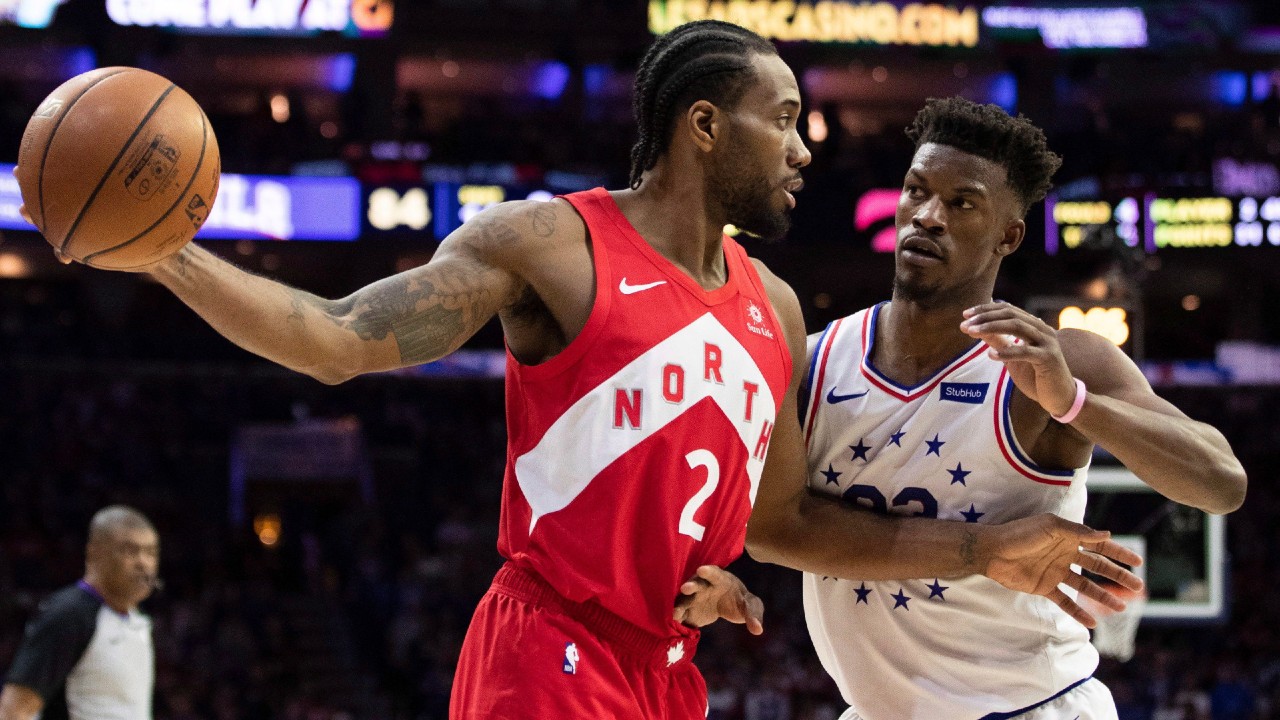
Leonard has the ball on the left side of the floor, just over half, with seven second left on the shot clock. Sixers guard Ben Simmons is in a stance and trying to fit in Leonard’s shorts, likely because the then-Raptors wing was shooting 4-of-6 from three at that stage and better than 50 per cent from deep in the playoffs. He’d earned the attention.
Leonard dribbles hard left, pushing Simmons down the floor far enough that Gasol can flip and set a screen on the big Sixers guard, forcing Embiid to switch on to him.
We know what happens: Leonard then drives hard to his right, stringing Embiid out and forcing him down below the three-point line before stepping back and letting it fly over the Sixers’ big man’s outstretched fingers.
The shot drops and the Raptors go up four. Some luck kicked in at that point, as Philly’s Tobias Harris misses a wide-open three on the next possession, which makes Leonard bricking a pair of free throws largely irrelevant. The Raptors win and tie the series, setting them up for their blowout win at home in Game 5 which gave them some semblance of control — even it did come down the wire in Game 7.
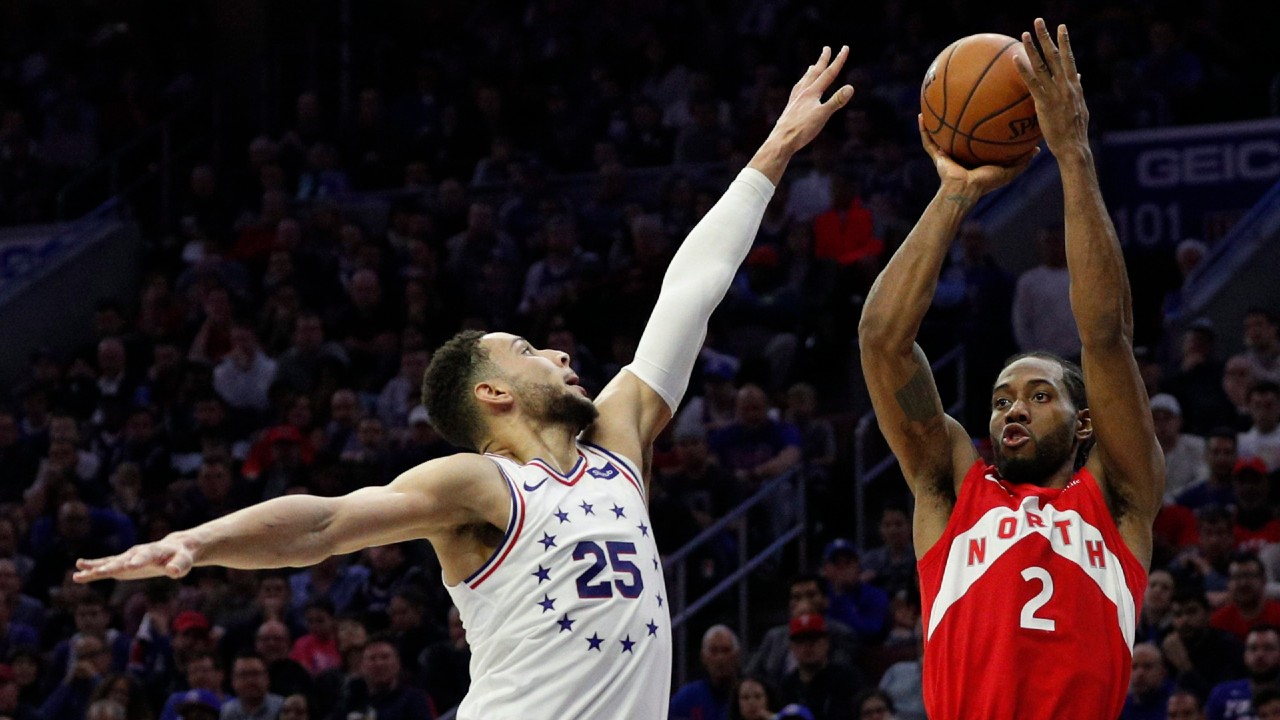
Leonard said the inspiration for his back-breaker came from a similar look he missed as the Raptors were trying to complete a comeback on the road against the Houston Rockets on Feb. 25. He dribbled right, pulled up hard but his shot was flat and never had a chance.
Everyone makes mistakes, but the great ones don’t repeat them.
“There were times in the past, playing in the regular season, I had times when I took those shots and they came up short,” Leonard said after Game 4. “So I guess I was thinking as well at the time to make sure I put it up high and get to the back rim, and that’s what I did … So just remembering moments like that, and practicing, and telling myself, ‘Try and get it to the back rim.’”
And if you think that the lessons he put into practice at the end of Game 4 might have come in handy for a certain big shot Leonard took and made over Embiid a few games later, you probably aren’t crazy.
What was crazy was Leonard’s overall playoff performance to that point. Through nine games he was averaging 32.3 points a game on 58.7 per cent shooting, including 54 per cent from three on six attempts a game. His true shooting percentage was an astounding .704 – during Steph Curry’s consecutive MVP seasons in 2014-15 and 2015-15 his true shooting percentage was .638 and .669., respectively.
Leonard’s dominance was almost without precedent. Only six players in league history had averaged that many points in a playoff season of at least nine games and no one had ever done it with a true shooting percentage better than .661 (Kevin Durant’s mark during the 12 games he played for the Warriors in the playoffs last year) or while making at least half of their threes (minimum five total attempts).
“The stuff that he can do to create his own shot is Kobe-like for me. He’s just so gifted in relation to doing that,” said Sixers head coach Brett Brown after the game, paying a compliment that has only grown more poignant over time. “But at the end of the day he’s a hell of a player. Thirty-nine points and you felt all of them.”
A series of body punches topped by knockout blow to the jaw, delivered by an all-time heavyweight.