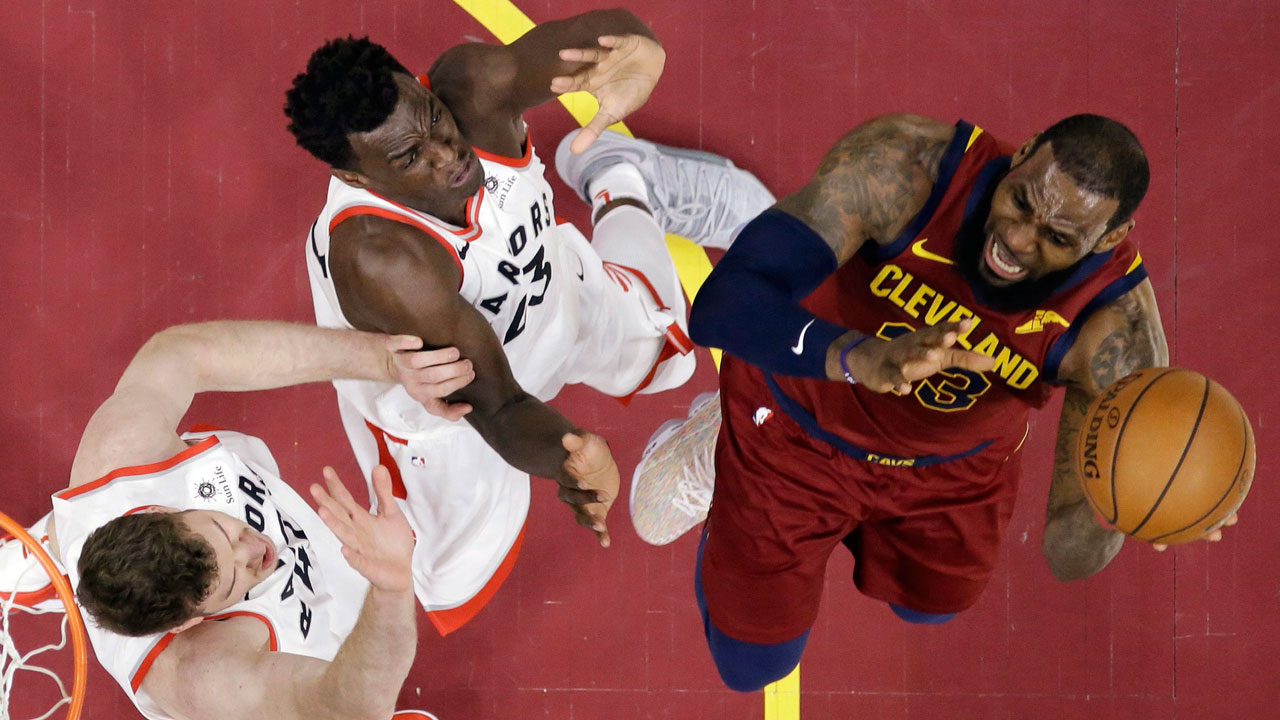

There are generally two ways to go about stopping the Cleveland Cavaliers. One is to hone in on LeBron James, sending double or triple teams at today’s greatest player and — knowing you can’t really stop him — try to make his life more difficult and force his teammates to step up and hit open shots.
The other is to focus on stopping those around him — impeding their ability to curl off screens and blocking passing lanes — and let James dominate his matchup.
Neither are particularly effective, and therein lies the challenge the Toronto Raptors face heading into Tuesday’s pivotal game against the Cavaliers in Cleveland.
The last time the Raps and Cavs met it didn’t matter what the Raptors had planned to slow down James and his team. They threw double-teams, and had mild success in the first half with Pascal Siakam trying to stay in front of him, but it was for naught. James outmaneuvered, outsmarted, and overpowered Toronto, scoring 35 points — including a series of clutch baskets to close the game — to go along with 17 assists (not even his season high) and, the most impressive part, zero turnovers.
A team like the Golden State Warriors can handle James not because of how they guard him, but because of their wealth of elite options offensively — a luxury the rest of the NBA doesn’t have. He averaged 34 points, 12 rebounds, and 10 assists per game on 56 per cent shooting versus the Warriors in the NBA Finals last year. His team lost the series 4-1.
For Toronto to have success against James and the Cavaliers, they need to be firing on all cylinders — big performances from their all-star backcourt and a healthy dose of the second unit operating at their highest gear. It helped the Raps destroy James and a roster that would be absolutely deconstructed within a month and a half back in January.
And the formula seemed to be working a couple weeks back, too, when the Raptors dropped 79 first-half points on Cleveland and seemed to be in a good position to eke out another win. DeRozan and Lowry combined for nearly 50 points; Jonas Valanciunas was a perfect 6-for-6 from the floor; Delon Wright, Jakob Poeltl, and Fred VanVleet combined for 46 points; the Raps had 10 offensive rebounds to just four for the Cavs…
Yet as the fourth quarter wore on and the Raptors’ lead got smaller, it was clear that there was nothing Toronto could do to stop James from completing the comeback — and taking over the game to seal the 132-129 victory.
And so a team like the Raptors faces a familiar quandary, and one with no discernible answer.
There was once a time when you could try to contain James on the perimeter and force him to take jumpers. But as his game has evolved over the years — we’re into season 15 and his game has never been more complete — that’s no longer an option. This season, James is hitting a respectable 37 per cent of his three-point attempts and has been effective in the mid-range as well. (Shot chart via NBA.com)
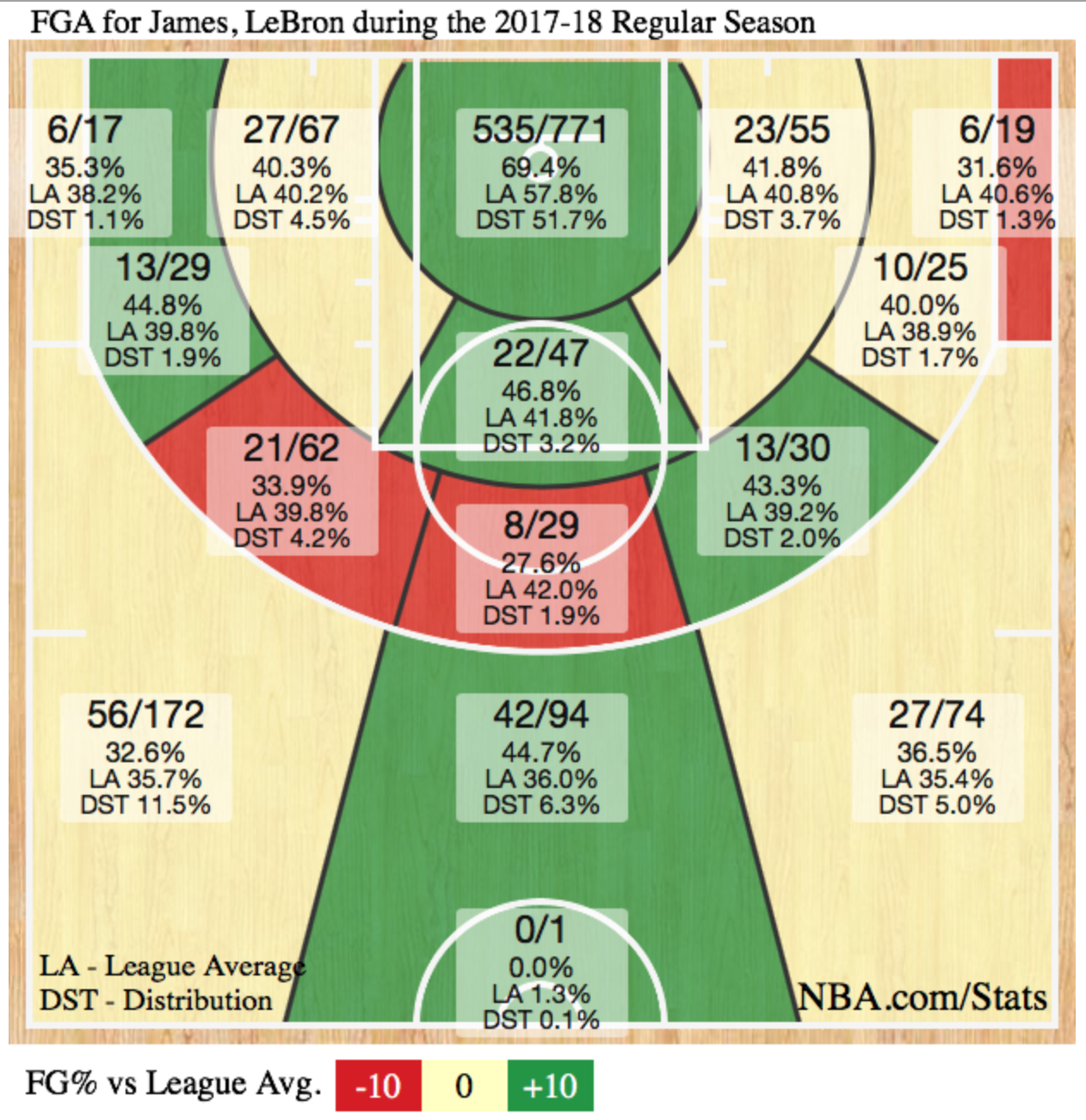
In Year 15 LeBron is playing some of the best basketball of his career, amid a revolving door of supporting cast members (James and the Cavs will be without George Hill and could also be missing Kevin Love, and Kyle Korver tonight, meaning the “new look,” post-deadline Cavs have barely played a full game together).
As good as he’s been this season, James enters Tuesday’s game on a special kind of tear. He’s averaging a triple-double over his last ten games, posting more than 30 points, 10 rebounds, and 10 assists per game to go along with a block and a steal for good measure. He’s playing 38 minutes per game and showing no signs of slowing down.
Take a look at what James was up to in the past month alone (and then go back to the beginning and watch it again):
https://twitter.com/ConradKaz/status/980822634299498496
Now watch it again. That’s what the Raptors have to contend with on Tuesday, and they have to do so while dealing with the reality that, with just six games remaining, they are briskly losing their grip on first place in the East and subsequent home-court advantage throughout the playoffs.
[relatedlinks]