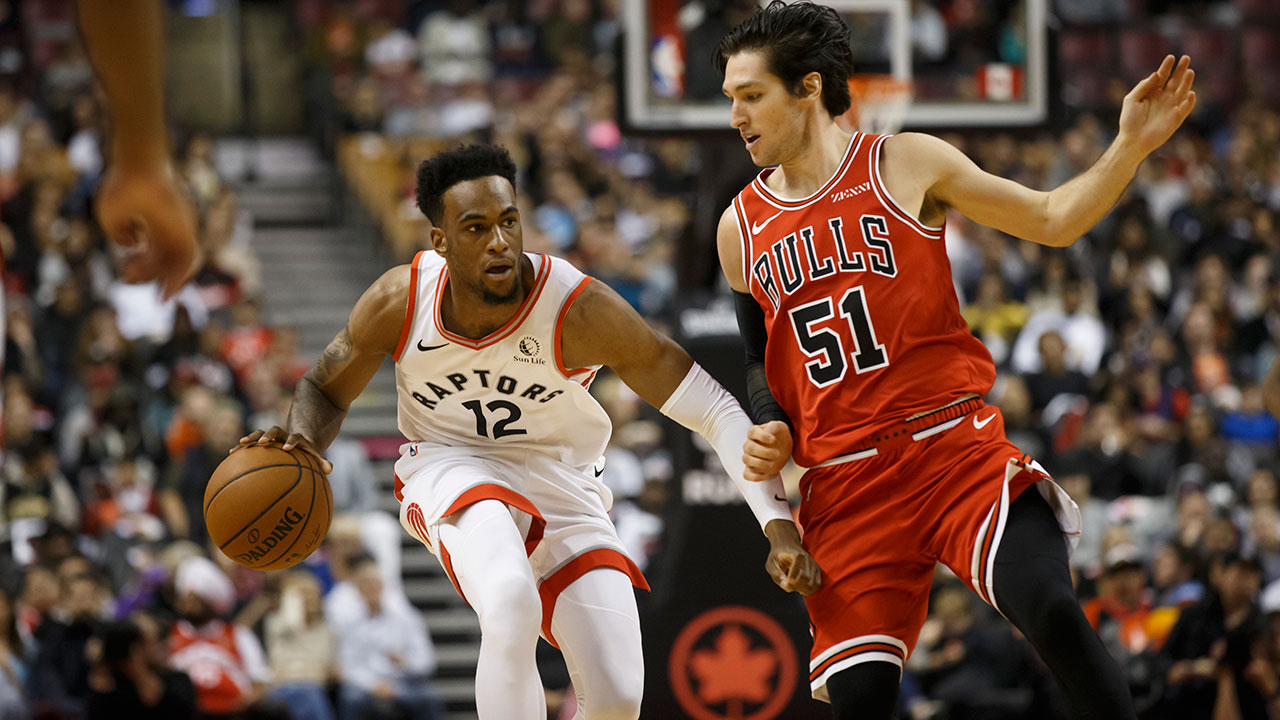
While the NBA continues its precarious tightrope walk, straddling the line between a successful return to action and all of the unsettling uncertainties that lie below, few questions are more pertinent than what happens if a player contracts COVID-19, or if a player doesn’t want to enter the bubble for any reason — and few teams are better-equipped to navigate that question than the Toronto Raptors.
As ESPN’s Adrian Wojnarowski and Bobby Marks have detailed, the plan is not to suspend games. Players who test positively for the virus (and there will be daily testing) would be forced to quarantine for at least 10 days, and teams would then be allowed to implement replacement players as necessary. Additionally, for any player who may not want to enter the Disney bubble, it’s been reported that teams may request replacement players for them, too.
These replacements would reportedly be sourced either from the eligible free agent pool (consisting only of players who were signed to NBA, G League, or training camp deals this season) or via players on two-way contracts. And so, taking a closer look at the options available to them, here’s why the Raptors are set up well to combat any ill fate (including serious injuries) that may befall them.
[snippet id=4725691]
Free agents
The first and, admittedly, most lacklustre option is for the Raptors to seek out a player from the aforementioned free-agent pool. Any player who has signed an NBA-or-related deal this season or, significantly, in a past year, will be considered a part of that pool.
Even so, the options here are essentially the equivalent of buyout players, the vast majority of whom have an underwhelming history when it comes to making a notable mark for the team that signs them. The major difference, though, is that unlike buyout players, who are at least typically given the chance to integrate into a team’s system for the latter half of a season, free agents signed this summer would be coming directly into the fray, without any rapport having been built up at all.
Still, there are some break-glass players on the market. DeMarcus Cousins (who was working his way back from a torn ACL before the Lakers released him in February) is sure to be a name on many teams’ minds if something happens to one of their bigs, and both Jamal Crawford and J.R. Smith, two players who have consistently been brought up throughout the course of the season by a multitude of teams, continue to be available.
Of more specific interest to the Raptors, due to their understanding of the team’s system and culture, guys like Jeremy Lin (signed with the Beijing Ducks) or Jordan Loyd (signed with Valencia Basket) will potentially be options as well, although any expectation of those players to enter the bubble and be highly impactful is likely ill-founded.
A positive for the Raptors in all of this is their pliability, which all but ensures they won’t have to probe the free-agent market at all. They have plus-defenders across the board to such a degree that they have been able to successfully plug holes created by injury already this season— even when those holes are obscene (think OG Anunoby guarding Nikola Jokic in place of Marc Gasol and Serge Ibaka in the last Raptors-Nuggets matchup). In almost any context, Toronto is versatile enough that it should be able to avoid feeling the pressure of needing to go after a free agent should something unfortunate happen.
[snippet id=3360195]
In-house options
This is the option that, should the Raptors find themselves in a position where they require emergency manpower, makes the most sense in terms of bringing a new player into the fold. Selecting either a two-way player or another training camp invitee ensures that Toronto would be absorbing someone who has been a part of the organization already to some degree, and therefore wouldn’t need to do as much on-the-fly learning.
Along with their two-way players in Oshae Brissett and Paul Watson Jr., the Raptors’ list of training camp invitees includes: Devin Robinson, Sagaba Konate, Cameron Payne, and Isaiah Taylor. Robinson had been having a solid season with the 905 as an explosive, rim-rattling finisher; Konate suffered a bone fracture in his foot back in October and had just started playing for the 905 (looking very much like someone returning from a major injury) on a minutes restriction; Payne is signed with the Shanxi Loongs in China; and Taylor had been playing decently as a moderate-efficiency point guard for the Rio Grande Valley Vipers (Houston’s G League affiliate).
One would imagine if the Raptors were to call upon one of these names, though, it would be one of the two-ways. Brissett has already proven that he can be valuable as an energetic, defensive-minded spark coming off the bench for an NBA team, and has thus far spent 19 games (or, more importantly, an estimated 43 of the allotted 45 days his contract allows him to spend with the parent club) with Toronto this season. Watson has received substantial praise for his growth with the 905 and only had a brief three-game stint with the Raptors.
According to The Athletic’s Shams Charania, unlike those who are part of the free-agent pool, the league will allow two-way players to enter the bubble initially with the regular roster, meaning that there will be 17 players allowed upon arrival. This comes after the original decision to exclude two-ways (meant to limit the number of people within the confined space), something that teams reportedly and, evidently, pushed back on.
Due to this alteration, if the Raptors were to require the services of Brissett or Watson, they would be immediately able to suit up for the team, making them a far more abrupt and useful option than any player beyond the walls of Disney World.
So, if it comes down to the Raptors absolutely needing a replacement player to fill a void, expect to see them signal to one of Brissett or Watson, especially since, once the playoffs arrive, only two-way players will be eligible to act as replacements.
[relatedlinks]
Do nothing
Of course, the simplest choice is often the most preferable. Despite the Raptors having limited options available to them, it’s abundantly transparent that there would be nothing they could do to truly replace the impact of one of their key players. And if they were to replace one of them, there’s a possibility that said player would become ineligible to return at all, meaning that the team would have to traverse the remainder of the season/playoffs without a core piece.
Not only that, but any replacement player entering the bubble would have to be flown in and quarantined themselves before even getting the opportunity to assimilate into their new team.
It would seem to make more sense, then, for the Raptors to just wait out the recovery time for any infected player, and hope that they can stave off elimination long enough to allow that player to return.
But even with that in mind, taking stock of alternative available precautions and generating backup plans is essential. In a situation like the one the NBA and all its teams are beginning to wade into, it’s impossible to be too careful.
The Raptors will have a full roster heading into Orlando. When the playoffs arrive, the rotation will likely shrink as per usual, meaning that only about eight players of the 15 on the team will be seeing regular minutes. If someone were to go down, then there will be immediate options waiting in the wings.
That may be an easier task for Toronto to handle as compared to other franchises, too, since the team dealt with injuries throughout the entirety of the regular season and yet managed to thrive by effectively utilizing a team-oriented offence (one that saw a number of players unexpectedly take advantage of their opportunities) and relying on a stifling, scrambling defence.
The flexibility that has become not only the Raptors’ players’ collective trademark, but Nick Nurse’s as well, may have, in a bizarre way, unknowingly set the team up better for a stretch run than could possibly have been anticipated prior to the league’s hiatus.