After posting a league-worst 15-67 record in 2013-2014—a season in which other teams were actively trying to lose for the best odds at a high lottery pick—the Milwaukee Bucks were in need of a fresh start.
That was nothing new, really. They’d needed a clean slate heading into last season, too, and had even managed to almost get it right when they pulled the cord on the Monta Ellis-Brandon Jennings backcourt experiment early in the summer. Ellis walked in free agency, and Milwaukee dealt Jennings to the Pistons for Brandon Knight and Khris Middleton. They also landed a guy named Viacheslav Kratsoz in the transaction, but he was traded to the Suns a month later and never suited up in Milwaukee. The more you know.
It’s no question the Bucks won the Jennings trade. They gave up the bigger name player, but in Knight and Middleton, they added two young rotation guys with potential, on rookie-scale contracts, without the headaches that’d accompanied Jennings’ tenure in Milwaukee.
It also didn’t hurt that the front office nailed their 2013 first-round draft pick, selecting Giannis Antetokounmpo fifteenth overall (a player Masai Ujiri went after pretty hard on draft night).
With those young pieces in place, it looked like the Bucks would embrace the Year of the Tank with their eyes fixed firmly on the future. But bottoming out—even for the greater good—has never been the prerogative of the Bucks organization, especially under former owner Herb Kohl. So, after those wise, thinking-long-term roster moves early in the 2013 off-season, Bucks fans must’ve felt a familiar dread set in as they watched the front office re-sign Zaza Pachulia to a three-year, $15.6-million deal and then ink free agents Gary Neal (two years, $6.5 million and subsequently traded to Charlotte) and O.J. Mayo (three years, $24 million).
None of the deals were awful, but each was certainly misguided.
Why would you want to sign guys that, in theory, make you competitive enough to fight for a bottom seed in a weak Eastern Conference only to lose in the first round?
The logic is even harder to follow when you consider that sneaking into the seventh or eighth seed and getting blown out in four games in the playoffs had already been the Bucks M.O. for over a decade. Why not just embrace the tank they were so obviously primed for and aim a little higher on the next go-round?
Well, the basketball gods must’ve felt the same way because, from the opening tip last season, the Bucks were absolutely obliterated by injuries and chemistry issues. Dragged kicking and screaming into what was the right move from the outset, they played their way to the worst record in the 47-year history of the Bucks franchise.
And how was the fine city of Milwaukee rewarded for that futility? Handsomely.
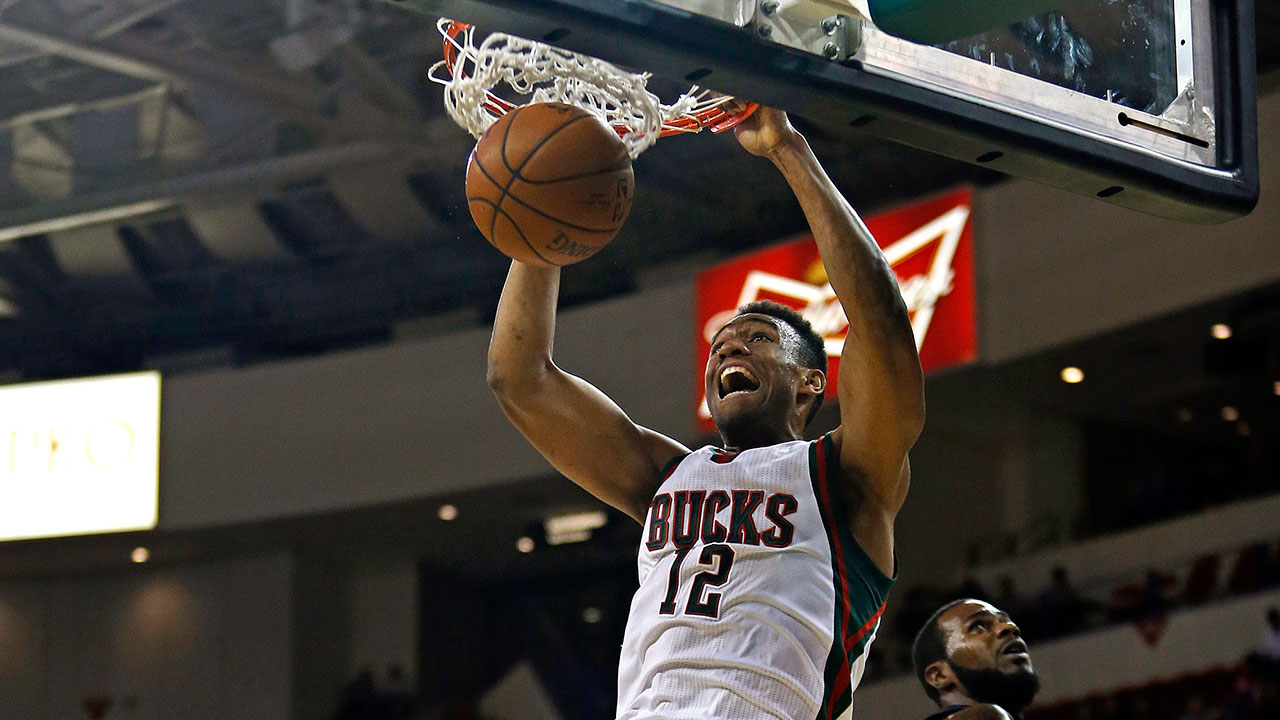
Herb Kohl sold the team midway through the season to a new ownership group, led by Wesley Edens and Marc Lasry, who have committed to keeping the team in Milwaukee (which, by league mandate, requires them to build a new arena by 2017). More importantly, one-and-done Duke standout Jabari Parker fell to the Bucks with the second pick of the 2014 draft.
The 19-year-old Parker, grew up in Chicago—an hour and a half drive from Milwaukee—and his game has been drawing comparisons to the likes of a young Paul Pierce and Carmelo Anthony since high school. Parker has the potential to be a franchise cornerstone the Bucks organization can build around for the foreseeable future. And Kohl had apparently thought an eighth seed was the better option? Crazy stuff.
Finally, it felt like the Bucks’ focus was on building something meaningful, rather than another futile first-round appearance. Parker and Antetokounmpo took centre stage and the Bucks’ PR department started running with the slogan #OwnTheFuture on social media.
Year two of what now definitely had to be a rebuild (right?) was off to a terrific start.
Yet, the way Milwaukee has started this 2014-2015 campaign threatens to derail it all: They’re winning.
Well, sort of.
The Bucks are 7-5 heading into Friday night’s matchup against the red-hot Toronto Raptors. They’re already just eight wins away from matching last season’s total. They’re also finally healthy (more or less) after losing 318 man-games to injury last season—second most in the league behind the Lakers (320)—meaning that key players like Larry Sanders, Ersan Ilyasova, Pachulia and Mayo are once again staples in the rotation.
Apart from the winning itself, the Bucks’ defence has been the biggest surprise thus far. They’re fourth in the league in defensive rating, allowing just 97.7 points per 100 possessions, and that’s not just because defensive monster Larry Sanders is back to locking down the paint. Guys like Brandon Knight and Khris Middleton, known more for their offensive games, are stepping it up on the defensive end and Giannis Antetokounmpo is rapidly developing into an elite defender, as evidenced by the way he repeatedly shut down Joe Johnson in Milwaukee’s triple-OT win over Brooklin on Wednesday. They’re a long, athletic and instinctive group, and there seems to be an identity forming behind that smothering defence.
The offence, however, leaves a lot to be desired. The Bucks are averaging 100.9 points per 100 possessions, which ranks them twenty-sixth in the league, and they’re playing at the NBA’s eighth-slowest pace.
Their youth shows on the offensive end. The ball sticks and sometimes guys drive or leave their feet with no apparent plan leading to a contested shot or a turnover—Milwaukee coughs the ball up 16.9 times per game, fourth most in the league.
The offence should improve as coach Jason Kidd’s rotation solidifies and the main lines find some more chemistry. Jabari Parker’s game will also pick up as he gets more comfortable at the NBA level, which will certainly help the Bucks’ attack.
But as Milwaukee keeps tallying W’s, they also raise an important question: Should the Bucks even want to be good this season?
Milwaukee has a promising young nucleus, but they’re mostly mid-to-late first-round and early second-round picks. Not that it’s unheard of for a player chosen outside of the lottery to develop into an all NBA-type talent, but it’s rare. Even a player like Giannis Antetokounmpo, with all the potential in the world, still needs everything to break right in order to maximize his potential.
Parker is the only top-ten pick currently on the roster, and Milwaukee isn’t exactly the biggest free agent draw. Why not take the opportunity to try to nab another lottery pick or two for him to grow alongside?
This means, if the early success continues, trying to trade guys like Mayo, Pachulia and Ilyasova as soon as there’s some interest. Those guys likely won’t be around for any future success, regardless, and losing any of them would deal a deathblow to the Bucks’ offence—upping their chances at another prime pick or two over the next couple of years.
Only the Bucks know their preferred timetable. They’ve got the new stadium to think about, which will require a few hundred million in taxpayer dollars, and fans may need placating if they’re going to fork over the public financing necessary to secure the team’s future in Milwaukee—after all, they’ve been paying off Miller Park for close to two decades.
Even if their definition of “owning the future” ultimately turns out to be “continuing to toil in the middle of the pack for those elusive six to eight seeds,” with Jabari, Giannis and Co., at least that four-game first-round exit will be an entertaining one.