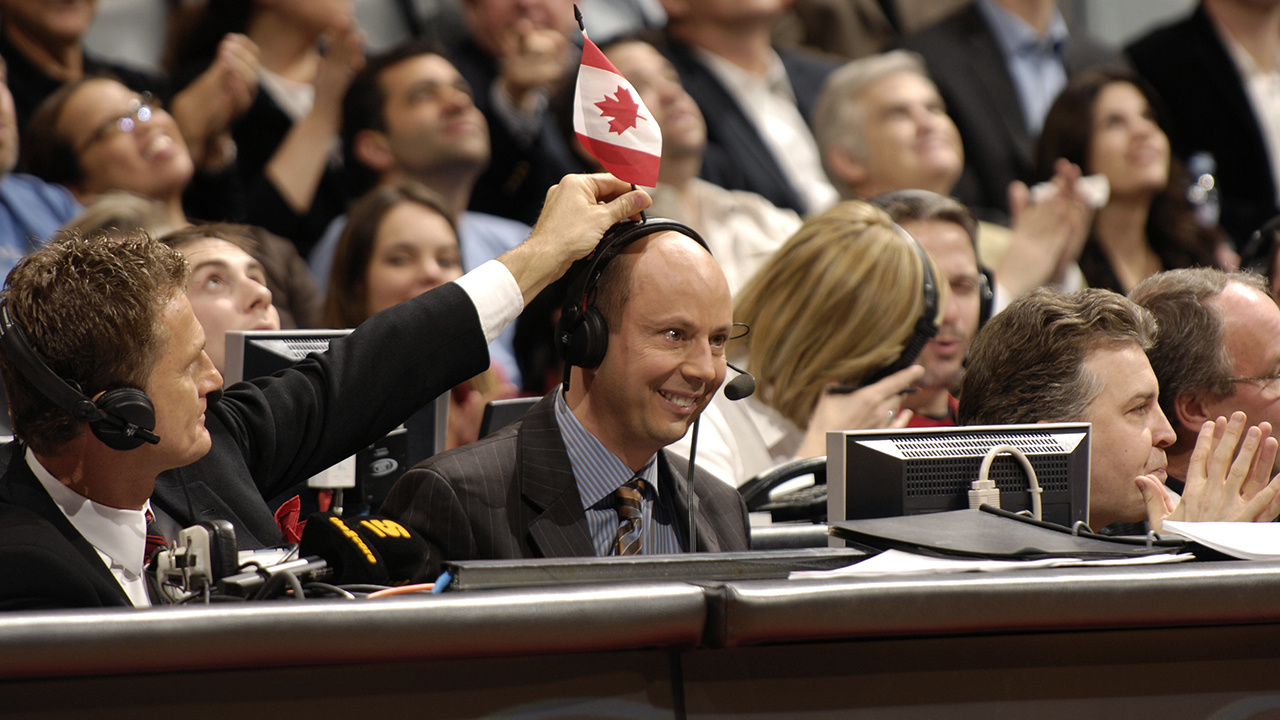

“You can get out the salami and cheese mama, this ball game is over!”
“Onions, baby, onions!”
“That was sick, wicked and nasty!”
If you’ve been following the Toronto Raptors for the past 20 seasons, you know these catch phrases and, more importantly, who first said them.
Between 1998 and 2008, Chuck Swirsky handled play-by-play duties for the Raptors, endearing himself to the fan base with his signature phrases and serving as a reminder of the team’s best times—the height of the Vince Carter era.
After the 2007-2008 season, Swirsky left the club to become the play-by-play man of the Chicago Bulls, a position he still holds today.
With the Bulls coming to town for a major showdown with Toronto on Thursday and the Raptors enjoying success not seen since those famous Vince Carter teams, we caught up with Swirsky (who became a Canadian citizen in 2008) to get his thoughts on the current team, the Raptors of old and how the Eastern Conference could end up shaking out.
Sportsnet: How did the Raptors evolve from an also-ran expansion club to a playoff competitor?
Chuck Swirsky: I joined the ball club in year three—in 1998—and I think the honeymoon period was still going on, although fans were starting to get a little bit impatient as far as putting a winning club together. It was a perfect storm because the club drafted Vince Carter, Glen Grunwald acquired Kevin Willis and Charles Oakley, Tracy McGrady was entering his second year, and the Raptors franchise was about to take off.
I think the opening of the Air Canada Centre in 1999 really set the foundation for a world-class building with players that were not only in their primes, in terms of Oakley and Willis, but McGrady was just an up-and-coming star—everyone could see that—and then Vince arrived and made a huge splash.
To this day, I maintain that Vince Carter was the most important, impactful professional basketball player that made basketball in Canada. There were some very good players prior to that—Bob Houbregs, Leo Rautins, Jay Triano, Bill Wennington—but without Vince Carter, I’m not sure basketball in Toronto would be what it is today.
SN: If not for Vince Carter, do you think the franchise would have been in jeopardy?
CS: No, because I think Toronto speaks for itself. The club was never in jeopardy, would never have been in jeopardy.
Every player that has passed through the Air Canada Centre knows about the commitment that Larry Tanenbaum has for basketball—and for them as a human being. That was felt in the locker room. So that was one element that was never, ever in question as far as the commitment to the game.
SN: Do you see any similarities between this current Raptors team and any you saw during your tenure as play-by-play man?
CS: The teams of 2000, 2001, 2002—although Carter was hurt in 2002. They were able to keep their core group together, and that was very, very important because they needed those players to send a message not only to the NBA, but also to the city: “We’re in this and we’re here for good, and we’ve got a pretty good thing going and we want to keep it going.” And so ownership stepped to the plate and the players loved Toronto, and the players wanted to stay in Toronto and the players found it very comforting to know that this group was going to stay together over the next few years.
I sense the same thing happening with [Kyle] Lowry re-signing, Patrick Patterson re-signing, [Greivis] Vasquez re-signing, DeMar DeRozan is already under contract, [Jonas] Valanciunas will be coming up in a couple of years and I’m sure they’re going to take care of him, so I think there are a lot of parallels between this year’s club, and what’s going on, compared to what happened over a decade ago.
SN: Do you think what the Raptors are doing is sustainable?
CS: I think this club right now, where the Eastern Conference is and where the Raptors are, they can make some serious in-roads over the next few years. I think Masai [Ujiri] has done a great job, but also, if you look at it, [Bryan] Colangelo did put some pieces of this team together.
So, I think it really was a combination of Bryan and, certainly, Masai who have put the elements together for a pretty good formula for success. No general manager is perfect, and everyone makes mistakes, but now [the Raptors] have got a plan and they’re sticking to a plan, and I think this plan is going to pay big dividends.
SN: You mention Bryan Colangelo. His signature move as GM was drafting Andrea Bargnani first overall in 2006. Why didn’t Bargnani pan out?
CS: I think Bryan Colangelo gave him a lot of support, [but] I think there were other factions involved who [could have come up] with a better way of helping him make the transition to NBA basketball.
I maintain that he could’ve been a better player. He should’ve been a better player, but the end result is he is who he is. …
The interesting thing is, had Joakim Noah come out in 2006, it would not have surprised me if Bryan Colangelo had drafted Noah ahead of Bargnani.
SN: How do you think the Eastern Conference will look come playoff time?
CS It’s easy to get carried away in November and December about where you think [a team will end up], but the truth of the matter is it all depends on the health in April, and I’ve been through this with the Raptors many, many times.
I went through this with Vince on a couple of occasions. In 2002, coming after the 2001 [Eastern Conference semi-final appearance], and I’m looking at the club and we had just added [Hakeem] Olajuwon, and I thought, “You know what, maybe we can squeeze just one year out of him and get to the Finals and this is worth it.” But it didn’t happen.
If the teams [this season] stay healthy in the East I think you’re looking at the Bulls, the Raptors, the Cavaliers, the Heat, and Washington. This thing is going to be so competitive come playoff time that it’s going to depend on, again, health. If everyone’s healthy then I think this thing is wide open.