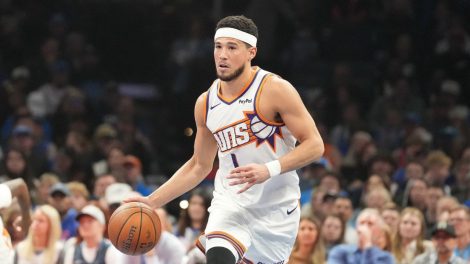
The NBA off-season was turned up to eleven on Tuesday night with the news that Kyrie Irving had been traded to the conference rival Boston Celtics — of all teams — in exchange for fellow all-star point guard, Isaiah Thomas.
It’s the latest — and arguably biggest — deal in an unfathomable summer that already saw Chris Paul, Jimmy Butler, Paul George, Gordon Hayward, Rudy Gay, and Paul Millsap change teams, as well as the first-overall pick being traded from Boston to Philadelphia.
In the fallout of the Irving-for-Thomas trade, three things immediately stand out: First, given how relatively little the Indiana Pacers got for George (a pair of role players in Victor Oladipo and Domantas Sabonis) and the Chicago Bulls got for Butler (Zach LaVine coming off post-ACL surgery and unspectacular rookie Lauri Markkanen), the Cavaliers and new GM Koby Altman made out like train robbers by comparison.
Cleveland’s haul of an elite all-star scorer (Thomas), impactful two-way starter (Jae Crowder), and a potential top-five pick (Brooklyn’s 2018 first-rounder) is so far and away better than market value that Cavs fans must be jumping over the moon right now.
Second, as massive as this trade is, it doesn’t really alter the landscape in the East all that much. Thomas could easily replace Irving’s production in Cleveland, and the Cavaliers are still tops in the East, while the new-look Celtics are a very clear No. 2 with a sizeable gap separating those two teams from the next tier, which includes the Raptors, Wizards, and Bucks.
Third, a trade like this is damn-near unprecedented.
If you’re wondering what history tells us about how this blockbuster might fall out, don’t be surprised to learn there isn’t a clear answer.
Superstars are traded all the time in the NBA, but generally speaking the return haul includes either a package of lesser players, or a high-potential draft pick in exchange for one star, or both. There are countless examples. Think: Shaquille O’Neal being moved to Miami in exchange for Lamar Odom, Caron Butler and picks, or, most recently, the seven players and a draft pick the Houston Rockets sent to the Clippers in order to land Chris Paul.
And then, of course, there are draft-night trades swapping potential stars, like the one that sent Chris Webber to Golden State in exchange for Penny Hardaway, or Vince Carter for Antwan Jamison.
That’s not to say two superstars haven’t been swapped like this before. One of the biggest moves of the previous generation was when Jason Kidd was traded from Phoenix to New Jersey in exchange for Stephon Marbury in 2001. And the 2004 move that saw Tracy McGrady traded from Orlando to Houston for Steve Francis, two all-stars still in their primes.
In both examples, however, Kidd and McGrady joined talented rosters with players like Kenyon Martin and Yao Ming that the new faces helped lift to new levels. Meanwhile, their counterparts, Marbury and Francis, were sent to languish as talented players tasked to carry less functional rosters — the Suns relied heavily on an aging Hardaway and finished last in their division, while the Magic finished below .500 in Francis’ first season, with Grant Hill failing to find his old form after his injury woes and a rookie Dwight Howard getting acclimated to the NBA.
Those deals may have carried similar star power, but the difference this time around is that both Irving and Thomas will join already-loaded rosters.
The Cavaliers employ the world’s best player in LeBron James, as well as Kevin Love, a very good modern-day power forward and overqualified third-banana. In Thomas, Cleveland will be able to replace Irving’s scoring production while ensuring they keep the ball in James’ hands more often than before which is a very, very good thing.
What’s more, defences won’t be able to hone in on Thomas like they did when he carried the Celtics’ scoring load and was his team’s clear go-to scorer. The double teams and beatings he took when he maneuvered his way into the paint will ease up with the threat of LeBron lingering nearby on the court. Not only does it stand to allow Thomas to get easier buckets, but will be crucial given the diminutive star is coming off a fairly serious hip surgery.
Crowder, too, stands to benefit from the trade. He knocks down open looks on catch-and-shoot opportunities (an eFG of 66 per cent, per Synergy Sports), which he’ll get plenty of, and is obviously one of the better perimeter defenders out there — a very useful weapon starting alongside James, or coming off the bench.
As for the Celtics, they have undergone a complete off-season transformation and now boast a talented core that already includes current and former all-stars in Hayward and Al Horford, as well as a pair of high-potential young wings in Jaylen Brown and Jason Tatum.
Throwing Irving into the mix gives the Celtics a clear No. 1 scoring option, like Thomas was. Except, unlike Thomas, Irving’s contract doesn’t expire at season’s end, giving Boston a little more stability moving forward.
What’s more, Irving’s ball-handling and shooting ability gives Boston coach Brad Stevens an even more dynamic offensive player to build his offence around. Playing under one of the most creative coaching minds in the game, it should be fascinating to see how (or if at all) Irving’s playmaking skills will develop — remember that the four-time all-star is just 25 years old and hasn’t even entered his prime.
Again, despite the magnitude of this trade, don’t expect it to affect the East standings all that much, but you can expect it to change the way each team plays and employs their new acquisitions.
There’s a very brief history of star-for-star trades in the NBA, and an even briefer history for ones that work out for both teams involved. Irving-for-Thomas stands to be one of them.
[relatedlinks]