
Since their playoff collapse last week the Los Angeles Clippers have come under heavy scrutiny. And for good reason — after dropping Game 7 to the Houston Rockets, they become just the ninth NBA team to blow a 3-1 series lead.
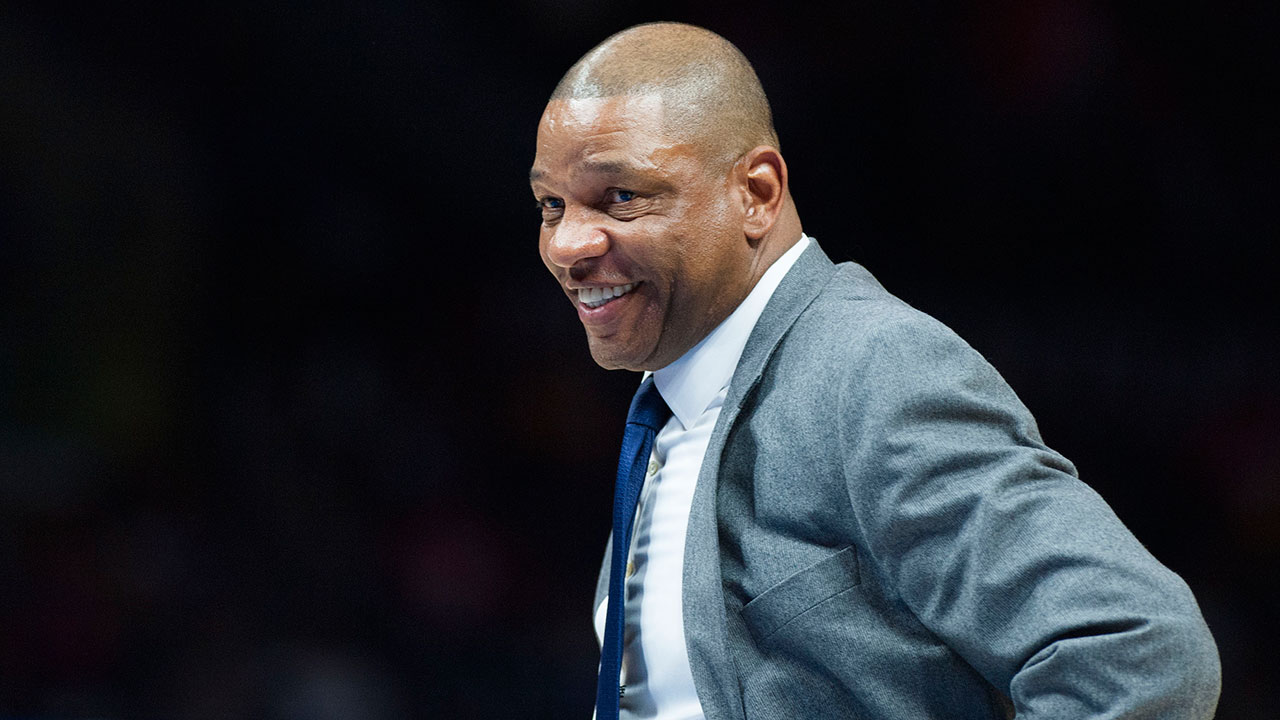
The Clippers’ chief issue is very simple: Doc Rivers the coach is sabotaging Doc Rivers the general manager (that’s why Rivers is the only person to appear twice on the list of coaches to blow a 3-1 lead).
Rivers was hired because of his championship pedigree in Boston, but was given more rope by L.A. as an added incentive to walk away from league’s most historic franchise (the Celtics) for unquestionably its worst (the Clippers). They gave him the title of senior vice president of basketball operations, and in the wake of the Donald Sterling fiasco, he was promoted to president of basketball operations.
Despite boasting serious talent at the top- namely Blake Griffin and Chris Paul, two players he inherited — Rivers says he knew the job would be a challenge from the start.
“The first thing I did before I took this job, I looked at the roster and we laughed,” Rivers revealed after Sunday’s Game 7 loss. “I was like, ‘What the (expletive) can we do with this?’ It was the contracts. But we have to try to do it somehow. I don’t know how yet, but something will work out.”
Except, it hasn’t.
His first big move was a three-team trade that brought him Jared Dudley and J.J. Redick in exchange for Caron Butler, Eric Bledsoe, and a future second-round pick.
Redick committed six turnovers in Game 7.
Meanwhile, Rivers lost patience with Dudley early in his L.A. tenure. Buried on Rivers’ bench, Dudley was later sent to Milwaukee along with a first-rounder in exchange for contracts Rivers would immediately waive — a cap-clearing measure made necessary by the off-season signings of Spencer Hawes and Jordan Farmar.
Rivers clipped Hawes out of the rotation a month into the season. He played in only eight of the Clippers’ 14 playoff games, averaging seven minutes per game. Almost all of those minutes were in garbage time, despite the Clippers glaring need for frontcourt depth.
Farmar was given the biannual exception, which a franchise can only use every two years. He was released in January.
This underscores Rivers’ inability to add and evaluate depth.
The musical chairs on the wing under Rivers hasn’t been any better. Ask Clippers fans, who have seen a washed up Grant Hill, an injured Danny Granger, a past his prime Stephen Jackson, and an out of shape Hedo Turkaglo pass through town in recent years.
It’s almost like if you had a big playoff series in the Eastern Conference at some point in your career, Rivers had a contract waiting for you.
That said, he’s never had an eye for developing new talent. Former first-round draft pick Reggie Bullock was traded to the Celtics for Doc’s son Austin who the Celtics were preparing to send to the NBA’s development league.
When you consider what got away, the summer of 2014 might have been the worst off-season in the history of the franchise.
Rivers failed to re-sign Darren Collision who would have helped spell Chris Paul. He was never was able to come to terms with Paul Pierce who would have immediately become a starter at a position of need. Trevor Ariza was also interested in returning to the L.A. area; he landed with the Rockets and hit six three-pointers on the way to 22 points to close out the Clippers.
Doc sure could have used any of those three in his lineup this post-season.
But he did have Blake Griffin, DeAndre Jordan and Chris Paul. You could make the argument that they are top-three talents at their respective positions in the league. They are that good. And no other team boasts that type of top end talent — not even the 67-win Golden State Warriors. But what the Warriors and the other three teams currently playing in the Conference finals do have is considerably more depth than “Lob City.”
Let’s go back to Rivers’ quote above regarding his first impressions of the roster when he joined the Clippers.
How broken could the team be that Doc inherited really have been? Vinny Del Negro won 56 games, a division title and lost in a second-round Game 7 in his second last year as the Clippers scapegoat. Doc was billed as the saviour but had similar results as his predecessor, winning 56 games before losing in a second round Game 7 this year.
The franchise isn’t much better off but that doesn’t mean Rivers and Del Negro are like-for-like replacements.
In making the change, the Clippers upgraded their coach but downgraded their GM.
Ironically enough, while Rivers is taking not-so-subtle shots at previous GM Neil Oshey’s roster construction, he owes his success in L.A. almost entirely to Oshey.
What Doc has done is slowly chipped away at the depth Oshey had acquired. Oshey is currently doing a brilliant job in Portland and the two GMs will be competing for the signature of Jordan this off-season, the burgeoning star whom Oshey drafted in the second round.
Jordan will likely command a five-year deal worth upwards of $100 million, punitive for the Clippers not only in dollars but also in roster options because that would take the team to a salary tax ballpark where you lose the ability to do sign-and-trade deals and use of the mid-level and biannual exception (which they’ve already lost anyways).
Rivers confirmed the team’s best course of action is offering Jordan the max. “We don’t need to go and get a max player, except for the one we have,” he said after Game 7.
If the Clippers don’t re-sign Jordan, they don’t have the cap space to offer that maximum money to an unrestricted free agent from another team since the CBA only allows you to go that far over the salary cap threshold to re-sign one of your own players. They are between a rock and a hard place.
The Clippers could try to clear space by declining team options on Matt Barnes and Jamal Crawford. But that only frees up less than $10 million in cap room, while eliminating two of the few rotation players they have, leaving just Paul, Griffin, Redick, Hawes, C.J. Wilcox, and possibly a re-signed Jordan under contract.
They are right up against the cap ceiling and filling out the roster with minimum contracts is not going to provide the roster depth Rivers needs. Though it may be his only option.
There is also the awkward business of re-signing his free agent son, Austin, who has already had his $3-million team option declined as a member of the Pelicans. Picking up such an option is normally a formality for a 10th overall draft pick, but a confounding problem given Austin’s poor play — not to mention the potential awkwardness their father-son dynamic may create within the organization.
All in all, very few options for Rivers this summer. And none of them any good.
Rivers simply has too much power and it’s weakening his ability to function as a coach. The best way to fix it is to bring in qualified help and give up some of his executive power, otherwise his star-laden team will never reach the height of their powers.
Absolute power corrupts absolutely.