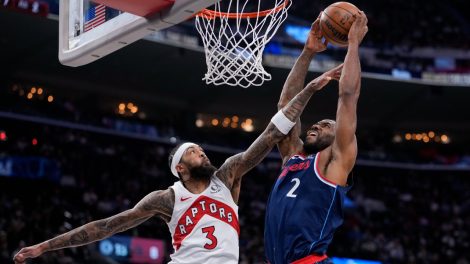
TORONTO — Here’s an interesting sequence from Monday’s comprehensive 127-106 Toronto Raptors victory over the Charlotte Hornets. It’s only a quick burst of basketball. It takes about 10 seconds. But it is illustrative of where the NBA appears to be going this season. And how the Raptors are trying to stay on the edge of that curve.
BAKA:
KLAW: pic.twitter.com/QQfUjjA1MX— Toronto Raptors (@Raptors) October 22, 2018
It begins with an emphatic Serge Ibaka block, as the sometimes bench forward, sometimes starting centre, volleyballs a Marvin Williams attempt into the shadow realm. And it ends with a Kawhi Leonard bucket at the other end — a three-pointer taken early in the shot clock.
[snippet id=4267701]
This is today’s NBA. You shoot early, you shoot often, and you almost always shoot from distance. Meandering possessions that chew up most of the shot clock are seldom seen. If you have a relatively uncontested three-point opportunity, you take it. If you’re shooting fewer than 30 three-pointers a game, you’re doing it wrong.
And at your own end, you protect your rim, crash the glass for rebounds, and sprint aggressively at shooters on closeouts to try to force them off the line. You trust your defensive rotations, you live with long, contested two-pointers, and if you happen upon a rebound, you move it in the opposite direction as quickly as possible.
It’s a fast, fluid, high-scoring NBA. It’s the natural evolution of a game that’s now being played like it’s in arcade mode. And Kyle Lowry, the veteran of a dozen NBA seasons, says it’s impossible not to notice the shift on the floor.
“I have noticed that. I think guys are just getting more comfortable offensively in their games. I think everyone is just expanding,” Lowry said. “Like, Serge [Ibaka] started at centre tonight, shooting threes. I think that just opens the floor up a lot more. A lot more shots are going up. A lot more freedom of movement. It’s making it more of an exciting game.”
Exciting for everyone but coaches, who have to devise a way to win in this new, high-octane environment. And to that end, Raptors head coach Nick Nurse was provided with a strong formula by his team Monday of exactly how to thrive in the current climate.
The Raptors shot 39 threes, with nine of the 10 players who saw at least 15 minutes of floor time attempting at least one. Toronto moved the ball quickly and efficiently, running up 36 assists on 50 made baskets, and outscoring Charlotte on the fast-break, 31-5. And, on the defensive end, the Raptors blocked eight shots and ran the Hornets off the three-point line aggressively, holding a team that came in averaging 38 three-point attempts per game this season to 9-of-28 shooting from distance.
“It was a high-scoring, free-shooting team coming in here and we asked them to get out and contest and disrupt some of their rhythm stuff and we did a pretty good job of that,” Nurse said. “That takes a lot of communication and energy to continually get out and get up high and get into it.”
Just how fast is today’s NBA? Through the first week of the season, league average pace was up by nearly five possessions, from 97.3 last season to 102.1 so far in this one. Teams were averaging four more field goals attempts per game, and seven more points. The last time the NBA average for points per game was as high as it is now (113.3) was in 1969-70, right at the end of the freewheeling 1960s, a decade that stands as the most prolific offensive era in NBA history.
And teams aren’t only scoring more — they’re doing it more efficiently. Offensive rating stood at 110.9 across the NBA coming into Monday’s games, which would represent a new high for the league if it holds up over the rest of the season. It’s resulted in a glut of high-scoring games, and a slight adjustment for coaches who can no longer harp on their players for giving up more than 100 points in a night. That’s the new norm.
“It’s still about points per possession. And field goal percentage defence still has a lot to do with your success,” Nurse said before Monday’s game. “But I think the days of us looking at the number up there — whether its 110 or 108 — and saying, ‘Uh oh, we gave up 110 points,’ are probably getting a little fewer and far between.”
Interestingly, this outburst of speed and production coincides with a league officiating staff that is being as stingy on defences as it has in years. Teams are committing nearly four more fouls per game this season than last, and, in turn, free throw attempts are up by nearly four as well, from 21.7 in 2017-18 to 25.6 so far this season.
Referees entered the year with a mandate to more stringently police what the league’s calling “freedom of movement.” Big men wrapping each other up in the post, guards getting nudged off course as they try to operate on the perimeter, cutting players being slowed up by a tug on their hip — officials are on high alert for all of it.
It’s early days and the sample’s small, but Toronto has so far been one of the league’s slowest teams to adjust. The Raptors were averaging 25.5 fouls per 100 possessions through their first three contests, the fourth-highest rate in the NBA.
“We’re trying to adjust to a couple things that we’ve noticed that seem to have changed — and we’re trying to adjust to them in the middle of games. One of them is the number of fouls, free throw rate,” Nurse said. “Now, will they change or will the calls lighten up? Maybe. But I think they’ve been given a mandate and they’re following it. That’s all they ever do, is ref what the league tells them to ref. And they’re doing it right now.”
But, again, Monday was a positive step. The Raptors committed only 21 personal fouls, their lowest total of the season, and significantly below the 29 committed both on opening night versus Cleveland and during Saturday’s victory over Washington.
Meanwhile, the accelerated pace of Monday’s game (101 possessions) and Toronto’s sky-high offensive rating (124.5) were right in line with the style of basketball we’ve seen played across the league so far this season.
With so many teams playing positionless, expansive brands of basketball, there’s little reason to think it’ll slow down. And as the NBA curves, the Raptors hope they’re staying ahead of it. Monday’s win was a good sign they are.
“It’s good, it’s good,” said Fred VanVleet. “That’s where we need to be. We need to be a 30-assist team, a high-pass team, moving the ball. Obviously, we were able to get out, get a lead and play comfortably a little bit there. Our defence kind of led the way, disrupting them. And then the ball was flying.”
[relatedlinks]