
BY ALEX FLETCHER – FAN FUEL BLOGGER
What makes a trade in the National Hockey League a good one? Most fans sure do not complain when their favourite team is the outright winner in a deal. But some of the best trades, I think, are those that benefit both teams.
With that in mind, here are the five “best” deadline day trades that have been executed by Canadian NHL teams since the 2004-05 lockout.
5. February 28th, 2011: The Vancouver Canucks acquired Maxim Lapierre and MacGregor Sharp from the Anaheim Ducks in exchange for Joel Perrault and a 2012 third-round draft pick.
Okay, so the Lapierre trade was not exactly a blockbuster. In fact, Perrault and Sharp combined to play just seven games with their new NHL teams following the trade, and both now play in Europe.
But beyond that, there is some punch to this deal. Lapierre clearly was not in the Ducks’ long-term plans, but he has found a home as an agitator, a capable hitter, and an occasional penalty-killer in Vancouver. During the Canucks’ march to the Stanley Cup Final following the trade, Lapierre doled out 83 hits, and followed up that performance with 244 hits (11th most in the NHL) last season.
Further, the Ducks made good use of their third-round pick, selecting goaltender Frederik Andersen. Andersen may still be unknown to most NHL fans, but, hey, Viktor Fasth was unknown to most NHL fans as recently as last season, too. Andersen may have a difficult time cracking the Ducks’ crease with Fasth and Jonas Hiller ahead of him, but he posted the highest save percentage (0.943) and lowest goals-against average (1.62) in the Swedish Elite League last season – even ahead of Fasth – and boasts sparkling statistics in the AHL this season, too.
4. February 26th, 2008: The Toronto Maple Leafs acquired a 2008 second-round draft pick and a 2009 fifth-round draft pick from the Pittsburgh Penguins in exchange for Hal Gill.
The Maple Leafs executed three player-for-draft-pick deals on the day of the 2008 trade deadline, including this one. Six points out of a playoff spot and six points away from the bottom of the conference, Toronto shipped Gill, an experienced defenceman, to the surging Pittsburgh Penguins.
The move paid off for the Penguins, who won the Stanley Cup – but not right away. Later that spring, Pittsburgh fell just short of a championship, losing in six games to the Detroit Red Wings in the Stanley Cup Final.
But, with one year left on his contract, Gill was still a Penguin when the Pens and Wings met once again in the 2009 Final. This time, Pittsburgh ensured it didn’t suffer the same fate, narrowly defeating Detroit in seven games. Gill was a factor in his team’s victory, finishing second on the roster in average shorthanded ice time in the playoffs.
Clearly, as Gill helped Pittsburgh to its first Stanley Cup in 17 years, the deal was a win for the Penguins. But it was also a win for the re-tooling Leafs. Toronto extracted 145 games, 40 points, and plenty of penalty killing minutes out of the towering defenceman before dealing him. Not only that, but, because the Leafs signed Gill as a free agent in 2006, they sacrificed only money in exchange for a couple years of service and a couple of draft picks.
Neither draft pick remained in the Leafs’ hands for too long. The team relinquished the fifth-round pick, which was eventually used to select forward Andy Bathgate, in a deal for enforcer Ryan Hollweg, and, two years after selecting 6’6″ forward Jimmy Hayes with the second-round pick, dealt him to the Chicago Blackhawks in exchange for a draft pick used to select prospect Brad Ross. Regardless, this was a fruitful free agent signing and a win-win deadline deal.
3. February 26th, 2008: The Montreal Canadiens acquired a 2009 second-round draft pick from the Washington Capitals in exchange for Cristobal Huet.
Remember this one? Oh, the controversy! Some deemed it a horribly underwhelming return for a goaltender who sported stellar stats – an impressive .920 save percentage in 117 games, to be precise – in Montreal. Others criticized the Canadiens for the pressure the trade was going to put on young Carey Price. Others still, though, commended the Habs for putting their faith in Price and managing to acquire a draft pick in exchange for a goaltender with whom they were set to part ways in the off-season when he became an unrestricted free agent.
Indeed, put their faith in Price the Canadiens did. He rose to the occasion, though, posting a 12-3-0 record and boosting his save percentage from 0.909 to a Huet-like 0.920 in 15 regular season games after the trade. He was also strong in the Canadiens’ seven-game victory over the Boston Bruins in the first round of the playoffs, earning two shutouts during the series.
Huet, meanwhile, was a stud for Washington down the stretch, managing an 11-2-0 record to go along with an astounding .936 save percentage. The team was ultimately eliminated at the hands of the Philadelphia Flyers in a seven-game battle in the first round of the playoffs, but considering the Capitals were 11th in the Eastern Conference before the trade, that showing was respectable.
As for the draft pick, it was ultimately used to select sniper Jeremy Morin. Although Montreal could have been a bit more prudent with the pick (the following season, the team sacrificed it in a deal to acquire 25-game rental Mathieu Schneider – who, granted, posted 17 points in those games), the original trade provided both teams with pretty good value.
2. March 4th, 2009: The Ottawa Senators acquired Pascal Leclaire and a 2009 second-round draft pick from the Columbus Blue Jackets in exchange for Antoine Vermette.
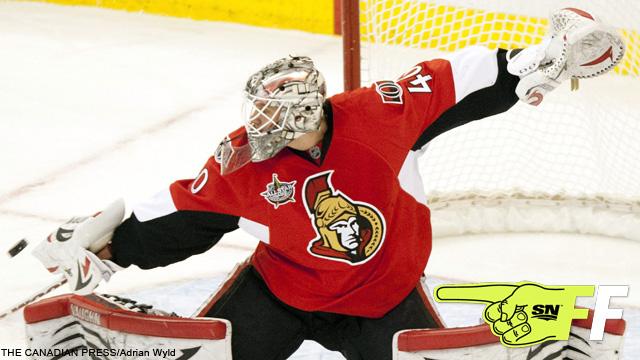
The Senators’ many years of lackluster goaltending are hardly a secret. This trade may be the one to set those troubles aside – but not because of Leclaire, the man who was thought to be the key chip coming to Ottawa in the deal. Rather, it would be because of the man they selected with the second-round pick: another goaltender, Robin Lehner.
Apparently, the fact that Leclaire was already injured at the time of the trade was a sign of things to come. The talented but fragile netminder continued to battle a medley of injuries in Ottawa, which limited him to just 51 games in the Senators’ net over two seasons.
Leclaire was let go by the team when his contract expired in the summer of 2011. That same summer, Lehner had reason to celebrate: he led the Binghamton Senators of the American Hockey League on a miraculous run to capture the Calder Cup, earning the award for playoff MVP along the way. Since then, especially, he has been considered by many to be Ottawa’s goaltender of the future.
The often-inconsistent Vermette, meanwhile, became a key forward in Columbus, where he helped the team to its only playoff appearance in franchise history that spring. The next season, he posted a career high of 65 points with the Blue Jackets, and then he added another 74 points in 142 games over the next two seasons before being dealt to Phoenix.
Ironically, the return in that deal was a goaltender (Curtis McElhinney) and a second-round draft pick used to select a goaltender (Anthony Stolarz, who, at number 45, was selected one slot before Lehner’s 2009 position, number 46), in addition to a conditional draft pick. Sound familiar?
1. March 9th, 2006: The Edmonton Oilers acquired Sergei Samsonov from the Boston Bruins in exchange for Marty Reasoner, Yan Stastny, and a 2006 second-round draft pick.
The Oilers’ addition of Samsonov was a wise injection of skill into a line-up that was already teeming with grit. One of several significant additions Edmonton made in the second half of the 2005-06 season, Samsonov contributed 16 points in 19 games down the stretch, helping the Oilers squeeze into the playoffs as the eighth seed.
From there, the team took off, dancing all the way to the Stanley Cup Final, where Edmonton lost in seven games at the hands of the Carolina Hurricanes. Samsonov continued to be a factor in the wild playoff run – although he posted just a single point in the Final, he pitched in with 14 points in 17 games in the first three rounds.
Meanwhile, Reasoner notched eight points in 19 games for the Bruins, who missed the playoffs, and then re-joined Edmonton as a free agent signing in the off-season, where he spent the next two seasons. Stastny spent one year contributing alternately as a depth player in Boston and a scorer with the AHL’s Providence Bruins before being traded for a late draft pick.
Oh, and the second-round pick? Boston used it to select Milan Lucic, who helped the Bruins on their own playoff conquest, which ended in victory, in 2011.