
BY WES ARMSTRONG – FAN FUEL BLOGGER
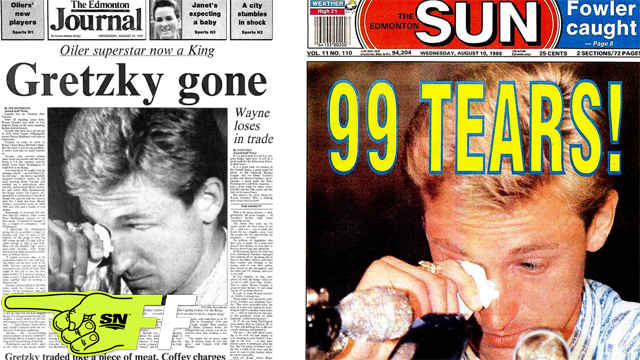
American comedian Kathy Griffin opened her Just for Laugh’s gig in Montreal a few weeks ago with a question, “Are you guys still pissed about Wayne Gretzky?” Like all successful comedians she knew this joke would work because it’s true, many of us are. The day that Wayne Gretzky was dealt to the Los Angeles Kings forever changed the way in which we look at professional hockey as a people. That day, August 9, 1988, is now 25 years old.
Families still crowd around the TV set from October to June, children still wear their favourite players’ jersey, and we love talking hockey around the water cooler, but you don’t have to look too hard to find someone who still holds tight to the theory that “they” are stealing “our” game. The “they” being Americans, so that they can popularize and monetize the game in large urban areas like Phoenix, Anaheim, Florida, Tampa Bay, Dallas, etc. despite the fact that a lot of their citizens have not seen snow.
The Wayne Gretzky trade, more than the future relocations of the Winnipeg Jets and Quebec Nordiques is the clearest example of the theory that Americans are taking “our” game.
 Have your say: Have an opinion on the news of the day? Better yet, want to become a Fan Fuel blogger? Email us here. | Read more Fan Fuel blogs here
It was a different world in 1988. The Berlin Wall still separated Germany into two separate countries — emblematic of the Cold War that silently raged on. The news told us that James Bond character-like enemies were the Heads-of-State of Eastern European countries and the Middle East, and the NHL had still not let a Soviet player lace up their skates. In this uncertain world where a simple call on a red phone could end civilization as we knew it, Wayne Gretzky was superhuman. He was our hero.
Gretzky made the impossible routine; he moved the puck from his stick to his teammates’ sticks as if there was no other possible direction it could travel. He made goalies look silly, setting up teammates with reckless abandon, and he brought out the greatness in so many others that he played with that we remember Bernie Nicholls as a guy who scored 70 goals and 150 points in a year– an offensive dynamo, rather than simply as a player with some above average skills and hockey instincts.
On September 15th, 1987, with a little over a minute left in the third period, Wayne Gretzky set up Mario Lemieux for the game-winning goal against the USSR at Copps Coliseum in Hamilton to secure the Canada Cup. That goal was on-par with the goal that Sidney Crosby scored to clinch the gold medal at the Vancouver Olympic games in 2010 (please YouTube it). On the heels of that Canada Cup tournament, Hamiltonians saw themselves as a hockey city — an NHL worthy city. Their new arena would certainly attract an expansion team now that “The Great One” had christened it. The whole nation was on its feet. Gretzky had helped to show the Soviets and the rest of the world that hockey is Canada’s game.
That same hockey season, Gretzky held aloft the Stanley Cup in Edmonton after defeating the Philadelphia Flyers in seven games to ensure that the Cup would remain where it belongs, in Canada — as it had for the past three seasons. Unlike the current Stanley Cup drought by Canadian teams, the Stanley Cup remained in Canada from 1984-1990 with the Calgary Flames and Montreal Canadians winning the cup once apiece and the Oilers winning it five times.
Have your say: Have an opinion on the news of the day? Better yet, want to become a Fan Fuel blogger? Email us here. | Read more Fan Fuel blogs here
Therefore, when Peter Pocklington and Bruce McNall completed the trade that sent Gretzky to the Los Angeles Kings along with Mike Krushelnyski and Marty McSorley in exchange for Jimmy Carson, Martin Gelinas, three first round draft picks, and $15 million, they were undoubtedly aware that the trade would have a considerable impact on the history of the NHL and would certainly leave a bitter taste in the Canadian hockey fan’s mouth.
Sure, Peter Pocklington brought the NHL to Edmonton, but Gretzky gave the city its name, “The City of Champions”, thanks to the four Stanley Cup championships he won with the Edmonton Oilers in the 1980s. He was the author of 49 NHL records at the time of the trade, and was the lifeblood of the city. He was “Number 99”, “The Great One”, and few could have had the foresight to see him play anywhere else. How could anyone have the audacity to let the jubilation end? Especially for $15 million and a few players and picks! How dare they! Wayne Gretzky belonged in Edmonton.
The nationally-broadcast Gretzky wedding at St. Joseph’s Basilica in Edmonton some three weeks prior to the trade couldn’t have helped to sell Edmontonians and Canadians on the trade either. Following the deal, newspapers and radio announcers compared Gretzky’s wife, Janet Jones Gretzky, to Yoko Ono, claiming that she forced him to leave, and hence had destroyed the Oilers in the same manner that Ono destroyed the Beatles — even though they probably knew that she hadn’t the power to do so.
The 99 tears that flowed from Wayne Gretzky’s eyes at the news conference announcing the deal seemed further proof, that Wayne Gretzky wanted no part of the deal and was sold by a businessman to another businessman (an American one at that), against his will at a time when hockey teams were not accustomed to do that type of thing.
However, if we consider that Wayne Gretzky earned $1.72 million in his first full season as an L.A. King, and that Frank Viola and Orel Hershiser earned $2.76 million as the highest-paid MLB stars, and that the NBA’s Michael Jordan was earning a little over $3 million dollars per season, accepting $15 million dollars along with a couple of players and three first round picks was not a bad haul for the time — especially when considering Pocklington’s business troubles and that $15 million dollars by 1988 standards would be similar to an owner accepting $30 million in today’s NHL.
Have your say: Have an opinion on the news of the day? Better yet, want to become a Fan Fuel blogger? Email us here. | Read more Fan Fuel blogs here
The league has changed considerably since the trade. When Gretzky was shipped to L.A., there were 21 teams in the NHL, there are now 30. With the recent relocation of the Atlanta Thrashers, there are now seven Canadian teams in the NHL and there were seven teams at the time of his trade. Hartford, Quebec, Minnesota, and Winnipeg’s franchises have all moved to southern cities in the years that followed, and there are now three teams in California, where there was only one when Gretzky was dealt. NHL hockey can be enjoyed live in two cities in Florida, and a city in each of Tennessee, Texas, and Arizona. In 1988, this would have been unthinkable. This is one of the legacies from sending the greatest hockey player of all-time to The City of Angels.
All these years later, your opinion on the trade rests on who you are. Maple Leaf fans best remember Wayne Gretzky and his evil Los Angeles Kings eliminating Toronto in the 1993 playoffs and so, they are not fans of the trade. Wealthy investors in large American markets have poured money into the sport that Gretzky helped to popularize — their opinion of the trade depends solely on their profits.
Canadian hockey players now have more options for where they can play professionally; are making more money than they ever had in the past, and are dating and marrying some of the most gorgeous women on the planet. What reason do they have to dislike the trade?
However, it’s the average hockey-loving Canadian, who sits at home with friends cheering on their favourite team that is left wondering when their boys are finally going to bring the championship home. It’s the Hamiltonians, anxiously awaiting an NHL expansion team, who remember with great fondness the time when the Canada Cup was clinched on their home turf — a good ol’ hockey-loving town, whose thirst for top-tier professional hockey was in part brought by the success of Gretzky, who can’t help but wonder what might have been had Gretzky stayed in Canada.
In spite of any animosity some of us may feel about the trade, there is no denying the enormity of the impact that Wayne Gretzky had on the NHL and Canada.
Want more from Wes Armstrong? Follow him on twitter at @WesOnSports
Even though we may not agree that sizeable Canadian markets like Quebec City, Hamilton, and Saskatoon house vacant arenas while hockey is being played in the desert (or we may not understand why Trevor Gretzky was more fond of an American sport than a Canadian one), the fact is that a century or so from now, Wayne Gretzky will still be remembered and talked about.
Decades after the Royal Baby has passed, we will most likely be mulling over putting George on our money, but there will also be a large chorus of Canadians trying to amend the constitution (if they hadn’t yet been successful) so that Gretzky’s face will be on our bills rather than a faraway Monarch. That’s what Wayne Gretzky means to the country.
He is, and will always be, “the Great One”.