
Every week I cast my vote for the CIS Football Top 10. Making my vote public undoubtedly garners me fans at a single institution and detractors at 26 others, but since I open myself up for such punishment the least I can do is provide some context; some explanation about the methods I use to make my final decision about which teams belong where. I rank teams based on who I think would win on a neutral field as their roster is constituted at that time — in layman’s terms, who is playing the best football right now.
1. Laval
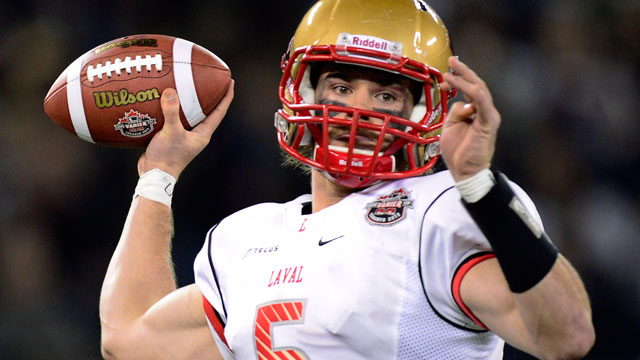
Tristan Grenon is the prototypical Laval quarterback — not flashy, but he doesn’t beat himself. He makes great checks at the line of scrimmage and gets his team in and out of the huddle proficiently. Laval will not go as far as his arm this year — but they’ll go as far as his heart. Grenon is hands down the best leader in CIS football and that’s why, despite losing some weapons on both sides of the ball, Laval is not rebuilding, they are reloading, heading towards another Vanier Cup appearance.
Grenon enters the season as a fourth-year senior and was the unanimous choice as team captain. Grenon only threw three picks all year last year and has been doing a better job of protecting the football in camp this season. To make matters worse for the rest of the CIS, Laval is once again hosting the Vanier Cup in 2013. They certainly don’t need any added motivation, but given that the championship is on their turf they’ll likely come out of the gate with extra motivation, eager to rain on the competition’s parade. Laval will get the benefit of the doubt and be perched atop my rankings unless someone upsets them. They remain the standard of excellence in the CIS.
2. Queen’s
I’m sure the Gaels are still having nightmares about how their 2012 season ended. (For those who need a recap, they fell in overtime after dominating the host Guelph Gryphons for the better part of three quarters.) This year, they are primed to give the rest of the league nightmares because their two-deep depth chart is scary. Everybody is back. You could make a legitimate argument that they’ll boast five All-Canadians (Andrew Lue, TJ Chase-Dunawa, Sam Sabourin, Cory Dyer, John Miniaci, Derek Wiggins) on defence alone.
Offensively, you’d expect another year of development from Billy McPhee who has the strongest arm in the CIS. Physically he has all the tools to make the leap from a serviceable to elite CIS quarterback. He throws well rolling out and in the pocket, can throw a strawberry through a brick wall and also has great vision. If he can be more judicial about the times he relies on that strong arm to fit the football into tight windows he’ll significantly reduce his number of interceptions — from nine in 2012 — and keep his explosive playmakers like Giovanni Aprile, Justin Chapdelaine, Chris Patrician and Doug Corby on the field.
3. Calgary
Calgary is tough to get a read on. They have enough talent to skate through the Can West conference once again, but with big hits to their depth on both the offensive and defensive line, there are real question marks surrounding their ability to compete at the national level. Losing Steven Lumbala, arguably the best running back in the history of the program, means they’ll be less explosive as an offence, but they do have a capable replacement in Mercer Timmins, who, by the end of his time in Calgary, may supplant the benchmarks Lumbala set. Quarterback Eric Dzwilewski is another notable worth watching. He’s mobile and crafty enough to mask any protection issues as their revamped offensive line comes together.
Will they win another Hardy Cup? Most likely. Was their great recruiting class enough to make up for the great players they’ve lost to graduation over the last two years? I’m not certain. I am certain their new Nike Pro Combat uniforms have them in the conversation for the best-dressed team in the CIS. Too deep and too strong for the rest of the Can West, I expect the Dinos to be high in my ranking until November — when their internal growth will be tested under the bowl spotlight.
4. Western
When evaluating football teams my general rule is that, when everything else is equal, look at three people specifically: their quarterback, their running back and their head coach — the two men who touch the football most and the guy who touches every person in the organization. Based on that formula you could make the argument Western is the best team in the country. The question is not if but when quarterback Will Finch becomes an All-Canadian. Garret Sanvido is already at that level and his backup, 2012 OUA rookie of the year Yannick Harou, is not far behind. As far as Greg Marshall goes, his success as a coach — seven Yates Cups — and as a player — Marshall won the Hec Crighton trophy as a Mustang in 1980 — speaks for itself. That pedigree has helped Marshall recruit some of the nation’s best talent to the Forest City. Just on five-star recruits alone, Western has the most decorated two-deep depth chart in the nation. Having said that, games and (more importantly) banners aren’t won on recruiting boards.
What gives me pause about moving the ’Stangs higher in the top 10 is the uncertainty that comes with having four new starters on the O-Line and secondary — the two units on a football team that depend most on communication and familiarity. Compounding that is the fact that a 10-day training camp provides limited time to work out the kinks. That said, the players who will be suiting up are highly recruited kids, many of whom have been in the Western system for a couple of years. The scary thing for opponents is the bulk of this team is going to be together for at least the next three years. They certainly can challenge for the Vanier Cup, but to say they are a favourite when a chunk of their team hasn’t even played together for three weeks is ambitious to say the least.
5. Guelph
A team goes as far as its leadership, and both head coach Stu Lang and starting quarterback Jazz Lindsey have said the Vanier Cup is not just the goal at Guelph, it is the expectation. Lindsey has all of his principal targets back on offence, including his older brother Saxon who is one of the better possession receivers in the CIS. Jazz also provides the added element of being the best rushing QB in the CIS, meaning Guelph is going to be a team that runs the ball well and often — not because they can’t throw for points, but to eat up the clock and keep their young defence off the field. The threat of Lindsey running keeps the field balanced for workhorse running back Rob Farquarson. Farquarson starts the year on the IR with a tweaked hamstring.
The Gryphons dominated recruiting at running back, headlined by workout phenom Johnny Augustine who is good enough to supplant the incumbent starter. Defensively, Guelph loses Mike Millar, Jarryd Baines, Jake Reinhart and Zach Androschuk. John Rush might be the best middle linebacker in the conference, but the front seven and secondary will both feature freshmen playing important snaps. If it wasn’t for issues with their kicking game they’d be ranked even higher.
6. McMaster
There’s been some concern about Mac’s change in coaching personnel, with defensive coordinator Greg Knox out and former CFLer Kevin Eiben in. As talented as Knox was, that transition doesn’t concern me one bit. For starters, Knox didn’t leave the cupboard bare. Eiben inherits hands down the best secondary in the CIS. Furthermore, an influx of 3-4 looks that Eiben is likely to employ from his days under CFL defensive coordinator Rich Stubler actually suits the 2013 Marauders better, as their linebacker skill and depth is far superior to that of their defensive line.
What concerns me more is their running game. As talented of a passer as All-Canadian Kyle Quinlan was, his loss will be felt more acutely on the ground. Not only was he Mac’s leading rusher, he also helped supplant their traditional running game by keeping defenders out of the box with his arm and keeping defenders honest with his ability to pull the ball himself. That said, the lights are not too big for Marshall Ferguson as he takes the reins as Quinlan’s replacement. He knows offensive coordinator Jon Behie’s offence well, he’s confident and, most importantly, he’s well respected in the Mac dressing room. He even has enough touch on the football to approximate Quinlan’s passing stats — especially because his receiving core is loaded. What Ferguson is not, however, is a rushing threat. Pair that with bulldog tailback Chris Pezzetta’s offseason knee injury and the fact that Ferguson is breaking in four first-time starters on the offensive line and the running game looks like it could be a weakness.
The one plus when it comes to the unit is the return of big man Matt Sewell who was good enough to be in a NFL camp this summer but opted out in favour of returning to Mac to pursue a Masters degree. There are a million reasons why the defending OUA champs should be the default choice in Ontario until proven otherwise, but in a conference as stacked as theirs, their question marks loom large to start the year.
7. Montreal
Aside from Carleton, Montreal had the largest recruiting class in the country. Their key to success will be one of the largest and best offensive lines in the CIS, paving the way for fifth-year senior tailback Rotrand Sene. Last year was supposed to be the year the Carabins took the next step and uprooted Quebec stalwart Laval. Things were moving in the right direction as they split the season series with the Rouge et Or and tied them for the regular season crown but they abruptly fell apart during the conference semifinals against Sherbrooke, as they were dominated in all three phases of the game.
Talent-wise, Montreal is closer to Laval than Sherbrooke in the Q’s pecking order but their tendency towards undisciplined play makes them mere mortals rather than monsters. Danny Maciocia has done a great job of wrestling away some of the elite French speaking recruits from Laval — now he needs to develop them into an elite team.
8. Sherbrooke
Sherbrooke will go as far as Jeremi Doyon-Roch’s arm will take them. He has some of the best throwing mechanics in the CIS with textbook weight transfer when it comes to staying on his back foot and snapping his hips. The question is if he can do that 35-40 times a game with an offensive line that is far better firing off the ball then retreating and pass protecting? I love how dynamic the Vert et Or offence can be on paper, I’m just not sure if they can protect their prized possession well enough to get through the year. If they can block up front, then blocking off hotel rooms in Quebec City for the Vanier Cup is not too ambitious. Improving on their 6-3 record is absolutely achievable. Anything less should be seen as a disappointing year.
9. Acadia
Quinlan isn’t the only star quarterback named Kyle departing a juggernaut team hoping for a conference three-peat — Acadia may be suffering a bigger blow as a result of the loss of Kyle Graves than McMaster took with the departure of Quinlan. Graves wasn’t just a pivot, he was also Acadia’s punter, making the loss two-fold. As far as his replacement goes, Evan Brown is far less of a proven heir apparent to Graves than Marshall Ferguson is to Quinlan. Thankfully, though, Brown has lots of talent on offence surrounding him, including AUS standout receiver Taylor Renaud who lead the conference in receiving last year. Add to that mix both Thomas Troop, the AUS’s best rusher in 2012, and Zach Skibin, the AUS’s best rusher in 2011 who missed 2012 with a broken leg.
Head coach Jeff Cummins has accumulated a plethora of speed at the skill positions that rivals his alma mater Oregon Ducks. Cummins is far and away one of the best coaches in the CIS, thus his squad will be judged by how they fare against the Quebec conference in the crossover games and in an eventual bowl matchup. A third consecutive 7-1 finish and an AUS ring will be neither surprising nor impressive. Such is the life of a dominant program trapped in a four-team league that, at the moment, is trending downwards.
10. Regina
Regina’s defence should be the strength of the squad, with lineman Logan Brooks leading the way. Brooks is not just chasing the record books, poised to become U of R’s all-time leading sack artist, he’ll also be counted on to contain the stable of mobile QBs that Can West has to offer. The Rams had another outstanding recruiting year, landing blue chip recruits receiver Davin Johnston and mobile quarterback Noah Picton. It will be up to Picton’s cousin Aaron and the rest of the Rams mobile O-Line to keep the Rams’ skilled players on the field and out of the infirmary, as last year when the Rams were severely banged up down the stretch.
As talented as Noah Picton is, Cayman Shutter might be the man leading the Rams in the near future. The Hawaii transfer who was high school teammates with Manti Te’o was a Mountain West Academic All-American and has the skill set to flourish in the Canadian game. Unlike most NCAA transfers Shutter won’t have to assimilate to three-down football as he was born in Regina before his family moved to Hawaii. Regina should be better later in the season once their young players have had time to develop and grow.
Honourable mention: Windsor Lancers, Saskatchewan Huskies