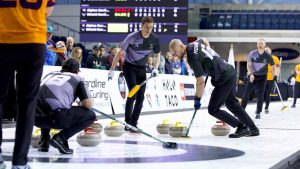
TORONTO — Even though Monday marked a historic day for the future of curling with the debut of Rock League, the first-ever professional curling league, there was a bigger topic of conversation floating around the rinks at the Mattamy Athletic Centre.
All the chatter was surrounding the double-touch controversy between Sweden’s Team Niklas Edin and Canada’s Team Brad Jacobs at the Olympics, which was reignited by a new video from Sweden this weekend.
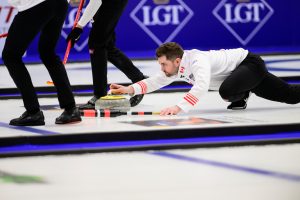
As first reported by the CBC’s Verity Stevenson, Swedish media outlet SVT published a video during last week's men's world championship that showed Edin's third Oskar Eriksson demonstrating the impact a double-touch can have on a rock. At the Olympics in February, Eriksson was the one who accused Jacobs' third Marc Kennedy of a double-touch violation, setting a blaze of controversy through the Olympic tournament.
Jacobs, who became the first skip to ever win two Olympic gold medals on the men’s side, saw the video and didn’t take too kindly to it.
“I think it’s just ridiculous that this is still going on and that they would put together a video like that... that’s just ridiculous, in my opinion, that that occurred,” Jacobs said Monday after his Shield Curling Club picked up the first win in Rock League history.
“I know that it’s not something I’m too happy about right now. I have nothing good to say about Oskar Eriksson or that entire team, or the Swedish curling federation right now, so I’m not going to say anything at all.”
In the video, Eriksson is quoted as saying through translation that “evil unfortunately wins sometimes,” and that he believes his team was just doing the right thing by calling Kennedy out.
“For me, it’s quite clear and obvious what was happening,” Eriksson said after coming off the ice for his first Rock League action with his team, Alpine Curling Club. “But I don’t want to take away anything (Team Jacobs have) done in the past, like they're a great team, they’re great curlers, even if not touching the rock and they’ve won a lot of events before the Olympics as well.”
Before the latest video from Eriksson, the curling world seemed ready to move on from what happened at the Olympics. Now, though, Jacobs says something more needs to be done to put the situation to rest.
“This whole thing is far from over, and that’s very clear and I think Oskar and the Swedish television made that very clear just now,” Jacobs said.
“So, yeah, we're going to try and work towards coming up with a good solution to all of this nonsense because that’s exactly what it is and if you actually read the WCF rule book and you read the language properly, there was never any infractions of any kind, there was zero cheating at the Olympics and this is all just ridiculous. So, this needs to be fixed and we’re gonna try to work together with the World Curling Federation to do that.”
Rule 5(e) in the curling rule book states: "A stone must be clearly released from the hand before it reaches the hog line at the delivery end. If the player fails to do so, the stone is immediately removed from play by the delivering team."
Rule 9(a) states: "If a moving stone is touched, or is caused to be touched, by the team to which it belongs, or by their equipment, the touched stone is removed from play immediately by that team. A double touch by the person delivering the stone, prior to the hog line at the delivering end, is not considered a violation."
Eriksson said that despite the feud with Jacobs' team, the other teams have still been friendly since the Olympics, including Canada’s Team Matt Dunstone, which features Jacobs' cousins E.J. and Ryan Harnden.
“I think all teams want to have a fair game, so I think most Canadians want that as well. Like, all the feedback we’ve got is positive, like Dunstone’s team at the worlds, they were very positive to us. Yeah, I haven't heard anything negative from other teams or people in general,” Eriksson said.
“They (Dunstone’s Team) thought it was funny first of all. Some controversy in the sport, it’s good for the sport, so they were joking a little bit about it that we should have done something in our round-robin game about it.”
One of the new changes being tested at Rock League this week is hog line challenges. Teams will have one challenge each game, and just like the new ABS system in baseball, will have to signal they want to challenge if someone crossed the hog line or double-touched the stone.
Jacobs says he isn’t focused very much on the change.
“Hog line cameras? Not even a thought for me. There are so many different rule changes. I don’t go over the hog line, I don’t think I’ve ever had a hog line violation. I know some players are a little bit more concerned about that than others," Jacobs said.
“I don’t necessarily think we need hog line cameras in curling because from what I can tell, nobody goes over the hog line enough to impact the rock at the far end… It will be neat to see someone use it at some point and see if it actually works or not and what that looks like. But there’s so many rule changes that that’s the last thing that’s on my mind.”
Jacobs did admit, however, that the controversy seems to be bringing some more attention to the sport as a whole.
“I guess the blessing in disguise is that a lot of people turned to curling that would’ve never otherwise turned to curling and got their eyeballs on it, that’s never going to be a bad thing for the sport,” he said.
Edin, now an eight-time world champion, has stayed quiet throughout this whole process, but he said Monday that he understands why Jacobs would be mad about Eriksson's video.
“I can’t say I wouldn’t feel the same thing if I was in his shoes," the Swedish skip said. "So, if he feels that way, he feels that way, I’m not going to try and change it."
Meanwhile, for Jacobs, it doesn’t seem like he will be speaking to Eriksson during Rock League this week.
"No, and I won’t be interacting with him, period."