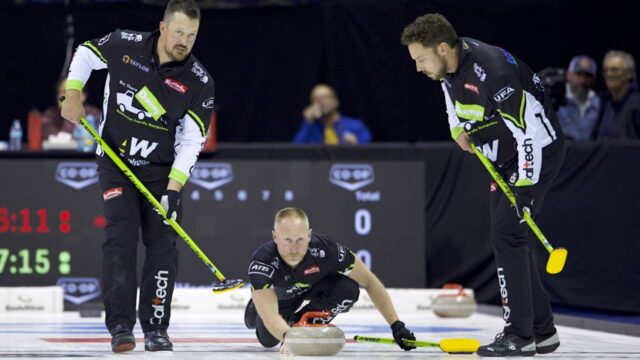
The first Grand Slam of Curling event of the season has come and gone.
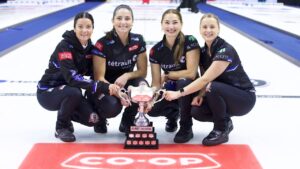
Canada’s new-look Kerri Einarson squad and Switzerland’s Yannick Schwaller were the first teams to be crowned champions in the new quadrennial at the Co-op Invitational in Victoria.
However, there is a lot more to the story than just the winners. We saw the GSOC debuts for many new rinks, how teams managed playing with one fewer minute of thinking time from last year and a newish sweeping technique that seems to be taking over the women’s game.
Along with the fact Canadian curling fans didn’t boo Sweden’s Oskar Eriksson in his first Grand Slam event in Canada since the double-touch controversy at the Olympics, here are a few things we learned:
Making the playoffs is harder
In past years, it felt like you could look at the teams playing in any given event and figure out just from that who would make the playoffs on both the men’s and women’s sides. Sure, you would occasionally see the top teams have a bad week, allowing a lower team to reach the playoffs, but for the most part it was pretty cookie-cutter.
But even though it’s just one event, it feels like both sides of the field are deeper, creating tougher matchups throughout the week and leading to unpredictable playoff brackets.
On the men’s side, we saw U.S. Team Danny Casper, Scotland’s Team Bruce Mouat and Sweden’s Team Eriksson all miss the playoffs. All three are ranked within the top seven. It was the same thing for the women’s side, with Canada’s Team Rachel Homan and two Japanese teams in Miku Nihira and Satsuki Fujisawa, all top 10 in the world rankings, not making the playoffs.
Homan and Mouat were in a different category because it was their first and second events of the season, respectively, so we can probably still expect them to make the playoffs moving forward. But even they learned a lesson this week: if any top rink thinks it can just show up to a Slam and make the playoffs, no problem, that’s no longer the case.
Schwallers might be early 2030 Olympic favourites
It's early, but cousins Yannick and Xenia Schwaller showed this week why they might be the favourites to win gold at the 2030 Olympics.
For Yannick’s rink, this was coming. Over the course of the last quadrennial, his Swiss squad just kept getting better each year, to the point where it was knocking on the door at the 2026 Olympics, coming away with a bronze medal.
To start the season, Schwaller has already surpassed Mouat as World No. 1, along with winning three of four events. Schwaller has preached that it's the structure that was put in place for them a couple seasons ago that has helped them get to where they are today.
On the other side, Xenia's team enjoyed a great week, reaching the semifinals against Team Kang. Even though she didn’t win the Co-op Invitational, a first GSOC victory will be in sight at the Masters next month.
Xenia shocked the world last year after losing her first game at the women’s world championships, winning 13 straight en route to capturing the title at age 23, the second-youngest skip to ever do so.
Despite winning worlds, it’s fair to say some probably still don’t view her as the No. 1 women’s team in the world, with more thinking of her squad as having had one incredible week.
For her team, unlike Yannick’s, the reason she might be a favourite isn’t because she’s dominating Slams but because of the team's trajectory. Xenia and teammates Selina Gafner, Fabienne Rieder and Selina Rychiger are in their fourth season together and you can see the improvements.
Forget the world-championship title — the Swiss squad's first full season playing Slams was in 2024-25, when it didn’t qualify for a single playoffs. Last year it got better, making the playoffs in three of the five events, including two trips to the semifinals.
Now, think about what this team can become by 2030.
Team Jacobs has more to accomplish
If Canada’s Team Brad Jacobs went 0-4 at the Co-op Invitational, nobody would’ve been shocked.
The Alberta rink hadn't played a competitive men’s fours game before showing up and it barely had any practice, yet it steamrolled through the round-robin at 4-0, finishing games in an average of seven ends (GSOC games are eight ends), including an 8-3 win against Eriksson in their first match since the double-touch controversy. Jacobs ended up making it to the semifinals, where his rink lost to Schwaller.
Despite winning Canada’s first Olympic gold medal in men’s curling since 2014 — when Jacobs also won with a different team — there is still more this team wants to accomplish.
Yes, it has a Brier championship under its belt as well, but the Jacobs rink doesn’t have a Grand Slam of Curling title, nor a world championship.
Based on its strong showing at the Co-op Invitational, this year isn’t going to be an Olympic gold-medal tour for Team Jacobs — it’s going to be about checking more victories off the list.
The next stop on the Slam tour is the GSOC Masters, which is set for Nov. 3-8 in Medicine Hat, Alta.



 1:22
 0:38