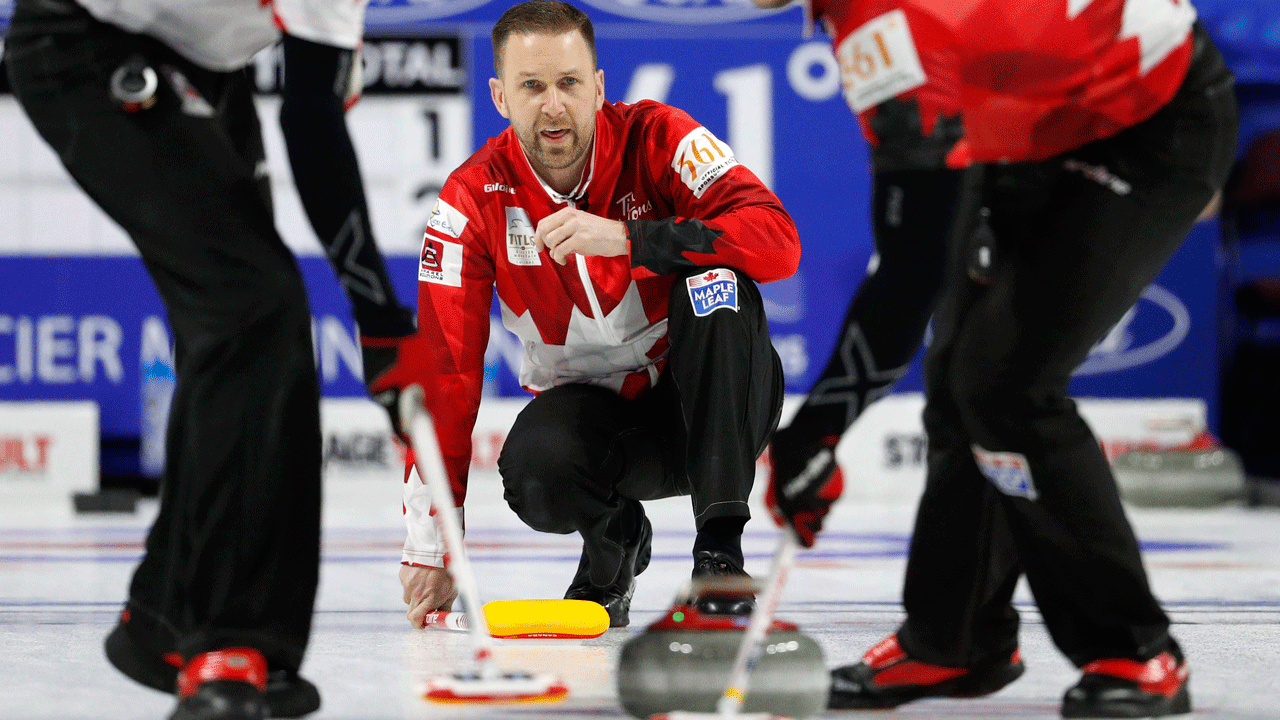

LAS VEGAS — Brad Gushue wasn’t worried about going home early from the men’s world curling championship in Saturday’s quarterfinal.
The Canadian skip was preoccupied trying to beat the United States in what felt like a sauna in the Orleans Arena.
Draws and finesse hits tricky because of frosty ice conditions in a humid building, Gushue’s team grabbed an early lead and defended en route to a 6-4 win.
Gushue still had to draw the four-foot rings with his last shot, however, to finish off the Americans.
"It was a grind. It’s really, really hard out there," Gushue said.
"As soon as I felt the ice, for probably the sixth time this week it had a different feel under your foot and your hand.
"It eliminates two of our biggest strengths, which is our finesse game and our sweeping. It’s a big equalizer, but we can still win under these conditions. We can play on bad ice conditions as good as anybody."
Canada faced Scotland’s Bruce Mouat in the evening semifinal. Sweden’s Niklas Edin edged South Korea’s ChangMin Kim 9-8 in an extra end in the afternoon semifinal.
The semifinal winners play for gold and the losers for bronze Sunday.
Under a new playoff format this year, six teams made playoffs instead of the traditional four.
The World Curling Federation also reverted to a pair of semifinals after a dozen years using the Page playoff, and added a quarterfinal round.
So defending champion Gushue faced elimination from medal contention on Saturday morning.
"You don’t really think about ‘if we lose, we’re going home,"’ he said. "You go for the win and tunnel vision going forward."
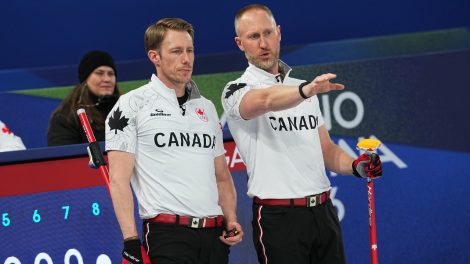
Gushue, vice Mark Nichols, second Brett Gallant and lead Geoff Walker from St. John’s, N.L., went undefeated to win last year’s world title in Edmonton.
The Canadians were the third seed in playoffs after posting a 9-3 record in the preliminary round behind Sweden and Scotland at 11-1.
The Scots are a young team with an average age of 23.5. Mouat, 23, won a world junior title two years ago.
"If the ice … is the same way tonight, it will be an advantage," Gushue said. "It took us a few ends to get used to it and it’s a different feel. We might be able to catch them in a mistake here or there just on them learning the ice.
"I think our experience, when it comes down to the last couple ends, we’ve played in some big games. World semifinal, if we get to the eighth, ninth, 10th end and it’s a tied game, I think the screws are going to tighten for them a little bit more than for us because we’ve been there and been successful."
Persinger posted a 6-6 record in the preliminary round. He throws fourth stones and serves as vice to Rich Ruohonen, but the team still plays under the Persinger name.
A moment of silence was observed prior to the morning draw for the Humboldt Broncos, a Canadian junior hockey team that suffered multiple fatalities in a bus crash in Saskatchewan the previous evening.
One of Canada’s three losses in the preliminary round was to the Americans — a 6-5 decision on Thursday.
With cloud cover over Las Vegas on Saturday morning, the arena was suddenly humid after several arid days.
"It was really hot," Gushue said. "Most of the week we were freezing out there. Today, I was sweating pretty good."
This being the desert, a dehumidification system wasn’t deemed necessary when the arena was built 17 years ago. The Orleans didn’t start hosting international curling events until 2014.
Gushue won the pre-game draw the button to get the all-important last-rock advantage in the first end. Canada scored one and then stole one in the second to take control of the game.
"We took a real defensive approach today," Gushue said. "Having hammer to start the game was a big difference."
A pair of heavy draws by the U.S. in the ninth end helped Canada lie three. Persinger drew for one to trail 5-4 coming home without hammer.
Persinger’s draw in the eighth hung up on a guard. Gushue tapped for two and a 5-3 lead. Gushue’s hit in the seventh didn’t roll, leaving Persinger a hit for two to even the score 3-3.
[relatedlinks]